IN-SPACe overreach threatens ISRO's strategic future: G Madhavan Nair
Former ISRO chief warns against regulatory overstep, criticises asset tenders, and stresses that institutional independence must be protected at all costs

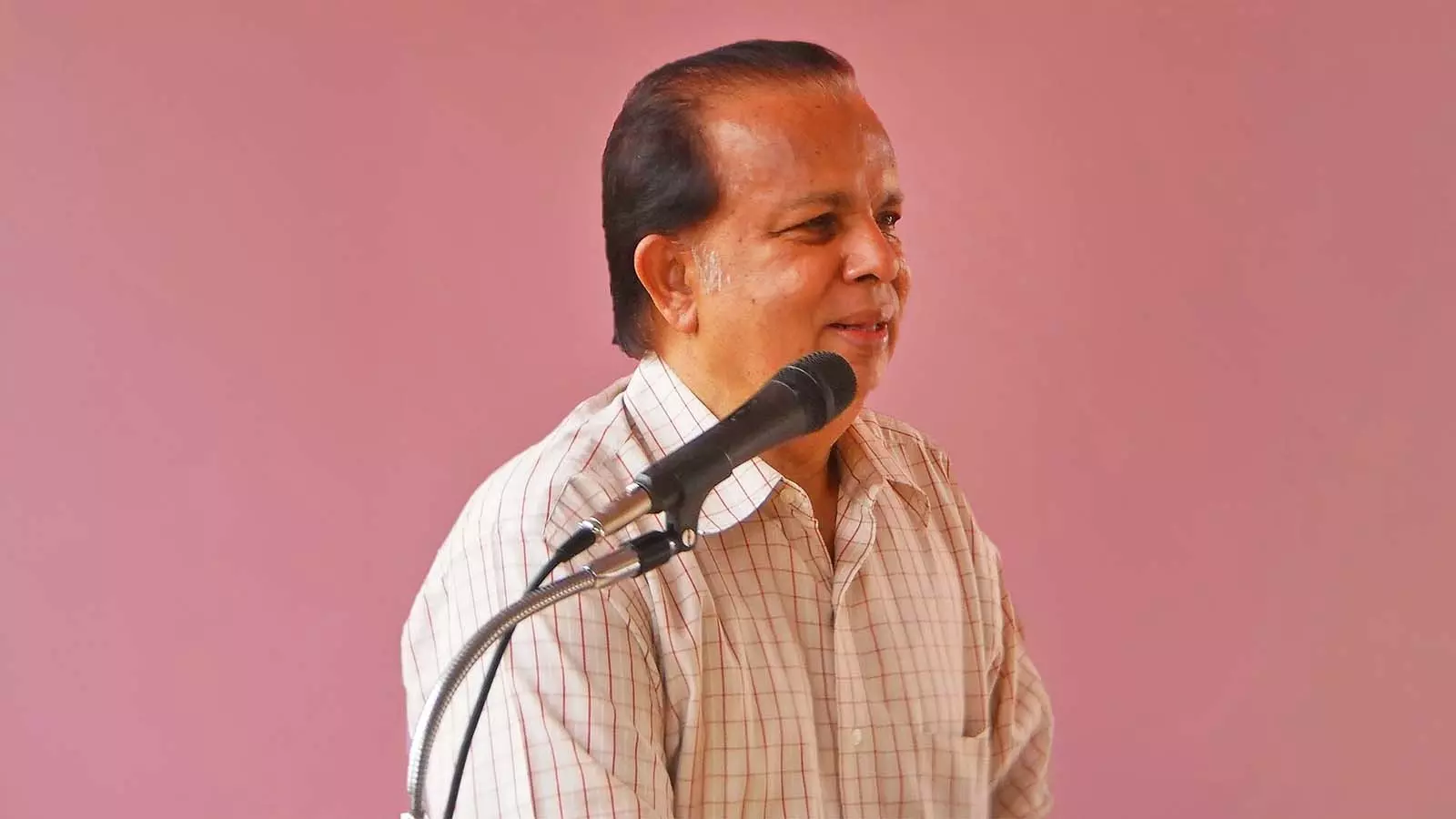
It appears that the Indian Space Research Organisation (ISRO) plunges into a crisis after achieving every major milestone. Is it a jinx or something that the Indian strategic organisation must contend with, wondered G Madhavan Nair, retired Secretary, Department of Space (DoS). and former Chairman, ISRO, in an interaction with The Federal.
Nair also categorically said the Indian National Space Promotion and Authorisation Centre (IN-SPACe), the regulator for private space sector players, is acting beyond its mandate by calling bids from industries for ISRO's technologies and assets.
First about the jinx
Once is happenstance, twice is coincidence and three times is enemy action, goes the old saying.
In ISRO's case, there appears to have been more than one such instance. Is it merely coincidence, a recurring institutional vulnerability, or something more deliberate?
"There seems to be a pattern. Soon after ISRO achieves a major technological milestone, some controversy or action happens, putting the organisation into a sort of crisis to pull it down," Nair told The Federal.
In support of his view, Nair said India successfully launched its Polar Satellite Launch Vehicle (PSLV) in October 1994, proving its ability to put satellites into orbit with its own rockets.
Also Read: TN rocket port in private hands: Is IN-SPACe becoming Centre’s space privatisation arm?
Shortly after this achievement, the agency was rocked by an espionage scandal. But the Supreme Court ruled that the charges against a top ISRO scientist were fabricated.
Antrix-Devas controversy
"The next issue was the Antrix Corporation-Devas Multimedia issue that happened soon after India's first moon mission, or Chandrayaan-1, came to an end in 2009," Nair said.
Also Read: Why are top scientists quitting ISRO?
The Chandrayaan-1 mission was launched in October 2008. In August 2009, ISRO formally announced the mission's end, by which time several discoveries, including evidence of water on the Moon, had been made by the Indian payloads.
ISRO's unique culture should be nurtured, and the golden egg-laying goose should not be killed.
And soon after that, the Antrix-Devas Multimedia agreement blew up into a major controversy and the agreement was scrapped.
LVM3 success and the new challenge
The year 2014 saw the emergence of ISRO's heavy-lift rocket LVM3. Since then, the LVM3 rocket has been flown nine times for orbiting domestic and foreign satellites, including those of European player OneWeb and US company AST SpaceMobile.
Also Read: Centre changes ISRO resignation rules amid exodus of experienced scientists
After launching of the foreign communication satellites, Nair sees the current phase as posing a sort of existential challenge to ISRO, with not only its rockets and other technologies being tendered out but also its infrastructure assets, including the upcoming spaceport at Kulasekarapattinam in Tamil Nadu.
IN-SPACe, set up as the regulator for private sector space players, has called for Expressions of Interest (EoI) for ISRO's PSLV and LVM3 rockets and for the about Rs 1,000 crore rocket port coming up in Tamil Nadu.
"IN-SPACe is overacting, assuming roles not assigned to them. They are interfering with ISRO's and NewSpace India Ltd's (NSIL) activities. A sectoral regulator cannot be the executor of programmes," Nair said.
Rocket tech transfers
Adding a note of caution on the transfer of rocket technologies with dual-use applications, Nair said there should be an appropriate legal framework, and currently there is no safeguard for this. "There is no space law in India now. And many things are happening before it is enacted," he said.
Citing India's other strategic sector, Nair said both space and nuclear power have a unified command structure.
Also Read: ISRO’s PSLV failure: Who pays when rocket missions go wrong?
The chairman of the sectoral apex bodies — the Space Commission and the Atomic Energy Commission — and the respective Departments are headed by one person. "Any change will upset the balance," Nair said.
Like the space sector, the Indian government has opened up the atomic power sector for private players. And it is only the Nuclear Power Corporation of India Ltd (NPCIL) that had invited bids for its small atomic reactors and not the sectoral regulator, Atomic Energy Regulatory Board (AERB).
ISRO, NSIL and IN-SPACe
According to Nair, the government-owned Indian space sector has three important organisations:
1) ISRO, which develops technologies and builds infrastructure, carries out space missions and, till date, remains India's only end-to-end integrated space sector player.
2) NSIL, formed to commercialise ISRO's services, its technologies and rockets.
3) IN-SPACe, a regulator, largely for the private sector.
Also Read: ISRO to triple spacecraft output, target Chandrayaan-4 launch in 2028: Narayanan
IN-SPACe is encroaching into the domain of NSIL and ISRO, Nair emphasised. "While the sectoral regulator can be independent, ISRO, NSIL and industrialisation should be under one roof, with the unity of direction and command being a must. NSIL can form a joint venture with the interested parties instead of transferring the technologies," he observed.
He said earlier the industry was not willing to set up separate facilities to cater to ISRO's needs. "Nearly 60% of ISRO's budget was spent in favour of industries in sourcing various systems and components," he recalled.
Private sector: hype vs reality
Referring to private players in the sector, Nair said there is a lot of hype but nothing major has come out, barring Skyroot Aerospace's successful maiden orbital launch of its rocket.
Nair also said the Indian space agency must check whether any of its intellectual property rights have been used without proper licence.
IN-SPACe is overacting, assuming roles not assigned to them. They are interfering with ISRO's and NSIL's activities. A sectoral regulator cannot be the executor of programmes.
He estimates that an outlay of about Rs 50,000 crore would be needed to realise India's plans to set up a space station, send humans to the Moon, build space capsules and pursue other ambitious programmes. It is only the government that can fund these programmes and not the private sector, he added.
Also Read: ISRO's strategic satellite delays expose cracks in India's space readiness
There is, however, another side to the debate. The opening up of the space sector to private players is a deliberate policy decision of the government, with IN-SPACe created precisely to facilitate and regulate private participation.
The question, therefore, is not whether private participation is desirable, but whether a regulator should also determine which ISRO technologies and assets should be transferred or commercialised, and on what terms.
'Do not kill the goose...'
The real test of India's space-sector reforms, therefore, may not be the number of private companies entering the sector or the number of ISRO technologies transferred to industry.
It will be whether private participation strengthens India's overall space capability without weakening the institutional capacity, technological independence and strategic role of ISRO.
Also Read: ISRO plans to send astronauts to Moon by 2040
"As compared to other R&D organisations in India, ISRO is the only organisation that has acquitted itself well and has taken the country to the skies. ISRO's unique culture should be nurtured, and the golden egg-laying goose should not be killed," Nair remarked.
The government can set up committees or groups to chalk out the roadmap for the sector as there are a large number of retired ISRO officials and Chairmen, he suggested. "There is no dearth of space scientists in India. What is the logic of sending home space technologists at 60 while having much older and an expert in the automobile sector as the sectoral regulator?"