CJP put Rajasthan students’ plight in the spotlight; ‘We Too’, say teachers
Crumbling schools, 1.5 lakh vacant posts, gruelling non-teaching burdens leave state's educators fighting a daily battle: First of a 3-part Teachers' Day series

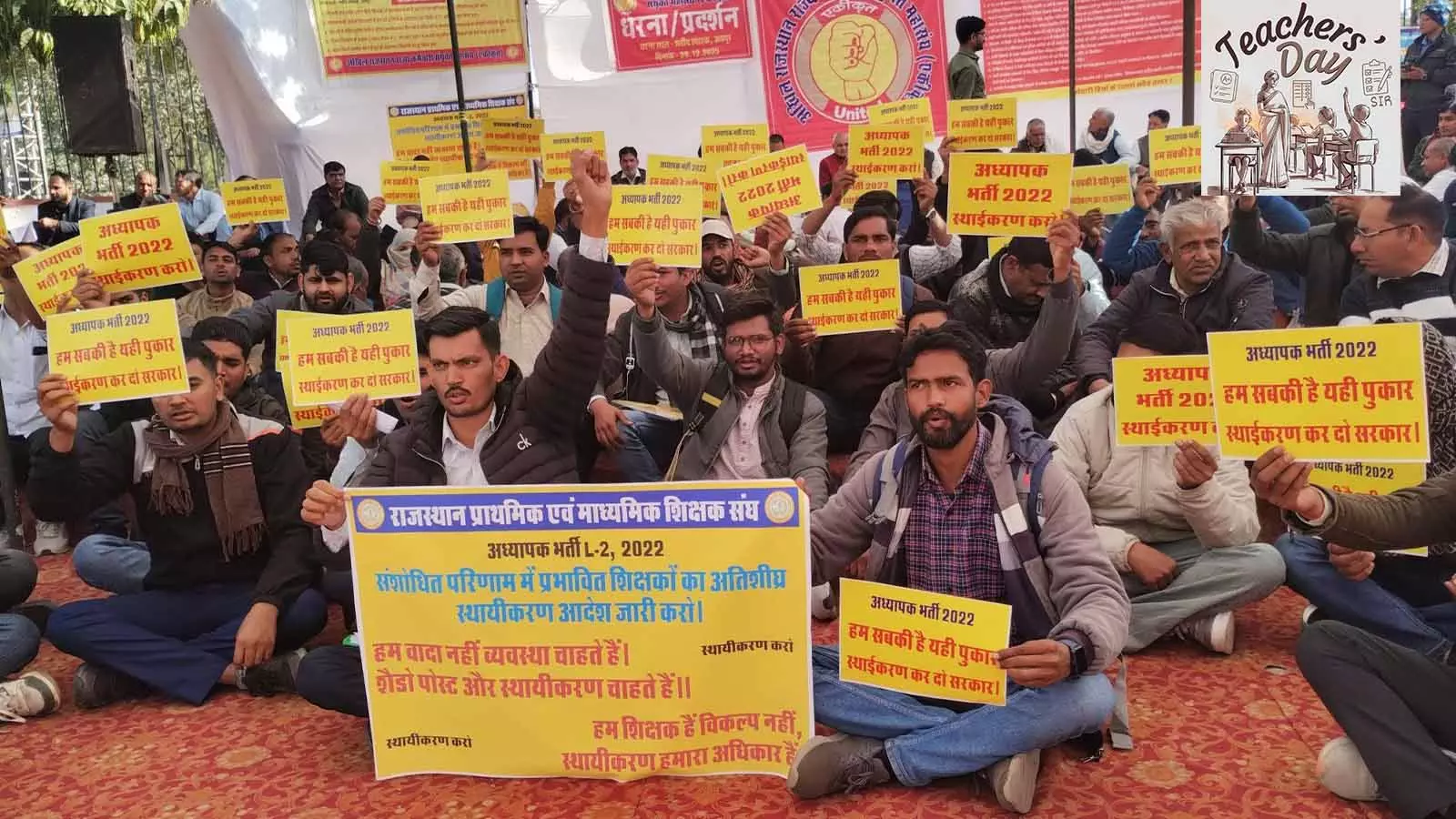
Students hitting the streets and the Cockroach Janta Party’s (CJP) protests have put India’s troubled school system in focus. But what about the teachers tasked with making the system work? Held accountable for everything from student wellbeing to learning outcomes to answering parents, teachers are also burdened with non-teaching duties, staff shortages, inadequate training, and little say in decisions affecting the education ecosystem.
Here's a Teachers' Day series that takes the spotlight where it should — on the plight of today's teaching staff. The first of the series looks at teachers in Rajasthan and the challenges they face.
The CJP's School Thik Karo (Fix the School) movement has exposed Rajasthan’s unsafe government schools, where students risk their lives in crumbling buildings. But the students are not the only ones operating under those roofs — joining them round the year are the teachers.
Crumbling school infra
In Piplodi Jhalawar, where a school roof collapse killed seven children in July 2025, students are still studying in a farmer’s two-room home. Their school building is yet to be repaired.
“It should not be just about students, but also a question of dignity for teachers,” Mahavir Sihaag, chairman of the Rajasthan Shikshak Sangh (Shekhawat), or RSSS, told The Federal. He added that 80 per cent of school toilets have no water, and there are no sweepers or cleaners.
Rajasthan Assembly data shows that 3,768 school buildings and 83,783 classrooms are classified as completely dilapidated. As many as 611 government schools have no building of their own, while 2,047 lack toilets and 1,049 have no drinking water.
Anticipating the CJP’s School Thik Karo campaign across the state, the Rajasthan government recently ordered that unauthorised entry, photography, videography and live streaming from government schools would require prior permission from the principal.
Also read: Amid CJP checks, Rajasthan govt admits 611 schools lack buildings
Teachers feel the shabby condition of schools should be shared on social media, not just for the students' benefit, but for theirs as well. Some schools have no rooms, fans or electricity. Some others run in municipal parking kiosks and tin sheds. Not very amenable places to teach.
Rajasthan's Budget 2026-27 has allocated Rs 68,989 crore to education, sports, art, culture, an increase of 6 per cent from last year’s allocation. But 75 per cent of the Budget goes into paying the salaries of the teachers, so there is hardly any left for infrastructure upgradation, say teachers The Federal spoke to.
Single-teacher schools
Rajasthan has 7.93 lakh teachers on its rolls, per official figures, the highest in the nation after Uttar Pradesh. The number of schools is 1.06 lakh, and the total number of students is 1.59 crore.
For Rajasthan government school teachers, though, the staff shortage is biting. Teachers often have back-to-back classes, with little rest, because the staff strength is far from adequate.
Often, it's a solo act. Rajasthan has around 7,200 single-teacher schools.
“Most primary schools with classes from 1 to 5 have sanctioned posts of two teachers each. How can there be quality education with two teachers juggling five different standards?” asked Vipin Prakash Sharma, state president of the Rajasthan Prathmik Avum Madhyamik Shikshak Sangh (RPAMSS).
Also read: Gen Alpha follows Gen Z: Schoolkids in 3 states protest over teachers, fans, toilets
Speaking to The Federal, Sharma recalled that the RTE Act prescribes two teachers for upto 60 admitted children and three teachers for 61-90 children. The Rajasthan teachers' demand that the schools recruit at least one teacher per class appears valid, but it's nowhere close to realisation.
Posts lying vacant
The state has 1.5 lakh teacher posts vacant, and there have been no visible efforts to fill them. The National Education Policy (NEP) does not promote closing down of schools but actively promotes a structural policy known as ‘school rationalisation’. Under this approach, multiple low-enrolment government schools are merged with an aim to share resources, teachers and infrastructure.
In Rajasthan, the school rationalisation project was initiated in 2014 during the Vasundhara Raje regime. The government initially merged 17,000 primary and upper primary schools. By the end of Raje's tenure, around 20,000 schools had been integrated.
“Around one lakh teaching posts were 'adjusted' then. The government advertised for 2,500 vacant posts; how do you compensate for the 1.5 lakh vacancies?" wondered Sihaag. "Around 1,500 government schools have now been merged. They are not doing it at one go.”
Also read | How government school mergers have triggered varied fallout across states
The Congress government after Raje's, under Ashok Gehlot, de-merged around 1,400 schools and focused on upgrading 2,000 government schools into Mahatma Gandhi English medium schools, but no new teachers’ posts were sanctioned. “So, the quality of education suffers, and teachers are often blamed,” observed Sharma of RPAMSS.
Job security, transfers
Teachers also complain about the regularisation policy, which is governed by the Rajasthan Contractual Hiring to Civil Posts Rules, 2022. The rules allow eligible contractual staff to become permanent after completing five years of satisfactory service.
But now, the government is bringing in the Vidya Sambal Yojana, which would be a contractual job for unemployed youths and retired educators on a purely temporary, session-based arrangement and on a minimal salary, not comparable to what government teachers are paid.
The transfer policy of teachers is another major cause for concern. Some teachers have not been transferred for more than six to eight years, it is alleged. Putting roots in a place gives them leverage, allowing them to pull strings and continue with their tenure there, while less lucky ones are transferred to remote places.
“Around 32,000 teachers have not been promoted for the last six years from Grade III to II,” said Sharma.
Education minister Madan Dilawar has stated that the transfer of Grade III teachers would be opened after a comprehensive guideline is notified for transfers. Most teachers awaiting transfers allege that the present policy is highly biased and favours the politically connected. Also, those who protest against arbitrary rules and regulations are given punishment postings.
Language teachers in transfer churn
Language teachers face yet another problem. They are often transferred to remote places, where very few students have opted for the language they teach. Sanskrit is often the only available alternative, but it has limited teachers.
Ameen Kamkhayani, state president, Rajasthan Urdu Teachers Association, told The Federal: “Language teachers, especially Urdu teachers, have been transferred recently to remote places and have been shifted out from schools which have large enrolments in the subject, leaving the students without properly qualified teachers, especially in minority dominated areas. Several Urdu teacher posts in minority-dominated areas of Jaipur have fallen vacant after the transfers. And, no replacements have been given in their places. The students who opted Urdu as a third language now have to study on their own.”
This January, the Rajasthan High Court had expressed serious concern over the large-scale transfers in the middle of the academic session. The petitioners in the case pointed out that although transfers are officially banned in the state, the government has been issuing special permission to carry out mass transfers without a transparent transfer policy.
The state government temporarily lifts the ban on general transfers for most state employees and officials during specific windows, but education department cadres like third-grade teachers are explicitly kept out of the order.
Burdened beyond teaching
Apart from teaching, the staff is involved in election duties, voter list updates, SIR enumeration and Census duties, said Sihaag. Teachers deployed as Booth Level Officers (BLOs) have to undergo gruelling schedules, face unrealistic data-entry targets and threats of suspension for slow progress.
Also read | Teachers on the brink: Deaths, threats, and unbearable SIR workload in Gujarat
“We have compulsory mobile hours, where we have to fill up data sets, and according to different performances. This work often takes hours as we have to meet a deadline. We work like computer operators almost, and that too on our phones," said Sihaag.
As teachers get burdened with non-teaching duties, the students bear the brunt, he pointed out. "Our teaching hours get shortened. We have often complained to education department officials about this, but they say teachers are the most reliable to complete the updation and enumeration process," he added.
The Rajasthan Shikshak Sangh (Shekhawat) has launched a five-year movement, Hume Padhane Do (Allow Us to Teach), to highlight the challenges faced by teachers today.
No time, no extra pay
Teachers are always the first point of reference for any administrative work, even for initiatives like the pulse polio campaign. Not that the extra work translates into more pay.
Government school teachers in Didwana-Kuchaman district, on BLO duty.
More than 90 per cent of the teachers in Rajasthan have served as BLOs. “We are given nominal remuneration for this work, which goes into our transportation. Apart from six hours of school work, we have to go out and complete the important enumeration work," a 22-year-old teacher, conducting the first phase of Census, told The Federal on the condition of anonymity.
"I am currently doing my PhD, and get very little time to spend on research or reading up," she added. "I have been out since morning."
While the pay is poor, the add-on duties don't come with much dignity either. "Some people look down on us, mistaking us for vendors. They wouldn't even let us into their homes," the young teacher rued, adding that "there's no respect for teachers nowadays".
Coming soon: Are teachers ready for Gen Z and Gen Alpha rage?