



Sabarimala case: Why every faith has a stake in the nine-judge SC Bench?
Legal Lens | The judges must decide how rights will speak to faith across India’s many religions

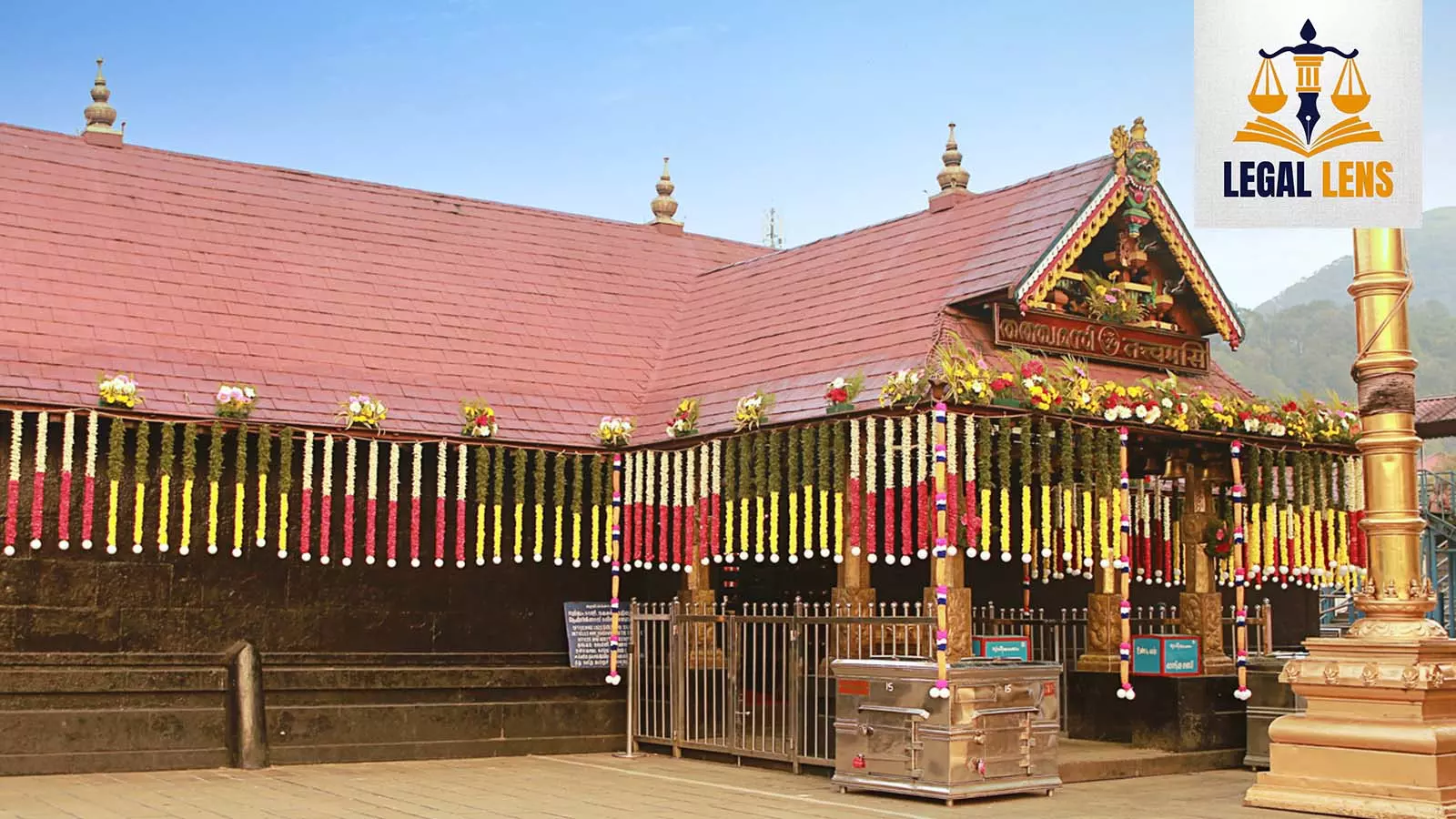
On April 7, a nine-judge Constitution Bench of the Supreme Court headed by Chief Justice Surya Kant began hearing the Sabarimala reference. Arguments were timetabled to close on April 22. They have already run past that schedule. The eighth hearing sat on April 23, with senior counsel arguing over whether pre-constitutional custom itself stands protected under Article 25.
Also read: Why Delhi HC judge’s refusal to recuse in Kejriwal case may not be the last word
The docket records a review of the Indian Young Lawyers Association v State of Kerala judgment of 2018. That verdict admitted women of all ages to the Ayyappa shrine in Kerala. Its description no longer captures what is at stake. Tagged to the review are 66 other petitions. They concern Muslim women denied entry to mosques, Parsi women disowned for marrying outside the community, and the Dawoodi Bohra practice of female genital cutting. Whatever the nine judges say will travel to all of them.
A map of the tagged disputes
The most prominent of those petitions is Yasmeen Zuber Ahmad Peerzade v Union of India. A Pune couple approached the court in March 2019 after a mosque administration refused the wife permission to offer namaz inside. Their petition seeks a declaration that the exclusion of Muslim women from mosques is unconstitutional. It rests on the 2018 Sabarimala judgment and on Articles 14, 15, 21, 25 and 29.
The most rhetorically effective move from the Union side has been the invocation of sati. Solicitor General Tushar Mehta has posed a rhetorical question. A Court that refuses to test religious practice against constitutional rights, he argues, would have upheld sati too.
Senior Advocate M R Shamshad appeared on April 23 for the All India Muslim Personal Law Board. He told the bench that Muslim women are in fact entitled to enter mosques for prayer. The Hadith tradition on this point, he added, has held steady for 12 centuries. That concession narrows the legal field. The petitioner, in effect, asks the Court to convert a theological position into an enforceable right against mosque administrations.
The second tagged case is Goolrokh M. Gupta v Burjor Pardiwala. A Parsi woman married a Hindu man. The Gujarat High Court, in 2012, held that marriage outside the community ended her Parsi identity. She thereby lost her right to enter the fire temple and to perform her parents’ last rites.
Also read: Sabarimala case: SC rejects ‘WhatsApp Varsity’ inputs, stresses limits of personal opinions
Her appeal in the top court was tagged to Sabarimala for a shared question. How far may a denomination’s autonomy extend before it collides with the individual’s right to profess her faith?
A third strand concerns the Dawoodi Bohras. Sunita Tiwari’s 2017 writ petition seeks a prohibition on female genital cutting within the community. In 2023, a separate Constitution Bench in Central Board of Dawoodi Bohra Community v State of Maharashtra referred the community’s practice of excommunication to this nine-judge bench. Both ask whether the autonomy of a denomination can extend to practices that bodily injure or socially expel its own members.
Each of these petitions turns on the same pivot as Sabarimala. Can the Court examine a religious practice for conformity with fundamental rights? If yes, by what test?
The Ayodhya shadow
The hearing has an unseen guest. In Dr M. Ismail Faruqui v Union of India (1994), a Constitution Bench upheld the state’s acquisition of the Ayodhya site. The Babri Masjid had stood there until its demolition in December 1992. The bench observed, along the way, that a mosque is not an essential part of the practice of Islam, because namaz could be offered anywhere.
The remark was not strictly necessary for the decision. It nevertheless became a doctrinal landmark. Muslim parties sought its reconsideration in 2018. A three-judge bench refused by 2:1. Justice S. Abdul Nazeer dissented. He held that the essentiality of a religious practice must be determined from within the religion’s own doctrine and belief, not asserted by judicial fiat.
Faruqui illustrates, more vividly than any contemporary argument, what goes wrong when secular courts decide theological questions. The asymmetry it left behind is worth noting. The Hindu claim that Ayyappa’s celibate deity requires the exclusion of women is being weighed, today, on the essentiality scale. The Hindu claim that Lord Ram’s birthplace lies at the demolition site was never tested on the same scale. It entered the record, in the 2019 title judgment, through a doctrinal device of “particular significance”.
If the Essential Religious Practices (ERP) doctrine survives this bench, it must survive as a test that applies equally across faiths.
Sati and Sabarimala
The most rhetorically effective move from the Union side has been the invocation of sati. Solicitor General Tushar Mehta has posed a rhetorical question. A Court that refuses to test religious practice against constitutional rights, he argues, would have upheld sati too.
The question rests on a legal confusion. Sati was not abolished through judicial review of essential religious practice. It was abolished by statute. The preamble of the Commission of Sati (Prevention) Act, 1987, declares that sati is “nowhere enjoined by any of the religions of India as an imperative duty”.
Also read: Why Article 17 matters in the Sabarimala reference
Parliament refused to enter the essentiality inquiry. It simply placed the practice outside religion. Article 25(2)(b), which carves out room for social reform legislation affecting Hindu institutions, is the anchor. The statute has a textual home. The essentiality question was never the instrument on which sati turned.
Sabarimala’s exclusion of women of menstruating age was defended, by contrast, as constitutive of the deity’s identity as a Naishtika Brahmachari, an eternal celibate. The 2018 majority, over Justice Indu Malhotra’s dissent, examined that claim and rejected it. That is the judicial move now under review. A statute can remove a practice by declaring it no religion. A court, to do the same, must either claim the authority to characterise the practice, or surrender it.
Four pivots
Four questions will decide the outcome. The first is the fate of the ERP doctrine. Its critics, the Solicitor General among them, urge the Court to abandon it altogether. They trace its genealogy to a wrong turn in Durgah Committee, Ajmer v Syed Hussain Ali (1961). A wholesale abandonment, however, leaves the judiciary disarmed. Any practice a denomination sincerely claims as its own would then stand beyond review.
A more disciplined test would preserve space for both faith and rights. It would place the burden on the state to justify regulation, rather than on the practice to prove itself essential.
The second is constitutional morality against societal morality. The Union has argued that “morality” under Articles 25 and 26 means whatever society happens to believe at any given moment. Justice B V Nagarathna reminded counsel, during argument, that standards of the 1950s would today belong in a museum, and that societies evolve.
Constitutional morality anchors the inquiry in the Constitution’s own values. Surrendering the anchor hands the question to whichever social majority happens to hold the microphone at the moment of hearing. The surrender serves power in the costume of humility before faith.
The third is the meaning of “morality” in Articles 25 and 26 themselves. Those provisions permit restriction of religious freedom on grounds of public order, morality and health. If “morality” means public morality as recorded by the cry of the street, religious freedom becomes the plaything of the loudest group. If it means the morality embedded in the Constitution’s own architecture of rights, religious freedom is tethered to principle.
Also read: Sabarimala hearing: SC asks if Constitution protects devotees barred from touching the deity
The fourth is standing in public interest litigation. The 2006 writ petition that led to the 2018 judgment was filed by a lawyers’ association, not by Ayyappa devotees. The bench is re-examining whether a PIL on a denomination’s internal practice can be maintained by an outsider. A tighter rule would sweep most of the tagged petitions out of court at the threshold, before the substantive questions are reached at all.
What The Federal’s reader should watch for
The easiest outcome is also the worst. A judgment that dismantles both the ERP doctrine and constitutional morality would leave religious freedom without either sword or scabbard. It would convert the restriction in Articles 25 and 26 into a plebiscite.
Whichever social majority happens to occupy the public square would then decide whose practice is tolerable and whose is not. That outcome, dressed as humility before faith, protects the powerful and leaves the dissenter to her fate.
Also read: Sabarimala case: Can Constitution override religious customs? 9 judges to decide
The harder outcome is the principled one. The Court can retain the ERP doctrine while disciplining it, by shifting the burden to the state. It can retain constitutional morality while setting out the textual anchors that discipline its use. It can clarify that “morality” in Articles 25 and 26 means constitutional morality rather than societal appetite. It can tighten PIL standing without placing denominational practice beyond review.
Nine judges is a large bench. It is also a difficult one to hold together in principle. The architecture of religious freedom in India for a generation now depends on whether it can.