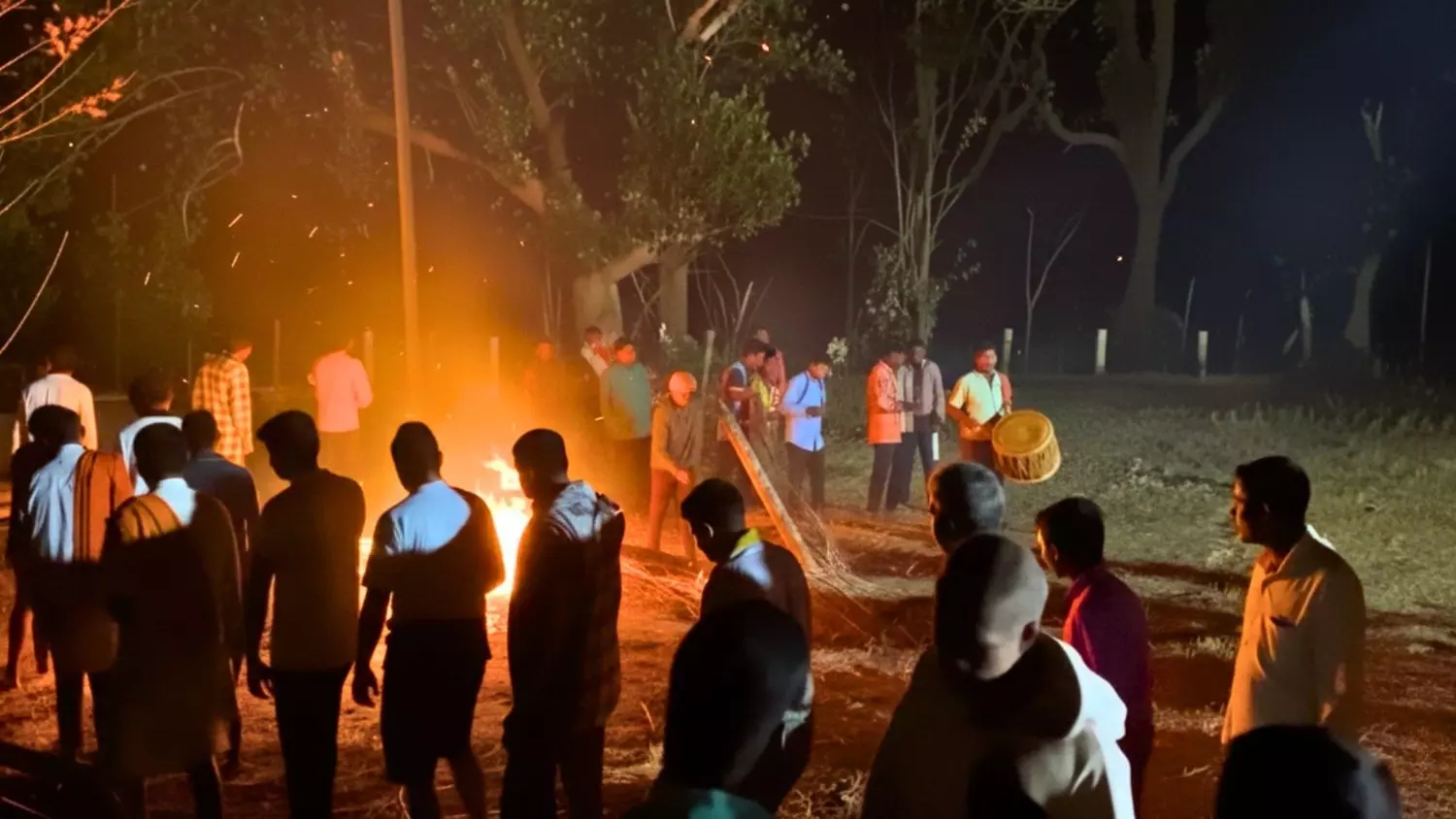
Members of coastal Karnataka's Koraga community beat drum as part of the 'Hanabu' ritual, a practice which has been widely criticised.
How outlawed caste practice of Hanabu persists in coastal Karnataka
Despite a prolonged ban, activists allege the Koraga community is still being intimidated into degrading ‘Ajalu’ traditions to 'absorb' village misfortune

In a development that would concern human rights activists, the Karnataka-Kerala Koraga Development Association has brought serious charges that the outlawed Ajalu practice was performed during a “Hanabu” ritual held during the Mahashivratri festivities in Shankaranarayana village located within Karnataka’s Byndoor Assembly constituency in the coastal Udupi district. The same was also reported from some other areas of the Udupi district.
Also read: Smell, stigma and supremacy: How 'food racism' shapes everyday life in India
The incident has brought to the fore the allegations that Dalit communities are still exploited in the name of tradition in the rural areas of coastal Karnataka, despite the presence of legal safeguards such as the Ajalu Prohibition Act of 2000.
Inhuman practice in the guise of festival?
According to members of the association, on the night of the festival, people from the Koraga community gathered through the night, carried torches, beat drums and moved from door to door seeking alms as part of a ritual. While the event appeared festive on the surface, the body alleged that it was, in reality, a continuation of the inhuman 'Ajalu' practice, under which the Koraga community is made to perform rituals believed to rid the village of 'mari' — or misfortune and disloyalty.
What is 'Ajalu'?
'Ajalu' is an inhuman social system imposed on the Koraga community in Karnataka's Dakshina Kannada and Udupi districts, saying that they had to serve in ceremonies, during the Kambala festival or occasions organised by the upper castes. To counter this, the Karnataka government enacted the Karnataka Koragas (Prohibition of Ajalu Practice) Act of 2000, under which any person who uses the Koraga community for 'Ajalu' practices against their will or in the name of tradition would be punished.
More than 60 inhuman practices are prohibited under this act, including guarding paddy fields in the night, begging for alms in the guise of 'money' at festivals or fairs, forcibly eating patients' leftover food mixed with hair and nails, using Koragas for menial tasks such as pulling temple chariots or at fairs.
A video purportedly showing the ritual also went viral on social media. The footage was shared on the social media account of one Nagaraja Shetty Naikambali and has since been widely circulated in WhatsApp groups associated with the Koraga association, triggering debate and criticism.
Sabitha, assistant professor in the sociology department at Mangalore University, expressed concern over the incident. “No matter how much awareness we create within the community, people continue to be exploited in the name of religion and God,” she said. “The elders remain bound by long-standing beliefs and are often inevitably subjected to such exploitation.”
Members and leaders of the association also disapproved of the incident.
Speaking to The Federal, Kumaradas Haladi, a member of the association, said what happened on the night of Shivratri violated the Karnataka Koragas (Prohibition of Ajalu Practice) Act of 2000, which bans 'Ajalu Chakari' (beating of drums by force or in the name of tradition), along with at least 60 other rituals that allegedly belittle human dignity.
Also read: Why some sections of society are protesting against UGC's equity rules | AI with Sanket
According to him, people of the upper castes force the Koraga people to beat the drum, and if they refuse, they threaten them emotionally, like by saying, “You will be subject to God’s wrath, and your children and grandchildren will suffer.”
'Can't beat drums to please upper castes'
Sushila Nada, president of the association, told this website that while it is not wrong for the Koragas to beat drums as part of their culture (he said there are cultural groups who perform respectfully on stages), but to go around the village all night beating drums to please people of the upper castes is a clear violation of human rights.
She also criticised the practice of standing outside temples and beating the drums on the night before the coastal areas’ Kambala festival.
Political leaders also criticised
The political class has also come under criticism. Although Byndoor MLA Gururaja Gantiholi stayed at the house of Surendra, a Koraga individual, in Alur gram panchayat that comes within his constituency, to raise awareness among the people to forge communal harmony, the association is not impressed.
Who are Koragas?
The Koraga community is an endangered tribal community found in the Dakshina Kannada and Udupi districts of Karnataka and the nearby Kasaragod district of Kerala. They have been identified as a 'Particularly Vulnerable Tribal Group' (PVTG) by the Indian government. They are believed to be the original inhabitants of coastal Karnataka’s Tulu Nadu region.
The Koragas, who once lived in the forests and depended on their products for living, are one of the most exploited and socially marginalised communities with problems such as illiteracy, malnutrition, poverty and superstition plaguing them.
While Gantiholi, a Bharatiya Janata Party leader, tried to promote local harmony by eating food prepared at Surendra’s house, the association alleged that the practice of ‘Hanabu’ right under the politicians’ eyes mirrored the system’s failure.
Also read: Ground Report: Why were roads to UP's Kapsad village blocked after Dalit murder, abduction?
According to Sushila, the MLAs should not limit themselves to just a symbolic village stay, but also pay attention to actual instances of human rights violations.
She also rued saying that while the younger generation is gradually becoming aware of the practice, the older generation was still carrying the baggage due to the fear instilled in their minds.
The association has demanded that the district administration and the concerned departments take strict action against such acts.
(The article was first published in The Federal Karnataka)