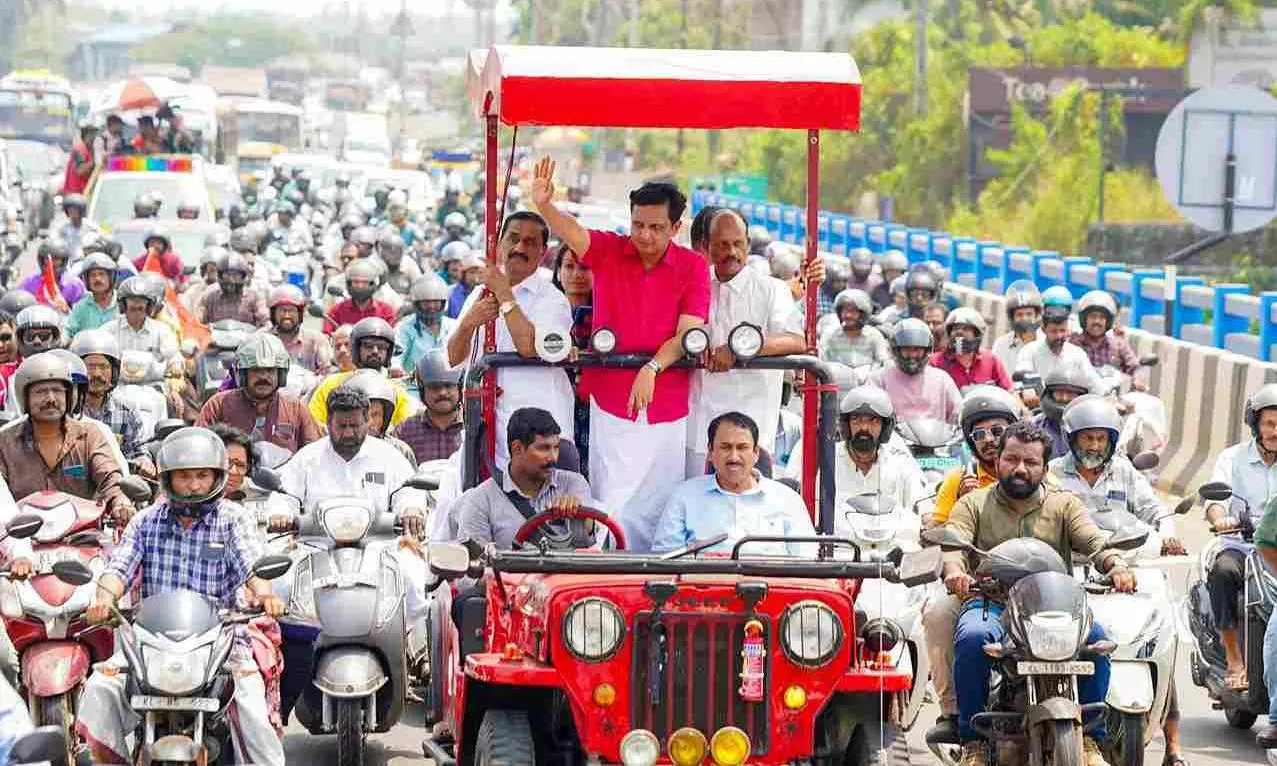
A political storm has erupted in Kerala after the exclusion of state public works minister PA Mohammed Riyas from the recent inauguration of key National Highway projects in the state by Prime Minister Narendra Modi.
“The Chief Minister was invited. Is there a need to invite his son-in-law and other relatives? Is that written as a law somewhere?” asked former Union Minister and now Kerala BJP president Rajeev Chandrasekhar, after questions were raised why an invitation was not extended to minister Riyas.
Chandrasekhar's remark was meant to dismiss a question about why Kerala minister Riyas was not invited to the inauguration. Instead, the sarcastic response set off a political row in Kerala and transformed what was meant to be a celebratory infrastructure event into an ugly controversy over protocol issues and federal respect.
The Prime Minister’s visit was planned around the inauguration of key infrastructure projects, including stretches of National Highway 66, a long-delayed expansion that has reshaped Kerala’s highway network. The widening of NH 66 is among the largest infrastructure projects undertaken in the state in decades.
'Political slight'
But even before the event began, the focus shifted away from development.
The Kerala government realised that the state’s Public Works Minister, whose department had coordinated much of the land acquisition and administrative groundwork for the highway expansion, had not been invited to the programme. Riyas publicly confirmed that he had received no invitation.
The irony made the situation even more awkward for the organisers. This is because the minister’s name was included on the project's official plaque, acknowledging his position and role in the department overseeing the work. Yet, the invitation to attend the inauguration ceremony was not extended to him.
For the ruling Left Democratic Front government led by Chief Minister Pinarayi Vijayan, the exclusion was not simply a protocol lapse. It was seen as a deliberate political slight. The reaction from the state government was swift.
Kerala CM Vijayan and two other members of his cabinet, MB Rajesh and K Krishnankutty decided to boycott the Prime Minister’s programme. The state government then organised parallel public events, roadshows along the newly-completed highway stretches, turning the inauguration into a political contest.
Ministers, legislators and local representatives attended what the ruling front described as “people’s inaugurations” along the highway corridor. The events highlighted the role played by the state government in making the project possible, particularly the complex process of land acquisition that had delayed highway expansion in Kerala for years.
Row intensifies
The political confrontation intensified after Chandrasekhar dismissed the controversy. His comment that the Chief Minister had been invited and that there was no need to invite his son-in-law quickly circulated across political platforms in the state. Soon afterwards, Thiruvananthapuram BJP leader S Suresh repeated the same argument while defending the decision to exclude the minister.
But the attempt to trivialise the issue appears to have backfired. Instead of weakening the criticism against the BJP, the remark allowed the ruling front to frame the controversy as a matter of political respect and federal dignity. The LDF argued that the Centre was attempting to deny the state government its due recognition in a project where Kerala had played a crucial role.
The CPI (M) described the exclusion as political vendetta.
According to the party, the Public Works Department and the minister had worked day and night to facilitate the highway expansion. The land acquisition process required to widen the highway corridor had been one of the most complex administrative exercises undertaken in the state.
Keeping the minister away from the inauguration, the party said in a statement, amounted to ignoring the department that had carried out the most difficult part of the project.
Another irony
The CPI (M) also pointed out another irony. While the minister directly responsible for the project was excluded, the BJP state leadership was included in the programme even though it had no administrative role in the highway development.
The ruling front also used the controversy to highlight the financial contribution made by the state government.
According to the CPI(M), Kerala had spent ₹5,580 crore on land acquisition and related work for the highway expansion through the Kerala Infrastructure Investment Fund Board. The party said the financial burden on the state effectively doubled because the Centre adjusted the amount against Kerala’s borrowing limits. In effect, the state ended up bearing a liability of more than ₹11,000 crore for facilitating the project.
At the same time, the Centre would recover its own expenditure through toll collection with interest.
Despite that imbalance, the state government had supported the project because it was considered essential for Kerala’s long-term development. The controversy soon moved to the national stage as well.
CPI (M) MP John Brittas said, “In this very session of Parliament, the central government itself admitted that Kerala has contributed the highest amount for national highway development. Only when you compare the national highway network in the states placed second and third with Kerala’s network will you understand the scale of our contribution. Even when all these facts exist, the Centre and the BJP are trying to insult the state during the inauguration of national highway development projects."
State govt's role
However, Mohammed Riyas himself chose a measured tone in his response. He said the issue was not about personal recognition but about acknowledging the role played by the state government and its institutions in completing the project.
The minister noted that the land acquisition process in Kerala had once been considered the biggest obstacle to highway expansion. Yet the state government managed to complete it within a relatively short period despite strong political protests and resistance from various quarters.
The CPI (M) also reminded the public about the earlier protests against the project. According to the party, both the BJP and the Congress had supported agitations against land acquisition during the early stages of the highway expansion. Leaders from both parties had participated in demonstrations opposing the project in several parts of the state.
The ruling front argued that the highway development had moved forward only because the state government pushed ahead with the project despite those protests. Interestingly, criticism of the BJP’s handling of the issue also came from leaders of the Opposition - the United Democratic Front (UDF).
UDF response
Several UDF leaders said that regardless of political differences, excluding the state’s PWD minister from the inauguration of a major project in the state was unnecessary and politically insensitive. Some Congress leaders also pointed out that the BJP had inadvertently handed the ruling front an opportunity to shift the narrative from development to questions of federal respect.