Peddi uses Janhvi Kapoor the way its hero uses consent: not at all
The Telugu film is facing severe backlash for the overtly glamorous role of Janhvi Kapoor in the Ram Charan-starrer, and we break down what went wrong

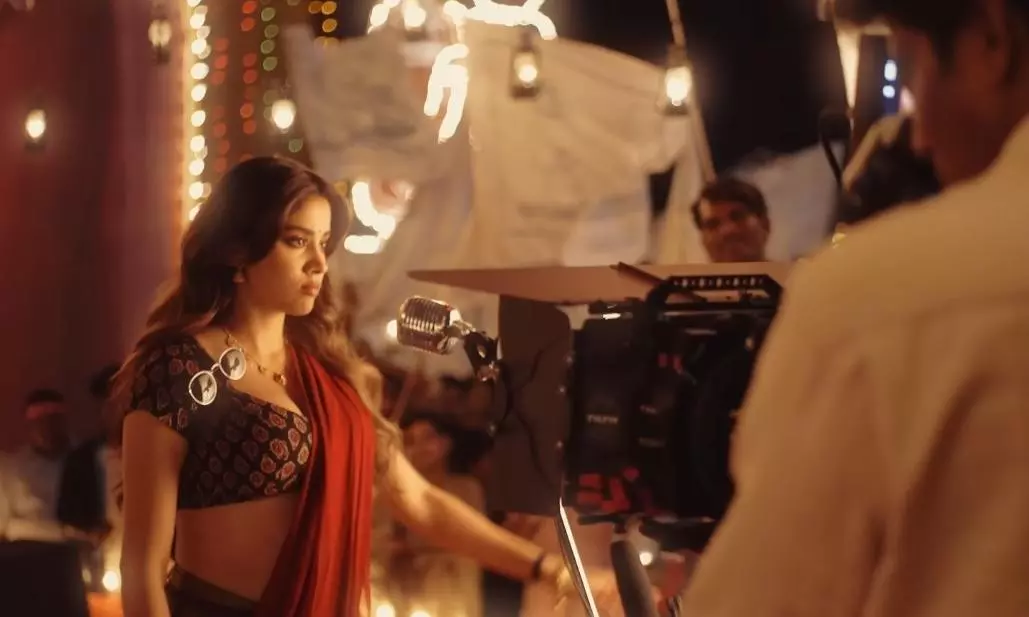
The introduction scene of Janhvi Kapoor (Aachiyamma) in Peddi goes like this. The rebellious daughter of the local politician, Aachiyamma, along with her father's right-hand man, who is supposed to be funny but isn't anywhere in the zip code of humour, drives her jeep through the sugarcane field of the opposition leader.
We are supposed to assume Aachiyamma is frivolous. Aachiyamma stops the car, and cinematographer Rathnavelu's camera lingers over her navel, her body, all over, but never her face. Then she gets down, removes her saree, rolls it onto a stick to make a torch, and as we brace for the predictable — throwing it on the enemy's field — she throws it on her own. We are supposed to be floored by her intelligence.
The next day, she creates a scene in the village about the lost crop to drive empathy, but even there, she seems to draw attention to her body with ill-clad clothes rather than burnt crops. The camera keeps resorting to angles that have nothing to do with the narrative and everything to do with the male gaze.
Love language: Sexual assault
Whenever Janhvi appears on screen, the camera lingers over her body more than her face, and that is exactly what hero Peddi (Ram Charan) seems fixated on too. The writing is brazen enough to have Peddi confess to his friends that he has fallen in love with Aachiyamma without having seen her face yet.
When they sneak into her house, his friends rightly ask how he intends to find her. Peddi's answer? Body measurements. "I know it is her if my one hand can fit in her whole hip, and even if my two hands can't…" You get the drift.
If you think that's atrocious, brace for impact. Peddi gets into Aachiyamma's room, the power conveniently goes off, and he grabs and kisses her. In legal terms: sexual assault. Aachiyamma, who doesn't even know who her assaulter is, cries.
Later, at a campaign event, opposition members get on stage and one uses a knife to cut her skirt to publicly humiliate her. Peddi, who has apparently decided that he should be the only man allowed to degrade her, cuts the tent off the stage just in time to cover her. Chivalry, Buchi Babu Sana style.
But then we learn that someone from the opposition had already taken pictures of Aachiyamma before the curtains fell. They celebrate, plan to release them. Peddi comes to the rescue, beats them all, burns the negatives, and as a result, Aachiyamma falls in love with her sexual assaulter.
It was love, apparently
To be fair to director Buchi Babu Sana, he does not let the assault go unaddressed. Peddi actually tells Aachiyamma that he was the one who kissed her that day. She slaps him. We exhale. And then Buchi Babu explains his hero's behaviour: Peddi, you see, is a man from a rural hill village with no name, and like how some people have gifts, food, and even playful bullying as their love language, Peddi's love language is sexual assault.
"This is my love. I don't know how else to express it. And I am not saying like all other guys that I love you. I am telling you I want to marry you."
Also Read: Ram Charan's Peddi review: Another 'hero hype' formula falls flat
See, Peddi may have only ever looked at Aachiyamma's body and never her face, may have assaulted her, but since his intention is marriage and not something as sinister as love, he is immediately forgiven. Aachiyamma cries again — but now with tears of joy. She has said yes.
Sanskari only after marriage
The only time Aachiyamma appears in proper clothing, and the camera gazes at her with any civility, is at the end — when she is wearing a mangalsutra. But even here there is a twist: the mangalsutra is not tied by Peddi but by herself, in his memory, because her family forbids the marriage.
"What a wonderful woman she is," marvels a villager upon learning the truth.
In the Buchi Babu Sana universe, a woman becomes respectable and deserving of modesty only once she is married. Before the knot, she is eye candy — available for an item number with the hero, performed with her own father watching from the audience.
The most vulgar role of the year
It is not the skimpy clothing that makes this the most vulgar and regressive role of the year. It is the complete and utter absence of self-respect this character is written with. Janhvi Kapoor is blatantly used for glamour, given an excuse of a role that moves nothing in the story and serves no one — least of all her.
The audience has not overlooked it. The film is facing significant backlash for Janhvi's portrayal, with viewers taking to social media in numbers.
One user wrote: "After watching Peddi, you can't help but feel pity for Janhvi Kapoor. Sridevi would have never allowed her to act in such B-grade films in the South."
Another noted with surgical precision: "In one scene from Peddi, Ram Charan compliments Janhvi Kapoor. He describes her eyes, scene then cuts to show her breasts. He describes her lips, then cuts to show her waist. To the editor — are you really that clueless about what eyes and lips are?"
She had already warned us
What makes all of this particularly painful is that Janhvi had, just months ago, spoken about exactly this. On Raj Shamani's podcast in April, she was asked if it affects her when filmmakers oversexualise her.
She said it depends on what she consented to. "I think at any and every stage, it's important to ask yourself, what did I consent to? I did a song called Bheegi saree where I'm in a wet saree, dancing pretty sensually. If someone looked at that and said, I'm not attracted to this chick, I would feel maybe offended. But that's very different from sexualising someone, especially without their consent. That, in any and every form, I'm not okay with. And that does bother me."
She also spoke about learning to push back against uncomfortable camera angles. "If a DOP puts a camera somewhere I'm not okay with, I should be able to say, nahi, ye nahi chalega ('no, this is not acceptable') — without seeming unprofessional. Sometimes I've been polite and picked my battles. But now I'm a little bit like, mera jugaad nikaal dungi ('I will find a way out'). I'll make my point clear somehow or the other."
But according to Peddi, it is not just Achiyamma; even Janhvi Kapoor doesn't have any role in what happens around her or to her.