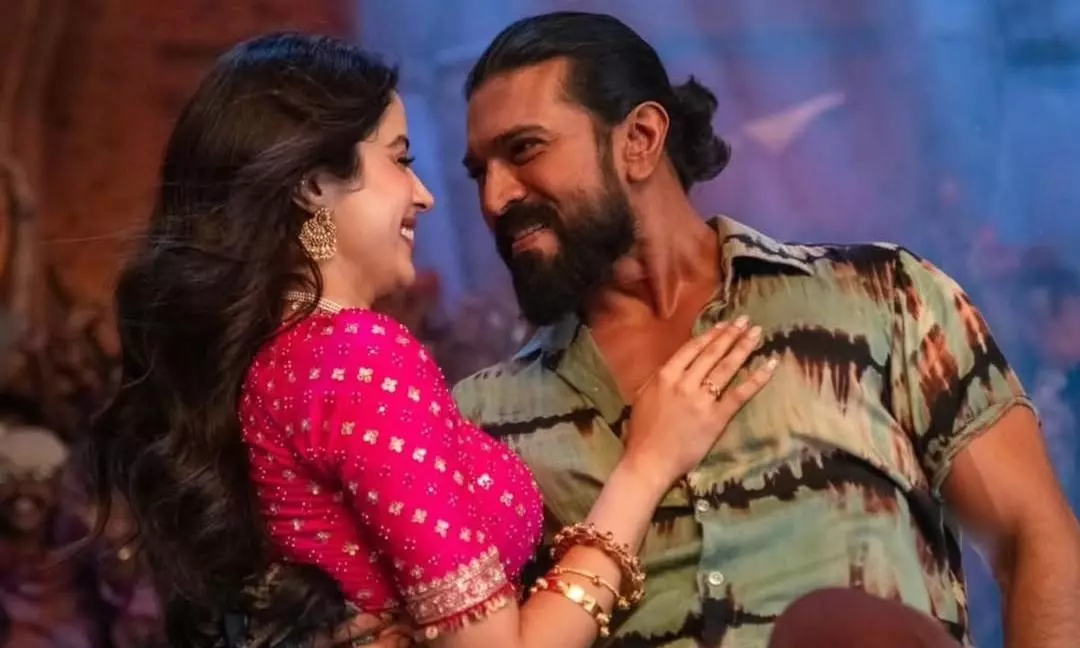
Ram Charan and Janhvi Kapoor in Peddi movie
Ram Charan's Peddi review: Another 'hero hype' formula falls flat
Peddi is a melodramatic sports film that tests your patience in the guise of telling an invigorating story of redemption; Jahnvi Kapoor exists purely as a plot device

Baahubali, KGF and Salaar's success has set a trend: films increasingly become hype instruments for their heroes. The template is now painfully familiar: a stranger arrives in town, bewildered by the hero's omnipresent worship. He then meets another archetype: the hypeman, clearly of the land, dispenses worldly wisdom like a street philosopher. The stranger, suitably elitist and condescending, serves as the audience surrogate. The hype rural man becomes the narrator.
In Peddi, Boman Irani gets the thankless honour of the uber-cool stranger, dragged through a dense forest by the hypeman just to hear the legend of Peddi (Ram Charan).
Sthuthi Puranam: The ritual introduction
As the template demands, the rural man narrates the hero's story, which is essentially a sthuthi puranam. Thirty minutes in, the film deity finally appears, anointed by AR Rahman's background score, which handily does the job of hooting and clapping in case the fans don’t .
Peddi, like all demigods of this genre, carries a sad backstory — his village has no name, no road, and the train that passes through it doesn't bother stopping. The government won't spend a rupee on 1,500 people in a nameless village. But for now, the hero remains magnificently indifferent, busy playing cricket as a sellsword — whoever bids the most money, he plays for them.
The heroine problem: Vulgar by design
Then there's Janhvi Kapoor as Achiamma, in perhaps the most gratuitous lead actress role in recent memory. Peddi brags to his friends that he hasn't seen her face, a complaint the audience shares, since the camera is far more interested in her navel and bosom.
But it isn't the skin show alone that's loathsome. It's the film's brazen lack of shame about it. Peddi sexually harasses her, kissing her in the dark without consent, and when confronted, defends it as a product of his "savage roots" .The heroine exists purely as a plot device: first to be harassed by the hero, then to be saved by him from men who are only marginally worse. But that marginal difference makes one the hero in our films.
Somebody has to die
Then there is another template in such films: the sacrificial goat, someone who dies to hand the hero his purpose. In Tamil films, Kalaiyarasan has made a career of it. Here, in a surprising casting reversal, Jagapathi Babu, usually the one doing the killing, becomes the victim. As Appalasoori, he spends his entire life petitioning the government to stop that one train at the nameless village. Petitions get ignored and his dignity gets crushed and eventually him too, literally, gifting Peddi his redemption arc.
Cricket, kushti, running, pick your sport
A normal film would have Peddi win a local tournament, unite the villages, put them on the map, and call it a day. But this is a Ram Charan film. Stakes must be cosmic. So Peddi plays cricket. Then kushti. Then becomes a runner. All so a train will stop at his village. If you're asking how any of this connects, you're simply not the target audience.
Also Read: Ranveer Singh vs FWICE: Everything you need to know about the Don 3 row
No straight answers
In a supposed heart-touching moment, Peddi tells the world there are 18,000 such nameless villages in India without even a pincode. By the end, a reinvigorated Boman Irani swears to fix things, and we expect him to do something about the villages.
But he proceeded to kickstart Narendra Modi's Khelo India Movement in 2016. The film's unintentional message lands with full clarity: the government will happily spend crores promoting sports so more Peddis can emerge to chase trains, but won't spend a paisa solving the actual problem. In India, you don't get straight answers. Nor, apparently, straight films.