Netflix release Maa Behen is a dark comedy that questions what happens when women tell their own stories
Starring Madhuri Dixit, Triptii Dimri and Dharna Durga, the Suresh Triveni directorial is about a woman and her two daughters who make people uncomfortable simply by existing. The plot thickens when a neighbour’s dead body lands up at their house — ironically named Kripa Niwas, the abode of blessings.

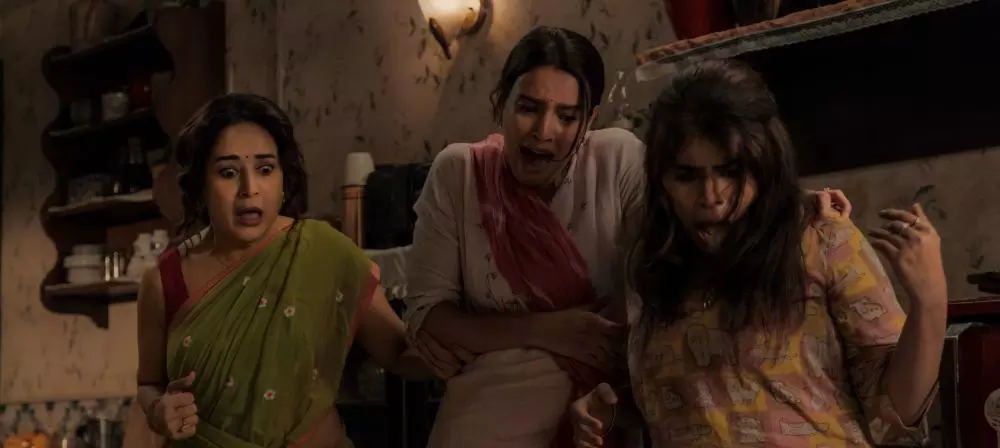
A scene from Maa Behen. Photo: Courtesy Netflix
Rekha (Madhuri Dixit) has spent years scandalising the residents of Aadarsh Nagar. A single mother who has, at various points, run a cybercafé, sold lingerie and now works in a liquor shop, she has never quite fit the colony’s idea of respectable womanhood. Known for her ‘bold’ saree blouses, crimson lipstick and refusal to conform, she is viewed by her neighbours, varyingly, as a seductress, a homewrecker and a woman capable of leading men astray.
Stories about her have travelled faster than facts. In director Suresh Triveni’s Maa Behen, which landed on Netflix on Thursday (June 4), those stories become the starting point for a dark comedy about three women who make people uncomfortable simply by existing.
That tension between who Rekha is and what society believes her to be lies at the heart of the film. When her daughters — Jaya (Triptii Dimri), who is pursuing IVF while navigating an exhausting married life and Sushma (Dharna Durga), a content creator chasing virality — are drawn into chaos after their neighbour Charitra Kumar Gupta’s (Ravi Kishan) body is found in their home, the film unfolds into a mystery that is as much about perception as it is about crime.
Also read: Shape of Momo, Tribeny Rai’s assured debut, is a portrait of womanhood that refuses easy answers
Society vs women
The film is narrated through the lens of Khalbali, a sensationalist crime show that Rekha obsessively watches. Its anchor functions as the story’s narrator, introducing characters and incidents with the exaggerated certainty of true-crime television. The device allows Triveni and co-writer Pooja Tholia (Sacred Games 2, Sarfira) to comment on society’s appetite for scandal, gossip and moral judgment. Long before these women get a chance to tell their own stories, someone else has already written the headlines for them.
The choice is particularly effective because everybody in Aadarsh Nagar seems to have a version of Rekha’s story. Her neighbours remain obsessed with her — from the parentage of her two daughters (both from different fathers), to speculating about whether she is a witch who has somehow never aged and even a potential murderer with a dead body buried beneath the marigolds she lovingly tends. Rekha’s home, ironically named Kripa Nivas (abode of blessings), becomes the address of the colony’s most judged woman.
Also read: From Thiruvilaiyadal to Karuppu, how 'God' evolved on Tamil screen
That gaze extends beyond Rekha to her daughters. Jaya is no goody two-shoes, but the girl who snagged her best friend’s fiancé and married him instead. Sushma, the so-called illegitimate child who has had a scandal with her boyfriend, is equally vilified. ‘Like mother, like daughters’, is the colony’s disparaging stand on the family and their home is perceived as a forbidden fortress that they fearfully claim could destroy anyone who enters. In Aadarsh Nagar, the details matter less than what follows: judgment.
As the women think of ways to dispose of the body in their home, Gupta’s wife (Geetanjali Kulkarni), busy with her daughter’s wedding festivities, begins to suspect the ‘dayan’ (enchantress) next door must have lured her husband. She insists on entering their house, wanting to purify the surroundings and banish the ‘evil’ that lurks inside.
The performances by Madhuri Dixit, Triptii Dimri and Dharna Durga are the film’s biggest strength. Photo: Courtesy Netflix
Suspicious after catching the unmistakable scent of her husband’s massage oil in Rekha’s house, she asks her brother Maheshwari (Arunoday Singh), a cop with a soft spot for Jaya, to investigate. Maheshwari, however, suspects Gupta may have wandered into trouble of his own making.
Between the three women hiding a body and the Gupta family eyeing them suspiciously, there is also a ransom call to contend with. The women, meanwhile, begin eyeing one another with suspicion, wondering if one of them knows more than she is letting on. Beneath the chaos lie old grievances, unresolved trauma and simmering resentments waiting to burst open.
The judgmental gaze
The title itself carries a sly provocation. Anyone who has spent time in North India would recognise “maa behen” as a phrase casually deployed in abuse, banter and anger. Triveni’s film reclaims those usages. The mother and daughters are no longer collateral in somebody else’s story; they become the story.
The performances are the film’s biggest strength. Madhuri Dixit is terrific as Rekha, delivering one of her most uninhibited performances in recent years. She plays the character with humour, defiance, vulnerability and warmth. It is a role that requires her to be larger than life while remaining emotionally grounded and she achieves that balance beautifully.
She is brilliantly supported by Triptii Dimri and Dharna Durga. Dimri gives Jaya a quiet complexity, while Dharna is perfectly cast as the social-media-savvy Sushma, bringing both humour and emotional honesty to the role. More importantly, the three actors share an easy, lived-in chemistry that makes the family dynamics feel authentic. Whether they are arguing, conspiring or confronting old wounds, they convince as women bound together by affection, resentment and history.
Also read: Why Bhooter Bhabishyat maker Anik Dutta will remain ‘immortal’, ‘undefeated’
Much as in Tumhari Sulu and Jalsa, Maa Behen finds Suresh Triveni returning to familiar territory: women navigating complicated lives while society rushes to define them. Here, however, he wraps those concerns in a dark comedy that doubles as a commentary on reputation, morality, virality and public judgment. The writing, aided by Pooja Tholia’s sharp dialogues, understands both the absurdity and cruelty of the labels people casually attach to women.
The film is at its strongest when it allows its characters to exist in the grey areas between perception and reality.
The latter half does lose some momentum and becomes more predictable than its wonderfully intriguing setup initially promises. Some of the revelations arrive with less impact than expected and the mystery itself is not always as compelling as the social observations surrounding it. Yet even when the plot wobbles, the performances keep the film firmly on track.
In the end, Maa Behen works because it looks beyond the rumours that surround its women. Beneath the satire, the mystery and the laughs is a story about women who have spent their lives being judged through other people’s lenses. Triveni’s dark comedy gently but firmly asks what happens when they finally get to tell their own story.