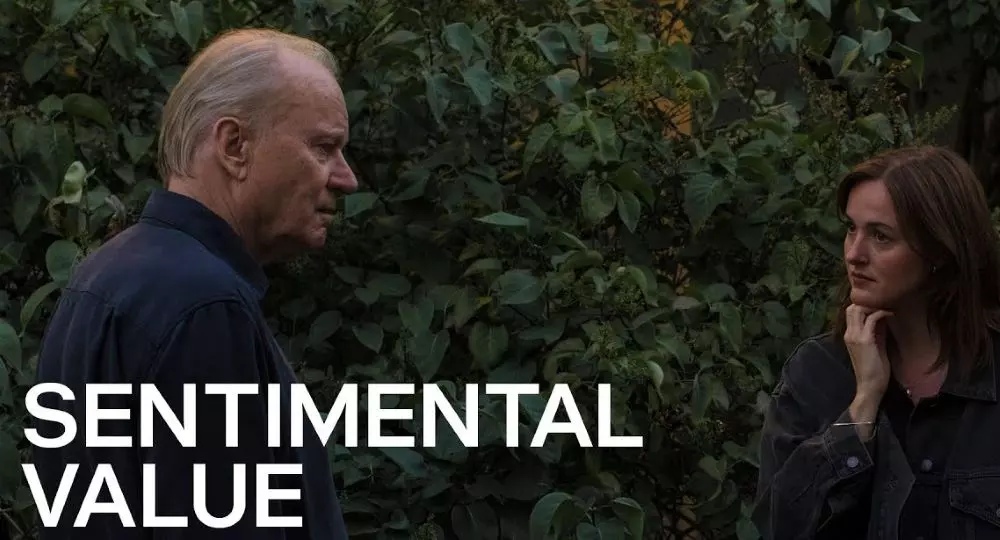
A scene from the film.
How Joachim Trier’s Sentimental Value weaves poetry through small moments and fragile conversations
The film, which won this year’s Oscars in the ‘Best International Film’ category, blurs the boundaries between memory and storytelling, its strength lying in its intimacy.

Joachim Trier’s Affeksjonsverdi (Sentimental Value) — which won the award for the ‘Best International Film’ at the 98th Academy Awards, the first Norwegian film to win in the category — was the most absorbing film I watched at the International Film Festival of Kerala last year. Some films fade away soon after the screening ends, but this one had me gripped long after I had stepped out of the theatre. The experience felt unusually intimate. Watching it was less like witnessing a conventional film and more like slowly entering a private emotional space. The story moved with the quiet rhythm of a short story, almost poetic in its tone, where feelings are not declared loudly but revealed through small moments and fragile conversations.
The film begins with a theatre. We see rehearsals for Anton Chekhov’s The Seagull, and that choice immediately establishes the emotional plane of the narrative. The stage becomes the first frame through which we encounter Nora, played by Renate Reinsve. Nora is a celebrated actress who appears confident in her craft but carries an inner restlessness. Even before the story moves forward, the film places her inside a familiar dilemma of performance. Acting becomes both refuge and burden. The stage gives her clarity, yet outside it she seems unsure of how to live with the emotions that shape her.
From that theatrical opening, the narrative slowly and subtly shifts to Nora’s personal life. The emotional centre of the film emerges when her estranged father Gustav, played by Stellan Skarsgard, re-enters her life after the death of her mother. Gustav is a filmmaker who once had recognition but has been absent from his daughters’ lives for many years. His return is uneasy and quiet, bringing back memories that the family has long tried to keep at a distance.
The father’s return is not only personal but also artistic. Gustav arrives with a screenplay that he hopes will revive his career. The script draws from his own past, and he hopes Nora will take the central role. For him, the project carries the weight of both cinema and confession. For Nora, however, it feels like an intrusion. Their disagreement hints at a deeper conflict about how personal memories can be reshaped into art and who has the right to retell them.
This tension between life and art becomes the underlying thread of the film. Gustav represents a kind of filmmaker who believes that lived experiences must inevitably find expression in cinema. Nora stands at a more cautious distance from that belief. As an actress, she understands performance, yet she questions the impulse to turn private family histories into creative material.
Also read: The Bride!: Maggie Gyllenhaal reimagines Frankenstein as a tale of creation, feminist rage
The presence of Nora’s sister Agnes, played by Inga Ibsdotter Lilleaas, adds another emotional dimension. Agnes lives a quieter life and appears more settled, but she too carries the memory of their childhood. The relationship between the sisters provides some of the film’s most delicate moments. Their conversations reveal how the same past can leave very different impressions on two people who grew up in the same house.
An echo of Ingmar Bergman
I could feel a quiet echo of Ingmar Bergman in the film’s narrative structure and emotional tone. The story unfolds like a sequence of intimate chapters rather than a conventional plot-driven drama. Dialogue and performance guide the movement of the film more than dramatic events. Many scenes resemble small theatrical encounters, where two or three characters sit together in a room and slowly circle around difficult emotions. The drama emerges through pauses, glances and restrained exchanges rather than overt confrontation.
Stellan Skarsgard’s portrayal of Gustav captures its complexity with remarkable subtlety. The character is confident when speaking about cinema and the creative process, yet uncertain when confronted with the consequences of his absence as a father. At times, he appears charming and reflective. At other moments, he seems unaware of the emotional distance he has created within his own family. This contradiction makes him feel less like a villain and more like a deeply flawed artist trying to understand the people he once left behind.
Also read: What makes Iranian filmmaker Jafar Panahi’s film, It Was Just an Accident, a riveting watch
The film’s visual language supports this intimacy. The camera stays close to the characters, allowing their expressions and silences to shape the emotional rhythm of each scene. The family home becomes an important presence throughout the narrative. It carries traces of earlier years and quietly reminds the characters of the life that once existed within its walls.
By the time the story reaches its later moments, the boundaries between memory and storytelling begin to blur. Gustav’s creative project becomes a way of revisiting the past, but it also forces the family to reconsider how those memories belong to each of them in different ways. The film resists the urge to resolve these tensions neatly.
That lingering openness is perhaps what made the experience of watching Sentimental Value so powerful. It is not a film built around spectacle or dramatic revelation. Its strength lies in its intimacy.