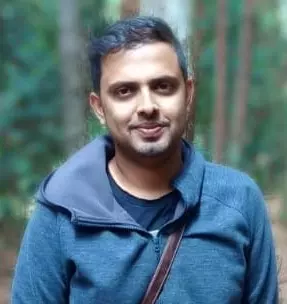
Starring Boddy Deol in the lead role, Kashyap's docu-fiction-like technique spells itself out loud throughout the 136-minute runtime. The approach is discomfortingly effective in dragging the viewer, along with the protagonist, across the concrete, whether in the dubious investigation carried out by the cops, the way the legal team questions, or the mortal fear the character feels inside the prison.

The foreign title of Anurag Kashyap’s Bandar, ‘Monkey in a Cage’, leaves no illusions about the subject.
Actor and Singer Samar Mehra (Bobby Deol) is 50 and has seen better days in both his career and life. With hit films and TV shows to his name in the past, the fame has been worn threadbare now, but is still useful enough to score gigs at weddings and such events. His back, literally, needs a brace to stay erect and he seeks relief from the loneliness engulfing him by rummaging through dating apps. The showbiz monkey or bandar that he has been for so long holds onto pride, but badly seeks validation.
And director Kashyap, aided by his co-director Sakshi Mehta Lau and scripting by Sudip Sharma and Abhisek Banerjee, relays this journey of desperation with his trademark directness.
Nothing under wraps
There is nothing beneath the surface here. When Samar finds out that his new “friend” Khushi (Saba Azad) is seeing other people as mutually agreed, he doesn’t hide the annoyance he feels. When the police pick him up on charges of rape (and blackmail and extortion) and he later vehemently denies being guilty of it, the cop in charge (played by Jitendra Joshi) makes sure that the damning evidence — an explicit photo and sexting chats — is read out loud to him as well as the audience. When Samar’s accuser/alleged victim, Gayatri (Sapna Pabbi), is introduced in the film, no doubts are left as to her obsessive and borderline psychotic behaviour, enunciated by repetitive visuals and an ominous music score.
The guard inside the under-trial prison asks Samar to squat specifically like a monkey. The toilets inside the barracks are clogged to the extent that turds float nearly up to the top and the camera makes sure to stay on the image for a good couple of seconds.
Also read: Shape of Momo, Tribeny Rai’s assured debut, is a portrait of womanhood that refuses easy answers
Even the song, banged out by two inmates (featuring Raj B Shetty and filmmaker Natesh Hegde, as the junked-out duo) says explicitly that everything here — from love to offspring to the country itself — is a pinjara or cage.
Kashyap stays as linearly focused as possible when he traces his protagonist’s living nightmare, and the hyper-realistic, docu-fiction-like technique he employs spells itself out loud throughout the 136-minute runtime. The approach is discomfortingly effective in dragging us, the viewer, along with Samar across the concrete, whether through the dubious investigation carried out by the cops or the way his legal team questions him for details that one is likely to forget or misremember, or the mortal fear he feels every second inside the prison.
There is no question about the craft being compelling, especially with the help of production designer Prashant Bidkar, cinematographer Saiyed Shaaz Rizvi and an ensemble cast comprising Sanya Malhotra (as Samar's sister), Indrajith Sukumaran, Sukant Goel and others.
Indeed, it is the least you expect from a filmmaker who never hides his penchant to stick his head as deep as possible into the muck. Kashyap takes what films or series like Kaalapani (1996) and The Night Of (2016) showcase with respect to the inhumanity of judicial institutions, and only injects more viscerality into it.
The concern, however, begins to surface when the same showmanship becomes the film, while almost entirely forgetting that a story such as this — of reliance, accountability and the crossing of the line — also needs at least one or more vantage points to feel significant nad essential.
The need, then, for a perspective different from Samar’s becomes important not only to add an element of grey into an otherwise black-and-white argument, but also to understand the very theme that the writer duo and the director are chasing together.
Many ideas, limited nuance
And Bandar goes after many ideas or themes at once. A man like Samar Mehra, it says, is an easy pawn for the legal system to make a grave example out of, considering its prejudice against the film industry. It says that the line between self-attested truth and public opinion is so thin that overlaps among the two could never really be avoided. It talks about a kind of entitlement that allows a man to casually make sexually aggressive requests, as well as about patience and diligence, more than anything else, in the era of cancel culture.
What it does overlook is nuance, which would have lent more girth to the argument that society must allow room for repentance and redemption, particularly if a transgression cannot be confirmed with complete clarity, or isn’t what a collective conscience deems unforgivable. What it doesn’t do is provide Gayatri with the agency to be a person of her own, one who could be both trusted and suspected like everyone else out there.
Bandar, instead, goes only as far as keeping things so obvious that it feels like it doesn’t wish to hold a discourse in the first place.
Also read: Peddi uses Janhvi Kapoor the way its hero uses consent: not at all
Does that mean this is one of those ’Men Too’ exercises (a spin on 'Me Too', which claims men too can be victims)? No, Bandar is well beyond the reductive stance that many take in everyday life. It indicts men, at times, by showing that no one accused of a sexual crime ever accepts his misdeed, let alone agrees to the fact that what a woman wears is never, ever the reason for the crime inflicted upon her.
The prison becomes almost a purgatory for Samar, who finds himself in a great conundrum wherein he must survive only by assimilating, but the only way to assimilate is by accepting something that he perhaps hasn’t perpetrated. Can his truth be the other man’s truth as well? Or does lying make him more truthful in that place? If only the story had leaned harder on these questions.