Ramayana: Part One review: An ambitious spectacle with moments of wonder
Ranbir Kapoor, Sai Pallavi and Yash starrer, directed by Nitesh Tiwari, is only the latest retelling of the revered epic and has drawn a fair bit of controversy even before it released.

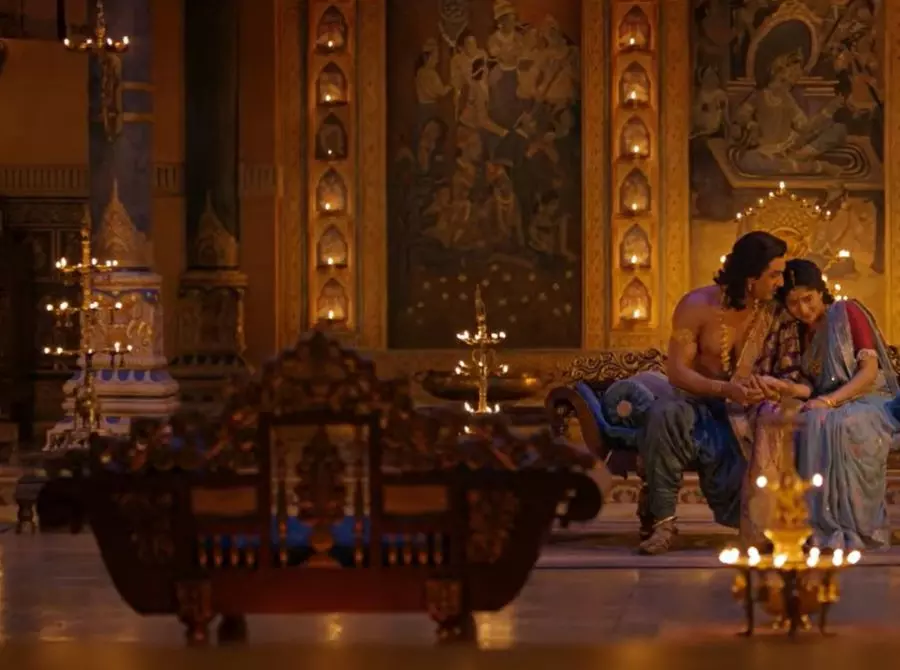
Ranbir Kapoor and Sai Pallavi in Ramayana: Part 1.
The Ranbir Kapoor, Sai Pallavi and Yash-starrer Ramayana became a topic of discussion, debate and controversy long before it hit the screens on November 5. The Nitesh Tiwari directorial, mounted on an exorbitant budget of reportedly Rs 4,000 crore and co-produced by Namit Malhotra and Yash, has been in the news for the ambitious vision of its creators and the promise of a visually crafted adaptation on a scale rarely seen on Indian screens.
A revered and sacred epic that has been retold and reinterpreted countless times across generations, the Ramayana continues to hold a special place in popular imagination. Ramanand Sagar’s 1987 television adaptation remains one of the most recognised screen interpretations of the sacred text. At the other end of the spectrum is Om Raut’s Prabhas-starrer Adipurush, which has been relegated to the status of a travesty that should never have been made.
When it comes to this latest retelling, the sheer ambition of the undertaking is impressive, even if the film doesn’t always get everything right.
A familiar epic on a grand canvas
Nitesh Tiwari’s Ramayana: Part One opens with a distinctly Narnia-esque landscape depicting a battle between the Asuras (demons) and the Devas (gods of the celestial realm). The aftermath takes us to the days of Lanka’s glory under Kubera, the divine treasurer. However, Kaikesi (Shobana) goads her son Dashagriva to devote himself to the cause of his fallen Asura kin rather than spending his time on the performing arts. His transformation into the formidable Ravana (Yash) follows years of penance and the divine boon that makes him virtually invincible. Soon, Ravana’s growing arrogance and might, which even the gods begin to fear, prompt Vishnu, the preserver, to take an avatar as Rama (Ranbir Kapoor), the son of Dasharath, in faraway Ayodhya. The first part, which runs for nearly three and a half hours, ends with Sita (Sai Pallavi) being abducted by Ravana.
Based on Valmiki’s epic, Part One spends considerable time establishing both sides of the story. Ravana, in particular, is presented as an intellectual with mastery over the arts, astrology and warfare. We see his rise to power and the forces that shape him, rather than simply being introduced to him as the antagonist in Rama’s story. It is an attempt to give the character greater depth and explore the making of a daunting figure whose ambition eventually turns into arrogance.
Yash commands the screen
When it comes to the performances, Yash stands out as Ravana. He fills the screen with his presence, the fury in his eyes and the aura of a man known to get his way. Ravana, who is credited as the creator of the Shiva Tandava Stotra, the sequence choreographed by Shiamak Davar, is among the film’s most striking moments.
Yash commands the screen as Ravana.
Another well-done moment being the sequence when Surpnakha (Rakul Preet Singh) approaches her brother, demanding that he avenge the insult inflicted on her by Rama and Lakshman. His dilemma, displayed through his ten personalities representing his ten worlds offering him conflicting counsel, is an intriguing dramatisation of the internal conflict of a character who is otherwise defined by his indomitable power.
Ranbir Kapoor as Rama takes some getting used to. The actor has long been associated with the brooding rock star, the restless man often caught in a conflict of identity. Watching him inhabit the composed, almost idealised figure of Rama required a shift in perspective. He is restrained in his portrayal, although there are moments when that restraint slips into stiffness. For the most part though, he manages to capture the quiet dignity and inner strength associated with Rama. Sai Pallavi makes for a graceful Sita (despite the many controversies over her casting and whether her looks match Sita’s) and her expressive eyes convey much of the character’s tenderness. But she does fail to match up to the expectations from the character at times, lacking a certain maturity that is expected from Sita.
Ravi Dubey embodies the short tempered, impulsive and selfless brother Lakshman to perfection. He gets the beats of the character’s temperament just right and brings an engaging energy to the role. Arun Govil is very good as Dasharath, bringing gravitas to the role. It is also a pleasure to see the legendary Ram of Ramanand Sagar’s television adaptation return to the Ramayana universe, this time as Rama’s father.
The iconic scene when Dasharath’s third wife Kaikeyi (Lara Dutta), influenced by her maid Manthra (Sheeba Chaddha), storms into her kop bhavan (brooding chamber), coercing Dasharath to banish Rama into the jungle is one of the most underwhelming and weaker portions of the narrative. Given how consequential and impactful this moment is in the epic and its many retellings, it falls flat with Lara Dutta unable to embody the rage, guilt and fury of a woman who has been consumed by her own ego.
A score that doesn’t quite move, a spectacle
worth experiencing
The music, composed by AR Rahman and Hans Zimmer, is another aspect that falls short of the film’s ambition. Given the emotional and devotional place the Ramayana occupies in popular memory, one expects a score that resonates beyond its sheer scale. Instead, much of it relies on sweeping, operatic orchestration that announces the grandeur of the spectacle without necessarily making you feel it.
Ranbir Kapoor gives a restrained performance as Ram.
From a production standpoint, filmed with IMAX-certified high-resolution cameras, the film creates a sprawling canvas that fills a giant IMAX screen from top to bottom. The visual effects are, by and large, impressive, and the technical ambition behind them is evident. DNEG, the Oscar-winning VFX studio led by producer Namit Malhotra, has been tasked with creating the fantastical worlds of the epic on an unprecedented scale.
Also read: Is BJP losing its grip on Ram as Ramlila mandals want Dussehra stages free of politics?
There is plenty to admire in the scale and detail of this visual undertaking. Certain sequences, particularly the Jatayu episode, have an undeniable visual impact. While some portions do fall short and occasionally look artificial or overly computer-generated, the overall effort is impressive. The visual language does, at times, recall the grand, maximalist spectacle of Baahubali and Kalki 2898 AD, rather than carving out an entirely distinct identity, but that does little to take away from the magnitude of the achievement.
Lanka, in particular, makes for an interesting creative choice. Traditionally described as a magnificent golden city, Ravana’s kingdom is presented here with a distinctly dark and ominous aura. Perhaps this is intended to establish a visual counterpoint to Rama’s association with light and righteousness, while reflecting the darkness attributed to Ravana. However, the treatment seems to come at the expense of some of the splendour and opulence that traditionally define Lanka.
Costumes miss the mark
Perhaps the most disappointing aspect of the film is its costume design by Harpreet and Rimple Narula. The heavily embellished velvets, replete with gota and zari work, chiffon and mukkaish wraps, the two-tone effects, along with gladiator sandals, create a curious mix of Greco-Roman influences and what appears to be an 18th-century medieval aesthetic meets over-the-top wedding couture. Yet, this combination does little to evoke the world of the epic and, instead, comes across as jarring.
Sai Pallavi as Sita.
The costumes worn by Rama and Sita when they retreat to the forest are equally unconvincing. The stitched garments seem anachronistic for the period in which the story is set, even allowing for the designers’ creative interpretation. The accessories, too, look conspicuously out of place, at times resembling pieces picked up from Amazon rather than carefully conceived elements of an epic’s visual world.
An ambitious undertaking
There is no denying that Ramayana: Part One is a brave and ambitious undertaking. The scale of the production, the visual imagination and the desire to reimagine an epic that has been part of our collective consciousness for generations deserve their due. However, one is left wondering whether the film is looking more towards an international audience than the Indian viewer who has grown up with the Ramayana in its many familiar forms. There is still an audience that is happy to see this story told in a simpler, more familiar way, without necessarily needing it to be reinvented as a sprawling global spectacle.
Also read: How a character’s success can limit the actor from experimenting on screen
At nearly three and a half hours, the film does feel like a stretch, and there are moments when its ambition gets the better of its storytelling.
Part 2 is scheduled for a Diwali 2028 release. Much of the anticipation for that will depend on how far Part 1 manages to grip the audience.