Why controversy over AR Rahman’s Ramayana track is at odds with India’s tradition of cultural exchange
Rahman’s Mangal Rang has received backlash for its ‘qawwali-inflected composition’. While questioning a composition’s musical merit, historical accuracy or ability to evoke an epic’s sacred character is perfectly legitimate, cultural experts say the issue is with criticism shifting from whether a composition works to whether a particular musical tradition has the right to enter the imaginative universe of the Ramayana.

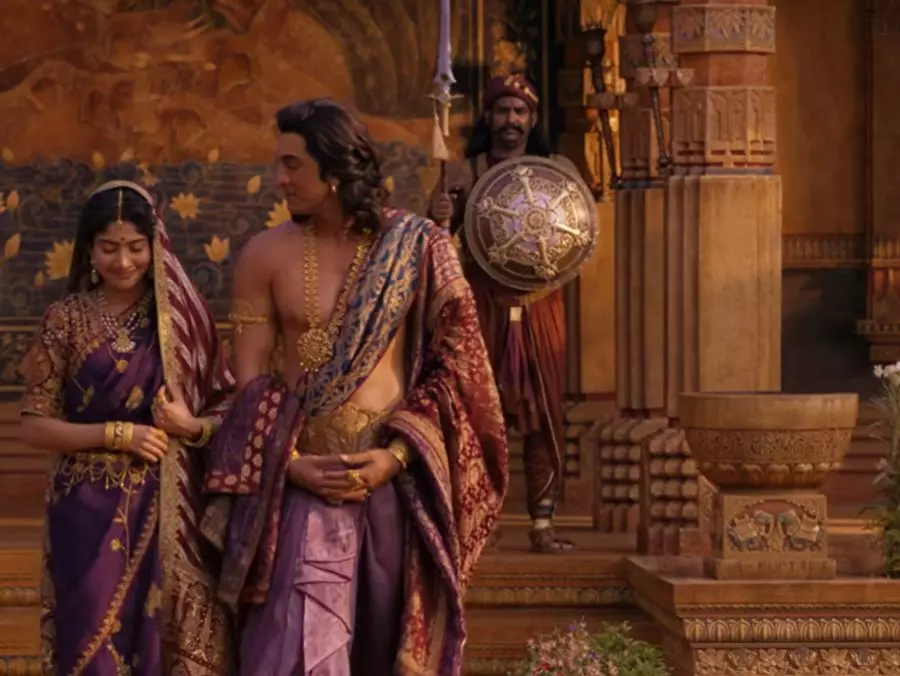
Ranbir Kapoor and Sai Pallavi in the upcoming Ramayana.
The backlash against AR Rahman’s “qawwali-inflected composition” for the upcoming Ramayana exposes an extraordinary contradiction: a civilisation whose epics, music, dance and devotional traditions have flourished through centuries of cultural exchange is now witnessing attempts to police the very influences that enriched it.
Directed by Nitesh Tiwari, the film — based on the Hindu epic of the same name and starring Ranbir Kapoor and Sai Pallavi in the characters of Ram and Sita — releases on November 5. In recent months, it has repeatedly found itself in the centre of controversy over issues including the cast, costumes, etc. The dispute over Rahman’s track is only the latest surrounding the film.
The ace composer has defended his musical choices in Mangal Rang (picturised on Ram and Sita), explaining that the composition “blends classical notes from [the ragas] Bilawal, Maand (a raga with roots in Rajasthani folk), and touches of Pahadi”. Urging his detractors to focus on his craft rather than him, he said: “My team puts in intense work, filtration, and iteration into the music. We prefer focusing on this creative process rather than monitoring real-time social media reactions.”
Neither this explanation nor the song’s climb to No. 1 on YouTube’s trending music chart during its release week has done much to stem the online hostility.
There is something “almost comical” about the insinuation that a composition does not sound Hindu enough, says culture studies expert and author Dr Madhubanti Bagchi. “It is strange that a particular musical idiom can be deemed unfit for an Indian epic simply because it’s associated with another religious tradition.” She admits that the controversy might have been dismissed as “a one-off that’s equal parts foolish and comical” were it not symptomatic of a larger malaise. “The attempt to retrospectively divide a cultural inheritance that centuries of poets, musicians, dancers, storytellers and devotees have spent their lives enriching is part of a larger malaise of exclusion and otherisation sweeping through this land.” She invokes Kabir: Hindu kahat Ram hamara, Musalman Rehmana/Aapas mein do ladhe marat hain, marm koyi nahin jaana/ Sadho dekho jag baurana (The Hindu calls Ram his own, the Muslim calls upon Rehman; and so they fight, and so they perish, blind to the truth beyond their ken. Oh seeker, behold! The world has lost its way).
Valmiki’s Sanskrit Ramayana is foundational, but it has never exhausted the story’s possibilities. Countless regional and oral retellings have given Rama, Sita, Lakshman, Ravana and even Hanuman different voices, textures and emphases.
Bagchi is hardly an uncritical Rahman admirer. She believes Mangal Rang “really scrubs the bottom of the barrel even by the composer’s own failing standards these past few years”, adding, “Take him to the cleaners on that or the fact that he lazily regurgitates his own Enna Solla Pogirai from Kandukondain for this track”. She also recalls being horrified 18 years ago by Rahman’s choice of harmonium in the opening bars of Khwaja Mere Khwaja in Jodhaa Akbar, given “that the harmonium arrived in India more than 350 years after Akbar died.”
Her distinction is important. Questioning a composition’s musical merit, historical accuracy or ability to evoke an epic’s sacred character is perfectly legitimate. “No composer is above scrutiny, and no audience is obliged to like every song s/he makes.”
But when criticism shifts from whether a composition works to whether a particular musical tradition has the right to enter the imaginative universe of the Ramayana, “we have left the realm of aesthetics and entered the decidedly less defensible territory of cultural policing”, Bagchi explains.
Sociocultural historian and commentator Mukund Kule agrees. “A listener’s entitled to dislike Rahman’s arrangement, find it derivative or argue that a different musical treatment would’ve served the scene better. What becomes difficult to defend is the presumption that qawwali, Sufi-inflected music or any other form associated with Islam is inherently alien to the cultural imagination in which the Ramayana lives.”
The distinction matters because India’s artistic traditions have never been so obligingly compartmentalised. Their histories, Kule argues, are “stories of encounters, borrowings, arguments, adaptations and astonishing acts of creative generosity”.
And nowhere is this more evident than in the Ramayana itself.
Whose Ramayana is it anyway?
Even the loudest voices attacking Rahman seem unable to answer a straightforward question: which Ramayana are they seeking to protect?
Valmiki’s Sanskrit Ramayana is foundational, but it has never exhausted the story’s possibilities. Kamban’s Tamil Ramavataram, Tulsidas’s Awadhi Ramcharitmanas, the Bengali Shri Ram Panchali by Krittibas Ojha and countless regional and oral retellings have given Rama, Sita, Lakshman, Ravana and even Hanuman different voices, textures and emphases. Buddhist and Jain traditions have also reimagined the narrative, sometimes substantially altering its characters, relationships and moral questions.
According to Dr Manik Sharma, a scholar of the epic, “Depending on who you speak to and its context, the tonality, texture and nuance of the same narrative varies vastly”.
She points to scholar AK Ramanujan’s celebrated essay Three Hundred Ramayanas, which explores the extraordinary diversity of the epic’s retellings across South and South East Asia.
Also read: Kadapa Amin Peer Dargah: 300-year-old Sufi shrine where boundaries dissolve
The story travelled far beyond the subcontinent, acquiring local performance conventions, aesthetics and political meanings. Thailand’s Ramakien is woven into its cultural heritage through classical dance, masked theatre, temple murals and royal traditions. Indonesia’s Kakawin Ramayana became a landmark of Javanese literature, while performances in Java and Bali gave the narrative a distinctive local life. Cambodia developed the Reamker, celebrated through classical dance and associated with the artistic heritage of Angkor Wat. Malaysia produced the Hikayat Seri Rama, while Myanmar embraced the story as Yama Zatdaw, incorporating it into royal theatre and traditional dance-drama.
Through Buddhist narratives such as the Dasaratha Jataka, versions of the Ramayana travelled further, including into China. Sri Lanka, too, has its own literary relationship with the epic, including the Sanskrit Janakiharan, attributed to the 7th-Century King Kumaradasa.
“Think about what these journeys tell us,” says Sharma. “The Ramayana crossed linguistic, religious and geographical boundaries because it was never sustained by a single authorised interpretation. It could become a Hindu epic, a Buddhist narrative, courtly literature, temple art, folk theatre, classical dance and royal performance.”
She cautions against mistaking this evolution for cultural dilution. “It is cultural vitality. The Ramayana’s strength lies precisely in its capacity to be retold, reinterpreted and reinvented. No community can claim exclusive ownership of a story that has been embraced, transformed and kept alive by so many others.”
The many Ramayanas are not merely translations of a fixed original. They are evidence of a story that has endured because different communities have made it their own. As Kule observes, an epic’s cultural authority need not depend on uniformity. To insist that every retelling reproduce a single supposedly authentic version would be to deny much of the cultural wealth accumulated around it.
When Muslim poets fell in love with Hindu deities
The impulse to police cultural boundaries becomes even more curious when set against the history of Muslim poets and devotees who found their spiritual and creative worlds in Hindu deities.
Kathak exponent Sushant Gaurav, India’s only exponent of the Lahore gharana, says he has encountered similar prejudice within the dance fraternity. “Ever since I began dancing in this style, I’ve had to bear the often not-so-subtle barbs from the who’s who from the dance fraternity. Camouflaged in humour, they always find a way of mocking my choice for its Islamic grammar,” he says, adding that similar toxicity surfaces in comments on his dance reels.
He finds this particularly disheartening given the history of Muslim poets who made Hindu deities the subject of their devotion. One of the best-known examples is Raskhan (Syed Ibrahim Khan), traditionally remembered as a Muslim devotee of Krishna. His poetry celebrates Braj (the region traditionally associated with Krishna), Krishna’s childhood, beauty and divine play. Despite uncertainties surrounding some biographical details, his literary legacy is unmistakable: Krishna bhakti found extraordinary expression in the work of a poet remembered as Muslim.
Rakshan's tomb in Mathura. Photo: Wikipedia
Raskhan was hardly an isolated figure. Leading Odissi exponent and guru Shubhada Varadkar points to Salabega, among Lord Jagannath’s most celebrated devotees. The 17th-century Odia poet is believed to have served in the Mughal army before an injury and a subsequent spiritual experience drew him towards the worship of Vishnu, Krishna and Jagannath.
Despite his devotion, Salabega was “not permitted to enter the Jagannath Temple in Puri because he was Muslim”. He channelled his devotion into bhajans instead. Varadkar recalls how deeply her guru, Pandit Kelucharan Mohapatra, was moved by Salabega’s story. “Here was a man who could not enter the temple, yet whose love for Jagannath found expression in poetry that continues to be sung and cherished. His story demonstrates how spirituality can transcend the divisions of caste, creed and religious identity.”
Ram in Sikh scripture: the limits of ownership
The name Ram offers another revealing example, although it requires an important theological distinction.
In Sikh scripture, including the Guru Granth Sahib, Ram and names such as Hari and Gobind frequently invoke the divine. Their meaning cannot automatically be reduced to Rama, son of Dasharatha, or treated as evidence that Sikh theology simply belongs to another religious tradition.
Patiala-based Sikh Studies scholar Gurmehar Singh explains: “In Gurbani, Ram often signifies the all-pervading divine reality. The name functions within a distinct theological framework, one that cannot be understood by lifting a word from its context and claiming it as exclusive property.”
A name can travel across traditions, acquiring layers of meaning without every usage being identical. Singh draws a parallel with Kabir, whose poetry draws on Hindu and Islamic vocabularies while challenging those who mistake religious labels for spiritual understanding.
“Kabir’s significance does not lie in proving that Hinduism and Islam are interchangeable. It lies in his refusal to accept that the truth of spiritual experience can be settled merely by identifying which community owns a particular word, ritual or form of expression.”
A 19th century painting of Kabir weaving. Photo: Wikipedia
This is not an argument for erasing religious distinctions. It is an acknowledgement that traditions can remain distinct while speaking to one another. Sometimes, the overlap is not an intrusion into history. It is the history itself.
When the Mughals translated the Mahabharata
Kule takes us to Akbar’s court in the sixteenth century for another striking example.
In the 1580s, Akbar commissioned a Persian translation of the Mahabharata, produced through collaboration between Sanskrit scholars and Persian-speaking Muslim intellectuals. The resulting work, known as the Razmnama, was part of a wider translation movement through which Sanskrit knowledge entered the Persianate intellectual world. Akbar also commissioned a Persian translation of the Ramayana in the late 1580s.
Also read: Beyond the unbroken line: How Jogen Chowdhury chronicled the anxieties of modern India
These were substantial literary undertakings, not casual references to Hindu mythology.
“Imagine the proposition from the standpoint of today’s cultural gatekeepers: Muslim scholars working with Hindu pandits to translate the Mahabharata, an epic of extraordinary religious and philosophical importance, into the language of a Mughal court,” says Kule. “Would this be dismissed as an unacceptable intrusion into Hindu culture? Would the translators be accused of diluting the epic by making it accessible to readers who did not know Sanskrit? Would the very act of translating it into Persian be treated as a betrayal of its civilisational origins?”
Persian-language authors went on to produce further adaptations of the Ramayana, and the story eventually found expression in Urdu too.
The classical arts have always borrowed
The controversy over Mangal Rang becomes even more curious when viewed against the history of Indian music.
“Hindustani classical music, as we know it today, emerged through a long and complicated history of patronage, performance, experimentation and exchange,” explains Bagchi. Its development involved interactions between Indic musical traditions and Persianate cultural worlds, alongside contributions from temples, courts, Sufi shrines and regional communities.
She also points to the historical relationship between qawwali and Hindustani classical music. “Scholars have examined the connections between qawwali, early khayal and other vocal forms, showing how musical practices developed through overlapping networks of performers and patrons.”
Kule offers examples that illustrate this cultural traffic.
Amir Khusro, whose legacy represents the meeting of Persianate and Indian cultural worlds. Traditionally credited with the creation of qawwali and associated with developments in khayal and instruments such as the sitar and tabla, Khusro’s place in music history is more layered than any single-inventor account might suggest. Yet his enduring significance lies in a musical imagination that brought different traditions into conversation.
Another example comes from the court of Kolhapur’s Rajarshi Chhatrapati Shahu Maharaj. Ustad Alladiya Khan, founder of the Jaipur-Atrauli gharana, was appointed a court musician. According to Kule, one of his regular responsibilities was to render musical service at the Bhavani temple in the Old Palace.
Ustad Bismillah Khan. Photo: Wikipedia
Ustad Bismillah Khan spent a lifetime playing the shehnai at Varanasi’s Kashi Vishwanath temple and on the ghats of the Ganga. His music became inseparable from the soundscape of one of Hinduism’s most revered cities. “Music and melody have no religion; they are merely the voice of the soul,” Kule recalls him as often saying.
These were not gestures staged for a modern audience. They belonged to the lived history of Indian music, where artistic excellence, patronage and shared cultural spaces often mattered more than the religious identity of the performer.
Kathak, Christianity & the question of artistic purity
Dance offers equally compelling evidence of the folly of cultural gatekeeping.
Kathak, says Gaurav, carries histories associated with storytelling and devotional performance alongside the influence of courtly settings under Hindu and Muslim rulers. Its evolution cannot be reduced to a simple journey from temple to court, still less to a binary opposition between Hindu and Muslim aesthetics.
The contemporary Bharatanatyam stage offers another telling example. In 1996, dancer Francis Barboza presented Preethinrityeshwar, a Bharatanatyam ballet exploring the life of Jesus Christ. Combining his Roman Catholic upbringing with advanced training in Indian classical dance, Barboza used Bharatanatyam’s vocabulary to interpret a Christian narrative. More recently, the Christmas presentation Cradle of Light, staged in Goa in December 2025, used the same classical dance form to depict the Nativity.
Gaurav is careful, however, to distinguish cultural exchange from appropriation. “Questions of attribution, power, commercial exploitation and the treatment of communities whose traditions are being used deserve serious consideration. Not every borrowing is respectful, and not every experiment succeeds.”
Losing the plot?
Every musical form does not belong in every composition. A composer working on the Ramayana must make choices about mood, instrumentation, rhythm, lyrics and dramatic context. Those choices are open to criticism on grounds of craft, coherence and historical imagination. But declaring an entire musical vocabulary inadmissible because of its association with another religious tradition is quite another matter.
As Gaurav puts it, “A dance form or any art for that matter is not and should not be made a religious border checkpoint.”
Also read: Mysuru Dussehra love story: Mahendra and Lakshmi, the Kumki pair, steal the show
Syncretism is often presented today as a fashionable attempt to blur distinctions that were supposedly clear and rigid in the past. History tells a different story. Premodern India was marked by religious distinctions, political conflicts, social hierarchies and competing claims to authority. It was also shaped by multilingual literary cultures, shared performance spaces, overlapping devotional vocabularies and sustained exchanges between communities. Recognising these encounters does not require romanticising the past or pretending that conflict never existed, argues Bagchi. “It does, however, require acknowledging that India’s cultural inheritance was never the exclusive creation of one religious community.”
That is what makes the reaction to Rahman’s Mangal Rang so revealing. An epic that has survived for centuries precisely because it has been retold, reinterpreted and reinvented hardly needs protection from a musical idiom that has also been shaped by centuries of cultural exchange, Bagchi points out. “Perhaps Mangal Rang invites us to revisit not the religious credentials of its composer or the supposed purity of his musical vocabulary, but the extraordinary cultural generosity that has allowed the Ramayana to belong to so many people, in so many different ways.”
The real question is not whether Rahman has brought the wrong music to the Ramayana. It is whether those policing his music have understood the Ramayana at all.