Why Yogi's Ram temple theft crackdown has Sangh, BJP shaken | Capital Beat
The CM's tough stand on the scandal has put the Sangh Parivar in an uneasy position but the BJP top brass cannot afford to change him so close to the polls

Uttar Pradesh Chief Minister Yogi Adityanath's aggressive handling of the Ram Temple donation theft case has placed him at odds with the Bharatiya Janata Party's (BJP) central leadership and influential sections of the wider Sangh Parivar.
Also read: Will Ayodhya Ram temple donation row impact 2027 UP Assembly elections?
The constitution of a Special Investigation Team (SIT) by the CM to probe the alleged embezzlement and his declaration that no one will be spared are being widely interpreted within the Sangh ecosystem as a clear signal that even prominent BJP and RSS (Rashtriya Swayamsevak Sangh) functionaries will not be immune from state action.
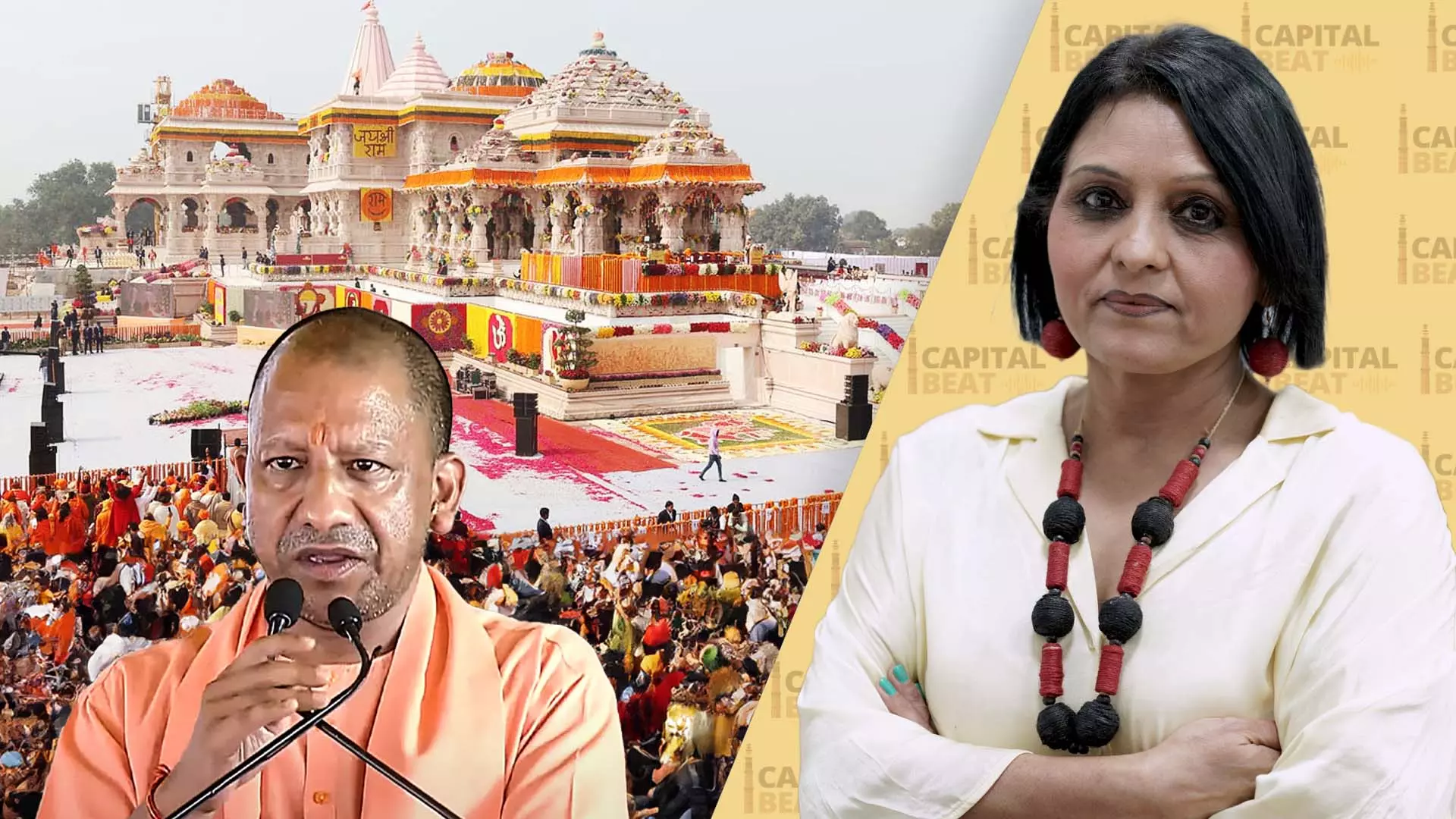
The Federal spoke with Sharat Pradhan, author and political commentator, and Sarvesh Tripathi, national spokesperson of the Samajwadi Party, in this episode of Capital Beat regarding the widening administrative and political rift between Lucknow and New Delhi over the control and accountability of the Shri Ram Janmabhoomi Teerth Kshetra Trust.
Historically dominated by the RSS and the Vishva Hindu Parishad (VHP), with many functionaries personally recommended by Prime Minister Narendra Modi, the trust has become a battleground for political assertion.
The ongoing investigation into financial irregularities has provided Adityanath an opportunity to assert his position as an uncompromising face of Hindutva ahead of the 2027 Uttar Pradesh Assembly elections, countering his initial exclusion from the trust's inner decision-making processes.
Political rifts and the ouster of Champat Rai
The administrative friction is highly visible between Lucknow and New Delhi, rooted in historical exclusions from the temple management structure. Former trust general secretary Champat Rai was instrumental in ensuring Adityanath was kept out of the temple trust, despite the historical involvement of the Gorakhnath Math in the temple movement, specifically through Adityanath’s predecessors, Mahant Avaidyanath and Mahant Digvijay Nath.
"Yogi always felt sidelined," stated Pradhan, adding that "this feud has been going on between Delhi and Lucknow." He noted that Rai reported directly to New Delhi, acting as the primary executor of the trust's decisions with direct patronage from Union Home Minister Amit Shah and Prime Minister Modi.
Also read: Ram temple donation scam: Why is Congress not cashing in on BJP's crisis?
The conflict has escalated to a point where the central leadership face tight electoral constraints. While the central command cannot afford to replace Adityanath so close to the elections, the chief minister has utilised the investigation to signal that his administration will not compromise on institutional corruption, effectively forcing Rai's resignation.
Administrative deflections and the role of SIT
The central leadership's initial response to the controversy involved extending institutional protection to the trust management. The temple's construction committee chairman, Nripendra Misra, initially distanced himself from the trust's internal operations, only to publicly defend Rai within 24 hours, reflecting New Delhi's desire to shield the trust's top executives.
I guess time is up for Champat Rai. He will become the sacrificial lamb.
"The way in which he gave a clean chit to Champat Rai clearly shows that he is directed by his bosses to protect the latter," observed Pradhan, pointing out the inherent conflict of interest, given Misra's institutional ties and familial political affiliations with the BJP.
The SIT constituted by the state government operates under heavy constraints, as the IAS and IPS officers on the panel remain subject to dual pressures from both the state and the central cadre-controlling authorities. The bureaucratic tug-of-war has raised serious doubts about whether the investigation will ever target the high-level management or if it will remain confined to lower-level functionaries.
Marginalisation of state leadership
The state leadership's current assertiveness highlights a deeper sense of political marginalisation, where the credit for the temple's construction was entirely centralised by New Delhi during the Ram Lalla idol's Pran Pratishtha (consecration) ceremony at the temple in January 2024, leaving regional leaders sidelined.
The political benefits of the temple movement have been systematically consolidated by the Prime Minister's Office, leaving the state administration to manage the fallout of the current financial scandal without having shared in the initial administrative control.
"This design is very deeply rooted and Yogi ji was nowhere in the design," stated Tripathi, adding that the chief minister "has been played badly by the Centre".
Also read: Ayodhya Ram temple theft probe turns spotlight on Mishra family’s ‘wealth surge’
He noted that while the central leadership monopolised the political credit during the temple's inauguration, the state administration is now left to manage the public backlash.
The structural distribution of power has ensured that the central government retains absolute authority over national religious projects, leaving the state government with all the electoral risks and none of the administrative control. This structural imbalance has fuelled internal frustration within the state leadership as they attempt to protect their political prospects for 2027.
Financial fraud and deflection to new religious fronts
The ongoing investigation has led to tactical shifts in the state's political narrative, with an increasing administrative focus being directed towards Mathura, another religious centre in the state, to divert public attention from the financial irregularities in Ayodhya.
The systemic pilferage of millions in donations has severely embarrassed the ruling establishment, forcing both the state and central factions to seek alternative religious narratives to sustain momentum.
"The whole idea is to divert the attention from this," Pradhan said, explaining that shifting the political focus towards Mathura is a calculated move to alter the public discourse. According to him, neither New Delhi nor Lucknow desires the full extent of the financial mismanagement to remain in the public domain.
Also read: Nripendra Mishra's shifting defences on Ram temple row: Genuine or managed?
The legal fallout has expanded to local institutions, with the Faizabad Bar Association formally resolving not to represent any of the accused in the embezzlement case, imposing a fine of five lakh rupees on any member who violates the directive. Despite this local outrage, the investigation has primarily targeted low-wage, contractual bank employees rather than the senior trust officials responsible for systemic oversight.
The sacrificial strategy and the trust's future
The final outcome of the investigation is widely expected to involve the legal sacrifice of intermediate officials to protect the highest levels of political and organisational leadership in New Delhi. Contractual employees and administrative staff members are being treated as the primary culprits, while the systemic lack of standard operating procedures highlighted in early audits remains unaddressed.
"I guess time is up for Champat Rai. He will become the sacrificial lamb," stated Tripathi, arguing that the central leadership will absorb the former's resignation as a moral victory while preserving its core influence over the trust.
Tripathi concluded that the structural control of the temple will remain firmly within the domain of New Delhi, irrespective of the state’s investigative efforts.
The political survival of the state leadership now depends entirely on its ability to decouple itself from the corruption allegations, while maintaining its core voter base. As the SIT continues its selective raids, the structural divide between Lucknow and New Delhi over the financial and administrative custody of Ayodhya’s institutional wealth remains unresolved.
The content above has been transcribed from video using a fine-tuned AI model. To ensure accuracy, quality, and editorial integrity, we employ a Human-In-The-Loop (HITL) process. While AI assists in creating the initial draft, our experienced editorial team carefully reviews, edits, and refines the content before publication. At The Federal, we combine the efficiency of AI with the expertise of human editors to deliver reliable and insightful journalism.