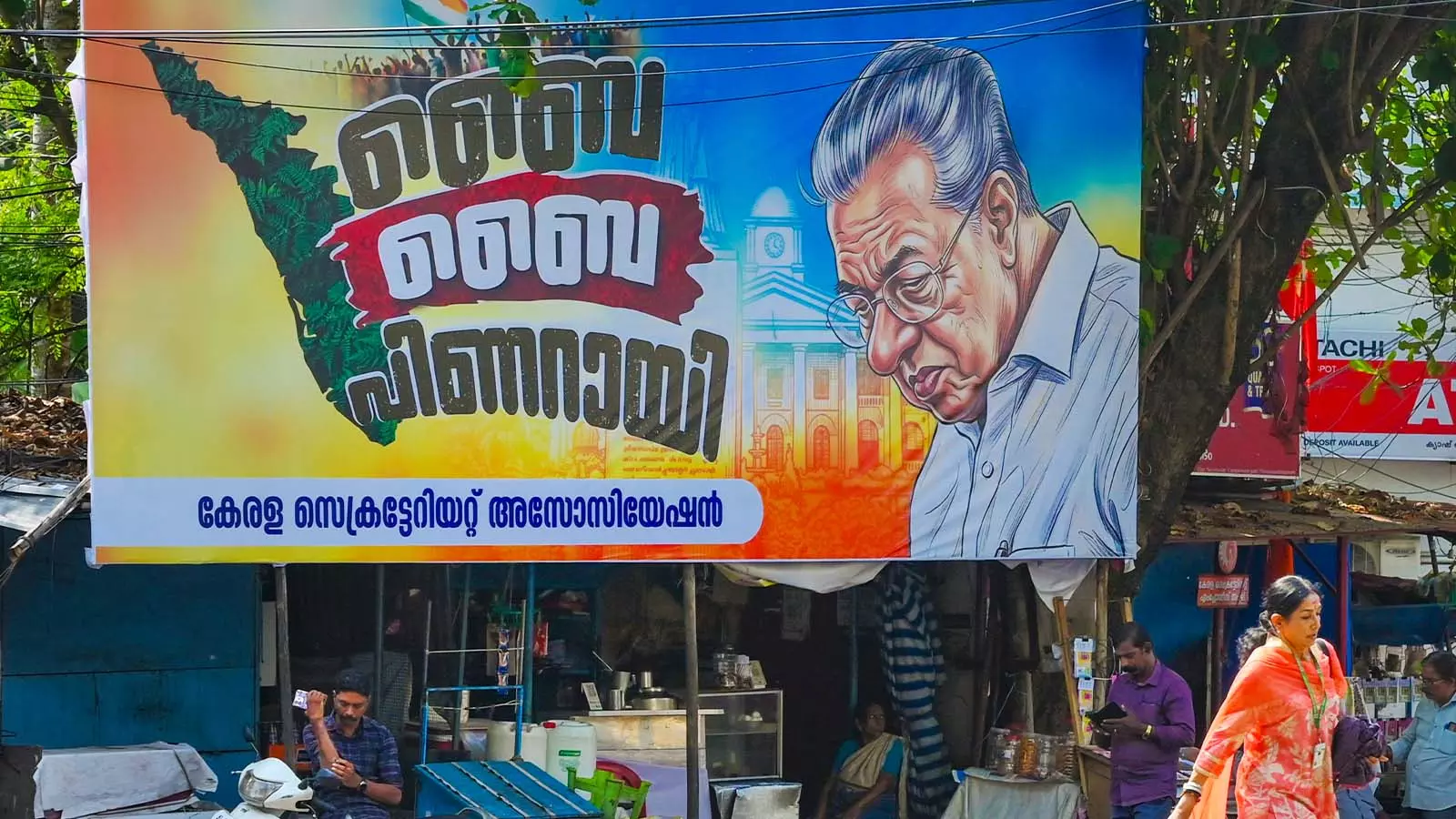
A flex board put up by the Kerala Secretariat Association reading 'Bye Bye Pinarayi' after the Left Democratic Front's (LDF) defeat in the Assembly elections, in Thiruvananthapuram, Tuesday, May 5. PTI
Kerala election results: What led to LDF's rout and what next for the Left?
The Left Democratic Front’s (LDF) defeat in Kerala is being seen as its biggest since its formation in 1979-80. Parallel to that is the scale of the United Democratic Front’s (UDF) victory. Crossing the 100-seat mark in a 140-member Assembly is not routine in Kerala’s bipolar politics

Payyannur in Kannur district had, for decades, stood as one of the most unshakeable fortresses of the Communist party in Kerala. None other than a communist party member had ever represented the constituency. That record fell this time, and in a manner that underlines the depth of the Left’s crisis. K Kunhikrishnan, a recently expelled CPI(M) leader, won the seat with the backing of the UDF. So did Thaliparamba, where another expelled district committee member, TK Govindan, defeated PK Shyamala, the wife of state secretary MV Govindan.
Also read: Kerala Minister Sivankutty alleges UDF-BJP nexus behind his defeat in Nemom
These developments need to be read alongside defeats in constituencies like Trikkaripur, which had never elected non-communist representatives before. In Kannur, the ideological heartland of the CPI(M), the results point to something more than routine anti-incumbency. Even Chief Minister Pinarayi Vijayan was trailing in Dharmadam in the initial rounds of counting, a rare occurrence in a constituency long seen as secure.
Biggest defeat since 1979-80
What is perhaps more telling is that sections of the Opposition had anticipated this shift, while parts of the CPI(M)’s grassroots machinery did not. This suggests a gap between leadership perception and ground reality.
The Left Democratic Front’s (LDF) defeat in Kerala is being seen as its biggest since its formation in 1979-80. Parallel to that is the scale of the United Democratic Front’s (UDF) victory. Crossing the 100-seat mark in a 140-member Assembly is not routine in Kerala’s bipolar politics. The last time any Front managed that was in 1977, when the Congress-led alliance swept the state in the aftermath of the Emergency, even as it faced defeat elsewhere in India.
Also read: Opposition deficit, rather than BJP triumph, is the message
One immediate embarrassment has been the BJP winning three seats at the expense of the LDF. While the Left can point out that the UDF was pushed to third place in those constituencies, it cannot avoid the more uncomfortable conclusion that its own vote erosion created the space for the BJP’s entry, at least in one constituency, Chathanoor.
Introspection begins
Within the CPI(M), a process of introspection has already begun, even if informally. Senior leader TM Thomas Isaac offered one of the first detailed responses in a Facebook post soon after the results, combining a defence of governance with an admission of political setbacks: “It is clear that the UDF’s propaganda gained the upper hand. One of them was the baseless campaign about a BJP-LDF deal. It still remains to be examined at whose expense the BJP’s three-seat victory came. In all three constituencies, the LDF finished second. At the same time, it is evident that a section of Left sympathisers voted for the UDF in some constituencies. The vote leakage from several of our strongholds is proof of this. This also indicates that the corrective measures we undertook after the Lok Sabha elections did not achieve the desired results.”
That admission is critical. The erosion was not limited to swing voters. It extended into the party’s own support base.
Unease among minority voters
One of the dominant explanations for this shift is what many describe as a failed attempt at social engineering. After the 2024 Lok Sabha elections, where minority voters, particularly Muslims, had moved decisively towards the UDF, the CPI(M) appeared to recalibrate. There was an effort to broaden its appeal among sections of the majority community. However, this recalibration seems to have unsettled its traditional support base without yielding compensatory gains.
Also read: How UDF won Kerala after a decade: From 'total disarray' to total dominance
The perceived proximity of Vijayan to Vellappally Natesan, the controversial Ezhava community leader, became a point of contention. Known for his sharp remarks against Muslim organisations and at times Muslims in general, his engagement with the Left leadership created unease among minority voters.
The fallout with senior leader G Sudhakaran in Alappuzha is now seen as having had electoral consequences, potentially costing the party multiple seats in the district.
Yet, the erosion was not confined to minorities. There was also a visible drift among sections of OBC voters, particularly in south Kerala districts like Alappuzha and Kollam. These communities have historically formed an important pillar of Left support. Their partial disengagement points to a broader weakening of the coalition that sustained the CPI(M) over decades.
Handling of Sabarimala temple issue
As Dr. B Ekbal, former member of the state planning board, points out: “The setback in the 2024 parliamentary elections and the drift of a section of traditional voters towards the BJP put the Left under severe pressure. Many of the positions it adopted to prevent this vote erosion created a perception in society that the Left was moving away from its secular values. At the same time, the government’s handling of the Sabarimala issue did not go well, and corruption allegations against senior leaders further affected its image. Controversies related to events like the Global Ayyappa Meet and the gold smuggling case pushed the government into a defensive position.”
Internal dissent compounded these challenges. The fallout with senior leader G Sudhakaran in Alappuzha is now seen as having had electoral consequences, potentially costing the party multiple seats in the district.
“The fact that some LDF MLAs and former MLAs contested the election as Congress or BJP candidates dealt a severe blow. There were also major lapses in candidate selection. There was criticism that youth and women were overlooked. While those who had contested twice were given another chance, some popular leaders were dropped, and others were shifted to less favourable constituencies, creating dissatisfaction among voters,” adds Dr. Ekbal.
Ideological clarity
Organisational questions are now coming to the fore. Critics within the broader Left ecosystem point to an increasing centralisation of power. The rise of Vijayan as a dominant figure has, in this view, altered the party’s internal balance, reducing the scope for collective functioning.
The CPI(M) leadership has acknowledged the need for introspection. General secretary MA Baby has stated that the party respects the verdict and will undertake a serious review of the reasons behind the defeat.
There is also a debate around ideological clarity. Academic and fellow traveller PK Pokker frames it sharply: “Historically, the strength of the Left has rested on ideological clarity and a distinct political identity. In recent years, however, there has been a growing perception of dilution. The shift in tone and approach appeared, at times, to blur the line between Left politics and positions associated with Hindutva. This perceived erosion of difference has unsettled core supporters and weakened the moral distinctiveness that once defined the movement.”
Such critiques highlight a broader challenge. The Left’s appeal has historically rested not just on governance, but on a moral and ideological position. Any perceived dilution of that identity can have consequences beyond immediate electoral outcomes.
MA Baby: Corrective measures will follow
“In West Bengal, towards the final phase of Left Front rule, a consolidation among Muslim voters had begun well before the Singur agitation led by Mamata Banerjee. That shift was later harnessed politically, helping turn minorities against the Left and paving the way for regime change. The BJP, in turn, expanded by accusing the new dispensation of minority appeasement. A similar trajectory, could emerge in Kerala. The Congress-led UDF’s victory has been powered by a consolidation of Muslim and Christian votes against the Left. If this perception of minority alignment hardens, it could open space for the BJP to mobilise Hindu voters on a counter-narrative of appeasement. In such a scenario, sections of the Christian community may also realign tactically, complicating the Congress’s position,” opines Varghese Koshy, senior journalist and political observer.
The CPI(M) leadership has acknowledged the need for introspection. General secretary MA Baby has stated that the party respects the verdict and will undertake a serious review of the reasons behind the defeat. He has emphasised that corrective measures will follow, even as the party continues its political struggles in defence of secularism and democratic rights. However, past experience shows that such course correction is far from easy for the Left in Kerala.