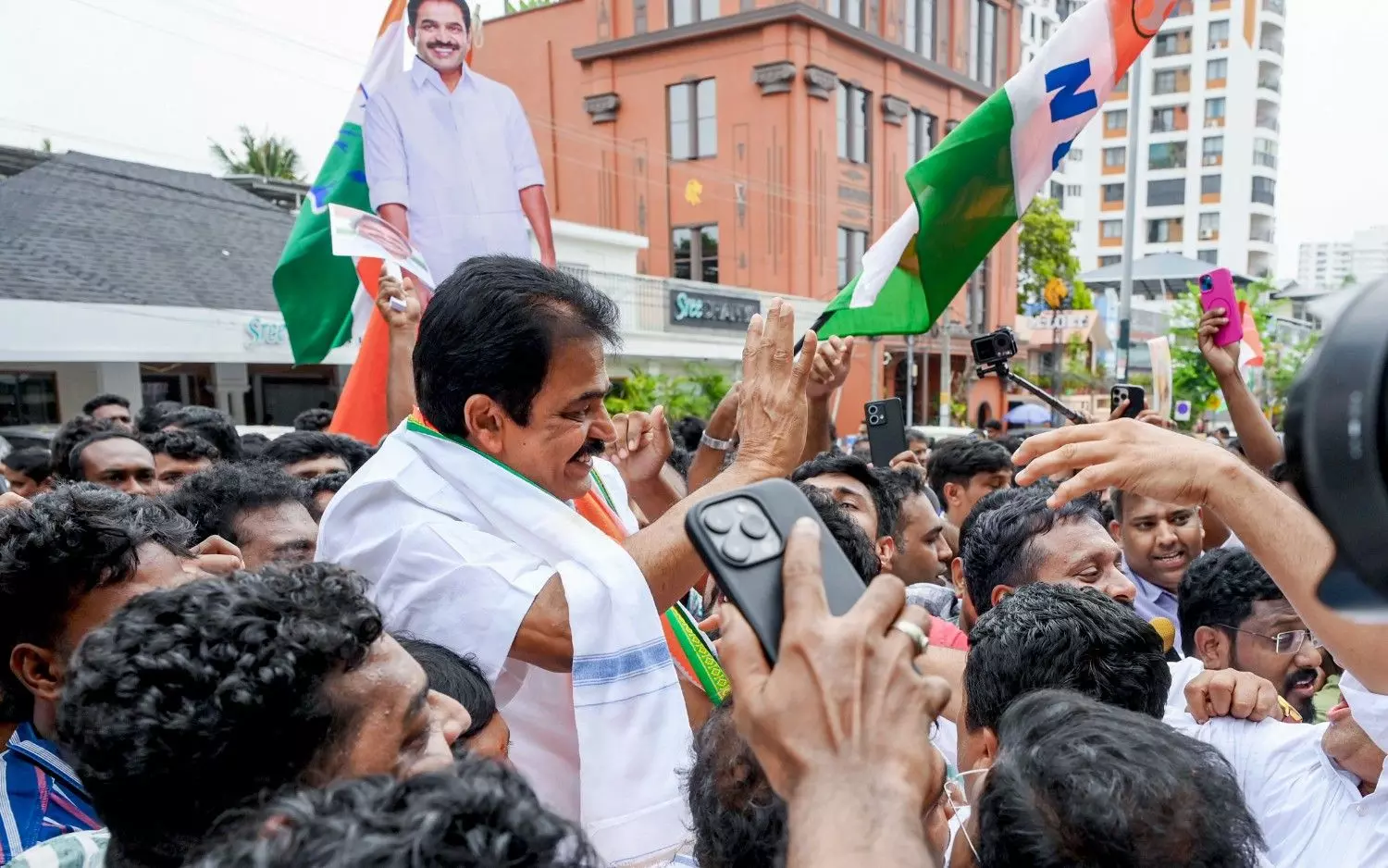
Congress MP KC Venugopal celebrates with party workers as the party-led UDF takes lead during the Kerala Assembly elections in Thiruvananthapuram on Monday, May 4, 2026. Photo: PTI
How UDF won Kerala after a decade: From 'total disarray' to total dominance
The Congress-led alliance returns to power, completing a methodical transition from a fragmented 'confederation of parties' to a unified social formation

A day before Kerala went to elections on April 9, state Opposition leader VD Satheesan said the United Democratic Front (UDF) was rebuilt patiently from scratch, and although the process took time, the results were showing.
Follow 2026 Assembly Election Results here
The Congress veteran’s words were not too off the mark when the trends came out on Monday (May 4) as the UDF was on course to return to power in Thiruvananthapuram after a gap of a decade.
'UDF a broader social formation'
“When I took charge of the UDF in Kerala, it was in total disarray. But we worked from scratch, patiently. It took some years, but the results are showing. The Lok Sabha election sweep, the by-elections, the LSG results, it has a pattern,” Satheesan told The Federal on the eve of the election.
“We could gather back all the sections that left us post-2001 to our fold, which include even left-leaning voters. Now the UDF is not merely a confederation of parties but a broader social formation,” he added.
The UDF’s victory in Kerala is not a sudden electoral upswing. It is the culmination of a slow, methodical rebuilding process that has been underway for several years.
Also read: With Pinarayi's LDF loss in Kerala, India left with no Left-ruled state
What makes this win significant is not just the scale, but the pattern behind it. From the Lok Sabha sweep to by-election gains and local self-government victories in the last few years, the UDF’s resurgence has followed a clear trajectory. This election only completes that arc.
UDF turned into cohesive unit
The key to this UDF victory is its ability to transform itself from a fragmented alliance into a cohesive political platform. For a long period, the UDF struggled with internal contradictions, leadership ambiguities, and a perception that it lacked ideological clarity.
But, under Satheesan’s leadership, the front has projected a more militant face, with sharper messaging and better coordination among its constituents.
The most crucial element of this transformation has been the rebuilding of its social coalition.
Historically, the UDF’s strength has come from a combination of minorities, the forward communities, and the urban middle classes. Over the years, parts of this coalition had drifted away, particularly after the early 2000s.
The current victory indicates that the UDF has been able to reclaim much of that lost ground.
Also read: Fall of the 'Captain': Pinarayi Vijayan's eventful decade-long run ends
Minority consolidation played a decisive role. Muslim and Christian voters, who form a significant part of Kerala’s electorate, appear to have rallied behind the UDF in large numbers. This was not merely a passive shift but the result of sustained political outreach.
The UDF positioned itself as the most credible counter to the BJP, while also seeding doubts about the LDF’s stance.
In a political climate where national issues increasingly shape state-level choices, that positioning proved effective. At the same time, the UDF expanded beyond its traditional base. One of the more striking aspects of this election is the degree to which it attracted support from sections that have historically leaned towards the Left.
Left dissenters helped UDF
This includes not just floating voters, but even segments with ideological proximity to the CPI(M). The ability to draw such support suggests that the UDF’s appeal was not limited to identity or community considerations but extended to a broader dissatisfaction with the incumbent government. The outreach to Left dissidents was another key factor, an experiment that has yielded rich returns.
Over the past few years, several leaders and local influencers who were once part of the CPI(M) or aligned with it found their way into the UDF camp. This was not accidental. It was part of a deliberate strategy to weaken the Left from within while strengthening the Congress-led alliance's grassroots presence. These dissidents brought with them not only personal credibility but also organisational insight, which proved valuable during the campaign.
UDF had a positive audience
Equally important was the UDF’s engagement with public discourse. Kerala’s political environment is deeply influenced by media narratives, intellectual debates, and civil society voices. The UDF managed to position itself as a democratic and inclusive alternative, contrasting its approach with what it portrayed as an increasingly centralised and inaccessible leadership in the LDF. This narrative found resonance among sections of the intelligentsia and urban voters, contributing to a favourable opinion climate.
The front’s campaign strategy also reflected a level of discipline that had been missing in earlier elections.
Another factor that worked in the UDF’s favour was its ability to adapt to the changing nature of Kerala’s electorate. The state is witnessing shifts in social and political behaviour, with identity, aspiration, and governance all playing a role in shaping voter preferences. The UDF appears to have recognised these changes and adjusted its strategy accordingly.
Also read: Bengal's Didi shield cracks: How Mamata Banerjee lost the state she dominated
By presenting itself as both a protector of minority interests and a platform for broader social inclusion, it was able to appeal to diverse groups.
The cumulative effect of these efforts is what Satheesan described as a transition from a “confederation of parties” to a “broader social formation.” This is perhaps the most important takeaway from the election.
The UDF is no longer seen merely as an electoral alliance that comes together during polls, but as a more integrated political force with a wider social base.
Also read: Bengal giant killer’s gambit: Suvendu Adhikari and the BJP’s breakthrough
It is also worth noting that this victory is not solely the result of the LDF’s weaknesses. Elections are not won by default; they are won by building and presenting a convincing narrative. In this case, the UDF managed to do both.
In the final analysis, this election marks a turning point for the UDF. It validates a long-term strategy built on patience, organisational rebuilding, and social outreach.
Satheesan’s words are not just a reflection of political optimism, but a summary of a process that has now delivered tangible results.