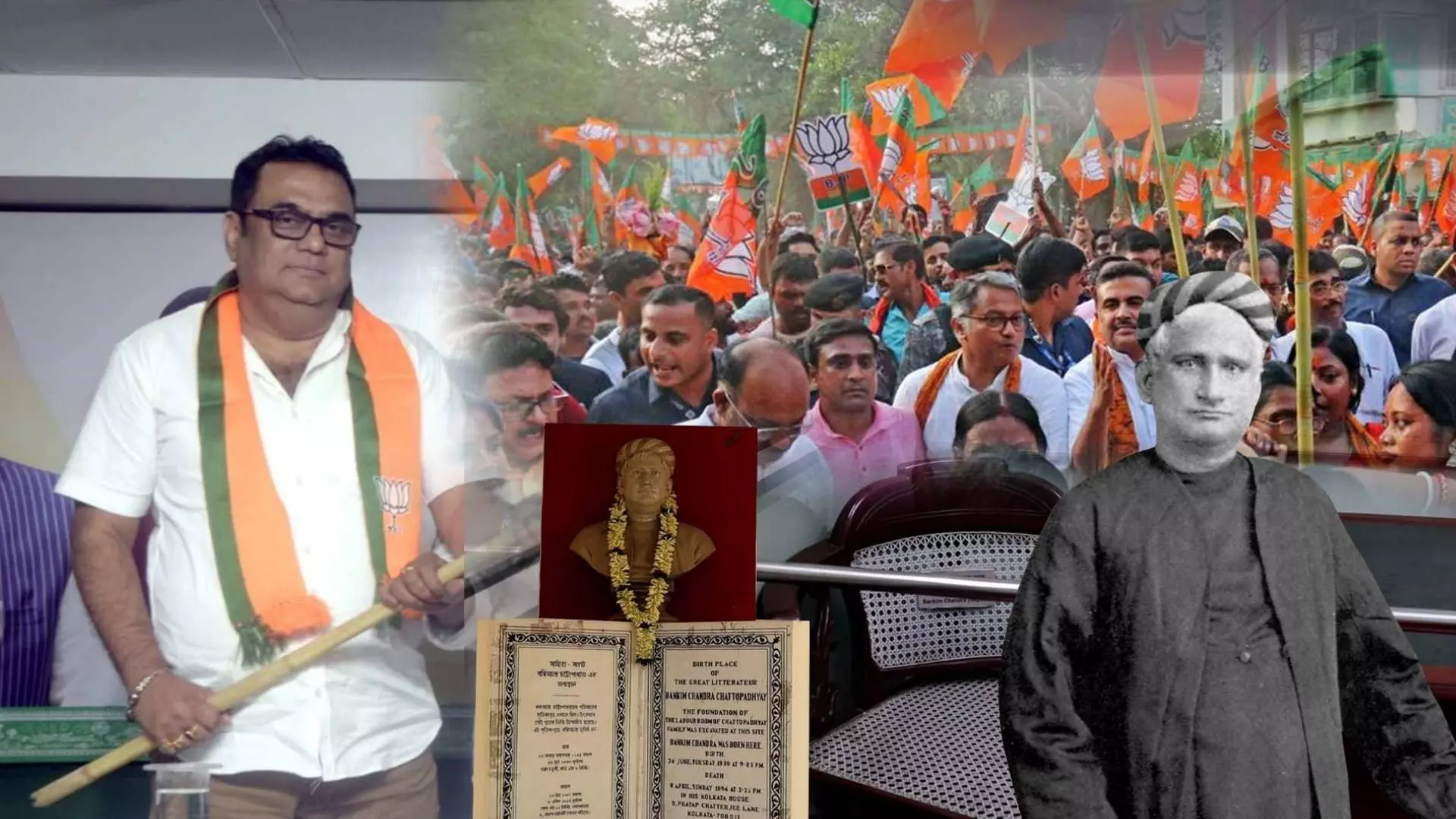
After Vande Mataram, it's Bankim: Electoral politics heats up in Bengal's Naihati
The TMC and BJP battle over Bankim Chandra Chattopadhyay’s legacy as history, identity, and elections collide. Who owns Bengal’s cultural icons?

The battle over the creation was already on. Now, it's over the creator.
After the face-off between the Bharatiya Janata Party (BJP), including Prime Minister Narendra Modi, and the Trinamool Congress (TMC), on the occasion of the 150th anniversary of the National Song, "Vande Mataram", last year, the focus has now shifted over to Bankim Chandra Chattopadhyay, the composer, as West Bengal heads to the second phase of its Assembly elections on April 29.
Also read: Bengal's battle for Bankim: BJP localises nationalist pitch to counter TMC in Naihati
Naihati seat in focus
As the TMC, the state's ruling party, and the BJP, its main opposition, fight over invoking the 19th-century literary doyen's cultural significance to strengthen their respective electoral narratives, the Assembly constituency of Naihati in southern Bengal's North 24 Parganas district has also stolen the limelight.
While Naihati has remained a TMC fortress since 2011, when it first came to power, the BJP has fielded Sumitra Chattopadhyay, a descendant of Bankim Chandra, to cash in on the lineage.
At street-corner rallies in Naihati, BJP leaders repeatedly highlight their candidate’s connection to Bankim Chandra’s family, presenting it as a symbol of nationalist and cultural continuity. The campaign has linked this directly to the legacy of “Vande Mataram”.
Also read: Bengal's high turnout signals pro-incumbency, says Netaji kin Chandra Bose | Interview
To understand why this matters, one must look at Naihati’s deep historical ties to Bankim Chandra. His ancestral home in the town's Kanthalpara neighbourhood remains a significant cultural landmark, with curators and historians emphasising that the site is not merely a family property but a national intellectual heritage.
Historical roots
Bankim Chandra’s house in Kanthalpara, which is closely associated with his literary career, including the writing of “Vande Mataram,” has long been considered a symbol of Bengal’s literary renaissance.
“This house is not just Bankim Chandra Chattopadhyay’s house. It belongs to all of India,” a curator noted, underscoring its broader national importance.
For generations, the house has served as a reminder of Bankim Chandra’s contribution to literature, nationalism, and Bengali identity. But in the current election climate, that legacy is increasingly being used for political messaging.
Election battle
The BJP’s strategy in Naihati reflects a broader push to anchor its nationalist politics in Bengal’s cultural history. By foregrounding Bankim Chandra’s family connection, the party seeks to align itself with Bengal’s intellectual icons while reinforcing its ideological narrative around “Vande Mataram”.
The TMC, however, has pushed back strongly, accusing the BJP of selectively politicising the litterateur's memory for electoral gain. TMC leaders have also raised allegations against the BJP candidate, arguing that cultural symbolism should not overshadow accountability.
Legacy debate
Academics and historians caution against reducing Bankim Chandra solely to present-day political narratives. They argue that while he was undeniably rooted in his cultural and religious context, his work should be viewed through a broader intellectual and historical lens.
“Bankim Chandra was definitely a Hindu, but understanding him only politically ignores his wider literary and philosophical significance,” one academic observed.
Also read: Who holds the edge in TN and West Bengal elections amid high turnout? | Capital Beat
On the ground, Naihati’s voters remain divided. While many see Bankim Chandra as inseparable from the town’s identity, others argue elections should focus more on present-day governance than symbolic heritage.
Naihati’s contest reflects how Bengal’s historical icons continue to shape contemporary politics, with parties increasingly turning to culture, nationalism, and identity to influence voter sentiment.
Campaigning in Naihati, which will go to polls along with 141 other seats in the state, will conclude on Monday (April 27). The first phase of polling was held on April 23.
The content above has been transcribed from video using a fine-tuned AI model. To ensure accuracy, quality, and editorial integrity, we employ a Human-In-The-Loop (HITL) process. While AI assists in creating the initial draft, our experienced editorial team carefully reviews, edits, and refines the content before publication. At The Federal, we combine the efficiency of AI with the expertise of human editors to deliver reliable and insightful journalism.