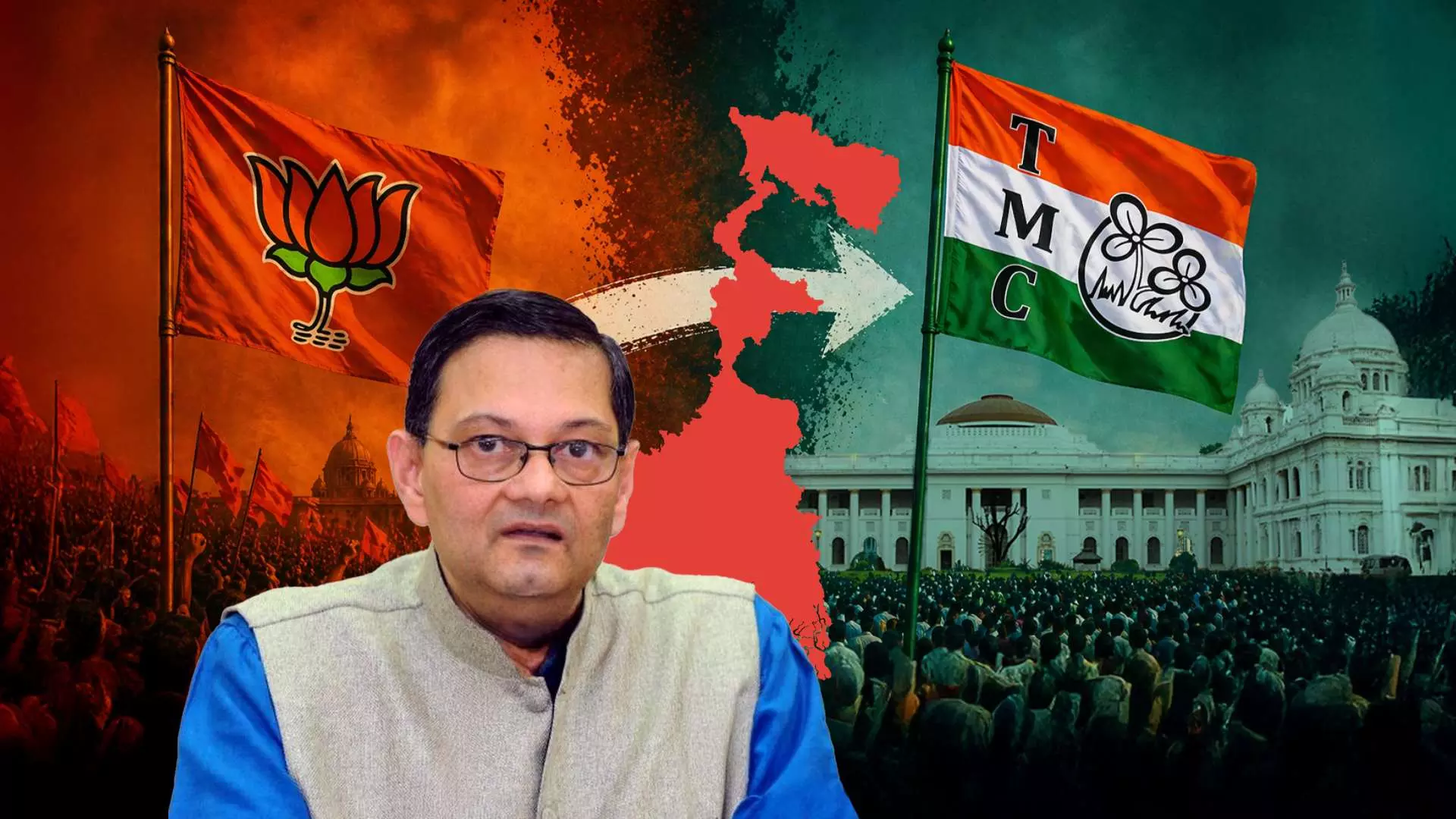
Chandra Kumar Bose, grandnephew of Netaji Subhas Chandra Bose, has joined the Trinamool Congress ahead of the 2026 Bengal elections.
Bengal's high turnout signals pro-incumbency, says Netaji kin Chandra Bose | Interview
Explaining his shift from the BJP, the TMC leader said the saffron party's strategy on voter roll revisions backfired, helping Mamata Banerjee

The high voter turnout in the first phase of polling in West Bengal on April 23 is not a sign of political change but reflects structural factors and growing support for the state's ruling Trinamool Congress (TMC), with the opposition’s strategy “backfiring,” feels Chandra Kumar Bose, the grandnephew of iconic Indian freedom fighter Netaji Subhas Chandra Bose and a member of the TMC.
Also read: Last-minute additions in Bengal rolls proof of faulty SIR exercise? AI With Sanket
Bose was earlier in the Bharatiya Janata Party (BJP), where he served as its vice president in Bengal, and also contested the 2016 state polls (in which he took on Chief Minister Mamata Banerjee) and the 2019 Lok Sabha elections. He joined the state's ruling party earlier this month and said the decision to join the BJP was a "historic mistake".
The Federal spoke with Bose on the evolving political landscape in the state, his shift from the BJP, which he quit in 2023, and the larger national implications. His remarks come amid a heated electoral battle in Bengal marked by allegations over voter roll revisions, governance, and political realignment.
Here are some excerpts from the interview
What explains the unusually high voter turnout in the first phase, and does it indicate a political shift?
If you see historically, Bengal elections have always had very high turnout, and that has not necessarily brought about a change in government. In 2011, 2016, and 2021, turnout was above 80 per cent. This time it is higher, and there could be two reasons.
One is the Special Intensive Revision (SIR). Around a crore voters have been deleted from the electoral rolls. So, if the same number of people voted but the total voter base has reduced, the percentage will automatically rise.
The second reason is the large number of women voters coming out. Women have always been active, but this time the numbers are significantly higher. Many women are supporting the TMC and Mamata Banerjee due to her schemes.
There is also fear among voters that they might lose their voting rights due to confusion around the SIR process. People felt they must come out and vote to protect their rights.
I consider joining the BJP a historic mistake, which I have now corrected by joining Mamata Banerjee, whom I see as an inclusive leader.
From what I have observed, despite anti-incumbency factors, the first phase appears pro-TMC and pro-Mamata Banerjee.
Did large-scale transfers of officials and external deployment affect the election process?
During elections, the Election Commission takes charge of governance, including police and law and order. But we have never seen such large-scale transfers at senior levels.
This sends a wrong message that the existing bureaucracy cannot be trusted. It creates divisions—“our people” versus “your people”. That is very unfortunate.
Also read: Second disenfranchisement? Travel hurdles rob Bengal’s migrant workers of their votes
Government officials are supposed to serve the Constitution, not any political entity. These transfers were unnecessary and have weakened the morale of the bureaucracy and police force.
Has the TMC retained its support base, especially in regions where the BJP was strong earlier?
The first phase covered North Bengal, where the BJP had some support earlier. But this time, they are on the back foot because they have not built a strong organisation.
Their divisive politics and mixing religion with governance are not appreciated in Bengal. Bengalis are spiritual, but they do not want religion in politics.
In South Bengal, the TMC remains very strong. The BJP lacks organisation there and does not have a chief ministerial face. Bengal's voters look for leadership. Mamata Banerjee is a mass leader who connects with people. BJP has not produced anyone of her stature.
Has the voter roll revision (SIR) affected TMC’s prospects?
The way the SIR was conducted suggests an attempt to delete the TMC’s vote bank. But it has backfired. Many Hindu voters have also been removed.
There were claims about large numbers of Rohingyas, but no evidence has been shown. Even respected families, freedom fighters’ descendants, and professionals were affected.
People in rural areas suffered the most—walking long distances, standing in queues, and even falling ill.
Overall, this exercise has angered people across communities. If you weigh the pros and cons, the TMC is benefiting because people see this as harassment.
Do you believe the voter deletions were a deliberate design to benefit the BJP?
It appears to be a deliberate design, but it has backfired.
People whose names were deleted, or whose relatives were affected, are unlikely to support the BJP now.
Also read: Can DMK retain power in TN and will TMC survive BJP challenge in Bengal? | Capital Beat
I cannot say with evidence that it was directed by the BJP, but it appears to be an attempt to gain an advantage. People of Bengal have understood this and will respond accordingly.
Is anti-incumbency a concern for the TMC after over a decade in power?
Any long-term government faces such issues, but the perception about Bengal has been wrongly projected.
Despite a lack of support from the Centre, the TMC has implemented over 100 schemes. Kanyashree has global recognition. Swasthya Sathi provides health coverage for all. Lakshmi Bhandar supports households.
We are third in GDP contribution among states. Claims of no business activity are incorrect.
Anti-incumbency is offset by development schemes and welfare delivery.
What prompted your shift from the BJP to the TMC?
I will be very frank. I supported Prime Minister Narendra Modi in 2014 for his development agenda. But many promises were not fulfilled.
Over time, I saw increasingly divisive politics. India is built on unity in diversity. The Constitution is inclusive in spirit.
I was promised an opportunity to promote Netaji Subhas Chandra Bose’s inclusive ideology through an Azad Hind platform, but that never happened even after seven years.
I realised BJP’s approach was against the inclusive spirit of the Constitution. I consider joining the BJP a historic mistake, which I have now corrected by joining Mamata Banerjee, whom I see as an inclusive leader.
How realistic is Mamata Banerjee’s call to unite opposition parties nationally?
This is a call for all like-minded, inclusive parties to unite for the nation, not for themselves.
India risks fragmentation if divisive politics continues. Bengal has historically shown the way, and it can do so again.
Before 2029, such unity is essential to preserve national integration and counter divisive forces.
What role do you see for yourself going forward?
I do not seek anything personally. If I can help unite inclusive leaders and parties across the country, that would be my role.
Also read: Bengal polls: Farmers’ distress in Malda turns into political ‘hot potato’ for TMC
I want to work towards preserving the unity of the nation, which leaders like Sarat Chandra Bose and Subhas Chandra Bose fought for.
That is my commitment.
The content above has been transcribed from video using a fine-tuned AI model. To ensure accuracy, quality, and editorial integrity, we employ a Human-In-The-Loop (HITL) process. While AI assists in creating the initial draft, our experienced editorial team carefully reviews, edits, and refines the content before publication. At The Federal, we combine the efficiency of AI with the expertise of human editors to deliver reliable and insightful journalism.