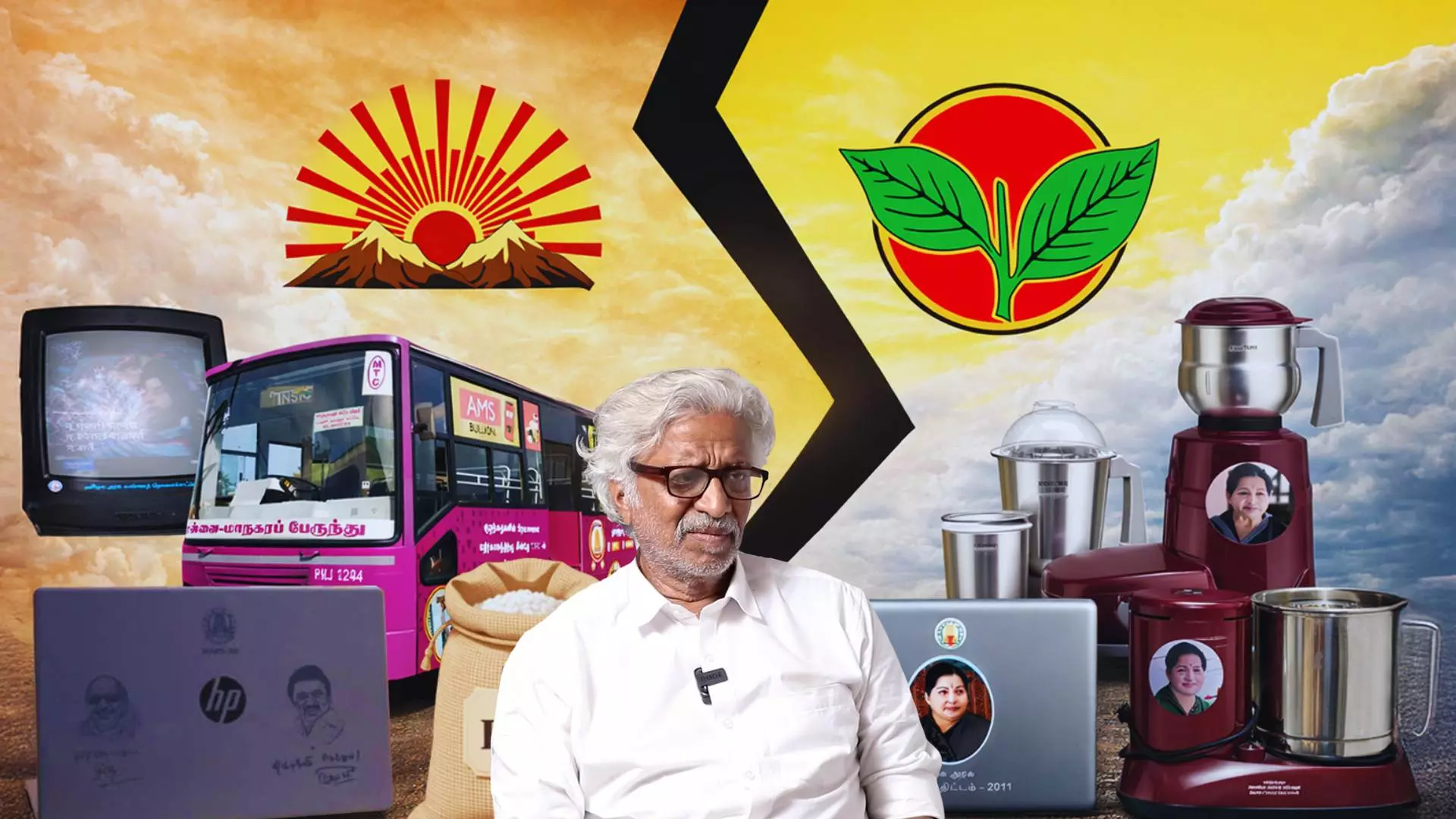
Welfare vs freebies: Political scientist Manivannan flags risks to TN’s growth
He warns that unchecked populism and poor fiscal discipline could undermine dignity, development, and long-term economic goals

Drawing a sharp line between welfare and freebies, political scientist Ramu Manivannan warns that poorly designed state support can “take away human dignity” instead of strengthening it.
As Tamil Nadu pushes ambitious economic goals while expanding welfare schemes, the debate over fiscal responsibility, federal tensions, and populism is intensifying. The Federal spoke to Manivannan on whether vision politics, welfare policies, and Centre-state friction are shaping or straining the state’s growth trajectory.
Do Tamil Nadu’s long-term vision statements reflect genuine growth intent or political image-building?
I think certainly, when you talk about policy planning, whether it is five-year plans or annual planning, it is all part of projection. I don’t see anything wrong in having a wish list or a vision statement for 2030 or 2035. The BJP has a vision for the country, and Dravidian leaders led by Stalin also have one for the state.
So, a vision statement is quite welcome for any state or political system. But whether projecting something like a $1 trillion economy is realistic is another matter. He has been talking about this for more than three years, and it is achievable with appropriate planning and efficient teamwork.
Also read: SC questions ‘freebies culture’, flags impact on economic development
However, there are concerns – deficit budgeting, overspending, and areas where there are no returns to the state. These must be identified. The government should not only project growth but also focus on cutting down weaknesses, shortcomings, and excesses in spending and policy.
Will friction with the Union government over funds affect Tamil Nadu’s growth?
Certainly, this is not just about the state; it affects the entire country. When the Centre denies funds meant for a state, whether it is RTE funds or sectoral allocations, it impacts overall national growth.
If the state government is under pressure due to lack of funds, the consequences are not limited to Tamil Nadu; they affect people across the country. The Centre must take a broader view.
At the same time, your question is relevant – why should a state undertake large welfare spending when funds from the Centre are limited? That is debatable. But if a state loses its ability to project new visions and demands, politics itself becomes stagnant.
We must, however, become more self-examining, especially about welfare policies and freebie programmes. We need to distinguish clearly between the two.
How do you distinguish between welfare and freebies?
As long as a policy contributes to human needs and human development, welfare has relevance. But when it takes away a person’s commitment to work, earn a livelihood, and preserve dignity, it becomes a freebie.
Also read: AIADMK’s poll promises put Tamil Nadu’s welfare politics, fiscal health in spotlight
Tamil Nadu has been travelling on a path where this distinction is blurred. The government must take responsibility to define it clearly.
The key question is: does a policy contribute to human development and dignity? If it simply creates dependency, it undermines dignity. That is where welfare turns into a freebie.
Has Tamil Nadu gone too far with populist schemes over the years?
Tamil Nadu has been a forerunner in such schemes – colour TVs, mixies, cycles, Pongal gifts, gas cylinders, even promises of washing machines.
Sometimes it feels self-degrading to reflect on this. Twenty or thirty years ago, people struggled to access basic necessities like rice or sugar. Today, we have a robust public distribution system.
Earlier, people worked throughout the year to make ends meet during festivals. Now, the situation has changed. Even government holidays are structured to allow extended travel around festivals.
We are moving in a different direction in understanding populism, efficiency, and economic productivity. I am not against welfare policies. Anything that contributes to human development and dignity is valid. But the same policies should not rob people of dignity.
We are standing on a very thin edge.
What should ideally qualify as a welfare scheme?
Any financial support that improves education, health, and family welfare qualifies. For example, incentives for children’s education or support for young women pursuing higher studies or competitive exams like UPSC or state civil services - that is, welfare.
On the other hand, if incentives remove motivation to work hard and achieve goals, they become counterproductive.
Also read: Rs 8,000 for TN women in 3 months: Is Stalin copying the Bihar model?
Take women’s self-help groups. The government must assess how funds have been used over the last 10–15 years. Have they improved family conditions? Have they led to savings or merely the circulation of loans?
If we don’t ask critical questions, welfare programmes risk becoming like World Bank schemes – detached and ineffective. That is the real danger.
Is the current government balancing welfare politics with its fight for state autonomy?
On one hand, fighting for state autonomy and rights in a federal system is essential. You cannot avoid that. Politics is always a combination of multiple issues.
On the other hand, welfare policies must be continuously evaluated. We must ask whether they are becoming liabilities.
Also read: 'Creating a class of parasites?': SC slams pre-poll freebies
The reality is that welfare can only be sustained if the state avoids falling into a debt trap. If revenue is insufficient and debt is rising, the government must rethink its approach.
Typically, states try to increase revenue through land registration, taxes, or tariffs. But I believe the government should focus on whether welfare spending is being recycled productively within communities.
There is very little follow-up or tracking of how funds are used. This is true not just in Tamil Nadu but across states in India.
For example, money given to self-help groups, how has it benefited families? Has it strengthened welfare outcomes? These questions are rarely examined.
Governments often treat such spending as part of vote-bank politics, especially targeting women voters. This attitude must change.
If the government provides good education, healthcare, and employment opportunities, people do not demand freebies. People are not looking for handouts, they want meaningful opportunities. And they are not going to be grateful for cash transfers alone, even in electoral terms.
(The content above has been transcribed from video using a fine-tuned AI model. To ensure accuracy, quality, and editorial integrity, we employ a Human-In-The-Loop (HITL) process. While AI assists in creating the initial draft, our experienced editorial team carefully reviews, edits, and refines the content before publication. At The Federal, we combine the efficiency of AI with the expertise of human editors to deliver reliable and insightful journalism.)