



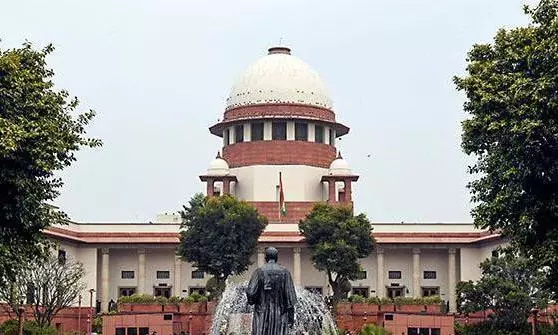
SC questions ‘freebies culture’, flags impact on economic development
Supreme Court questions rising “freebies culture”, flags economic impact, and asks states to prioritise development over universal welfare schemes

The Supreme Court on Thursday (February 19) criticised the freebies culture, stating that such a practice has an adverse impact on the country’s economic development. The remarks were made by a bench comprising Chief Justice Surya Kant and Justices Joymalya Bagchi and Vipul M Pancholi during the hearing of a plea by the Tamil Nadu Power Distribution Corporation Ltd, which proposed to provide free electricity to all, irrespective of the financial status of consumers.
The top court stated that although it was quite understandable if states hand-hold the poor, despite being revenue-deficient, most of the states were offering such freebies.
‘Why announce welfare scheme before elections’
The bench questioned the trend of welfare schemes being announced when elections are approaching, stating that it was high time for the political community to revisit such practices.
Also Read: SC issues notice to Centre on plea challenging 2023 data protection law
"Is it in the public interest that...the State is absorbing all these? Because of freebies, the entire country is already...we are not talking of Tamil Nadu in particular. We are talking of pan-India. What kind of culture are we developing? What is the distinction between persons who are capable of paying the electricity bill and persons who are marginalised?” said the CJI.
“ It is understandable that, as a welfare state, you want to provide relief to the marginalised. But without drawing any distinction between those who can afford and those who cannot afford, if you start giving, will it not amount to a sort of appeasing policy?" he added as quoted by Live Law.
‘We are sometimes really disturbed’
Expressing his displeasure over the freebies culture, the CJI asked that even if a state was revenue surplus, was it not its responsibility to utilise the funds for the development of the public.
Also Read: When Supreme Court had to remind India that women own their bodies
"We are sometimes really disturbed." "Even if you are a revenue surplus state, is it not your obligation to spend that amount for the development of the overall public, to develop roads, hospitals, and schools. Instead of that, you keep on distributing food, clothes, and people enjoy everything at the time of elections. What is happening in this country?" said the CJI.
Issues notice to Centre
The top court, however, issued notice to the Centre and others on the plea of the DMK government-led power distribution firm, which proposes to provide free electricity.
The power firm has challenged a rule of the Electricity Amendment Rules, 2024.
Also Read: Sonam Wangchuk case sparks debate on linking rights with duties
“What kind of culture are we developing in India? It is understandable that as part of the welfare measure you want to provide to those who are incapable of pay the electricity charges,” the bench asked.
“But without drawing a distinction between those who can afford and those who cannot, you start distributing. Will it not amount to an appeasing policy,” the CJI asked.
‘States should work on employment generation’
The bench asked as to why the Tamil Nadu firm suddenly decided to loosen the purse strings after the electricity tariff was notified.
“The states should work to open avenues for employment. If you start giving free food from morning to evening then free cycle, then free electricity then who will work and then what will happen to the work culture,” the CJI said.
The bench said states, instead of spending on development projects, do two jobs - paying salaries and distributing such largesse.
(With agency inputs)