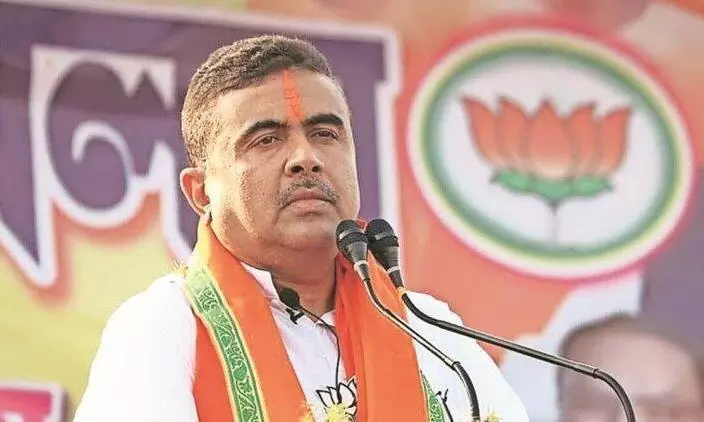
Bengal giant killer’s gambit: Suvendu Adhikari and the BJP’s breakthrough
From outgoing CM Mamata’s 'Man Friday' to the saffron party's principal strategist, Suvendu's journey mirrors the ideological shift of a state at a political crossroads

In Binandapur, a village in Nandigram in West Bengal draped in saffron flags and hand-painted “Jai Shri Ram” slogans, Opposition Leader Suvendu Adhikari paused mid-speech and pointed beyond the crowd.
“The BJP cannot campaign in Muslim villages,” he said, his voice rising as supporters pressed closer. “But the Trinamool can go in Hindu villages. Tell me, when will you unite?”
Follow 2026 Assembly election Live results here
The remark, delivered at a late-evening rally during the final stretch of campaigning during this election, captured both the tenor of this election and the evolution of the man making the appeal.
For Suvendu, this was not just another campaign in the constituency that shaped his political identity. It was a test of whether a leader forged in land protests and regional mobilisation could morph himself as the face of a broader ideological project, and carry it to power.
Suvendu Adhikari's past record as MLA
♦ Won from Contai South in East Midnapore in 2006 by 8,580 votes
♦ Won from Nandigram in East Mindapore in 2016 by 81,230 votes
♦ Won from Nandigram in 2021 by 1,956 votes (defeated Mamata Banerjee)
With the Bharatiya Janata Party (BJP) securing victory in Bengal, Suvendu emerges as its principal strategist and the leading contender to convert that win into governance, completing a political journey that both mirrors and rivals his former mentor, Mamata Banerjee.
Like the latter, who rose to national prominence after defeating Somnath Chatterjee in 1984, Suvendu built an image as a combative and relentless street fighter rooted in local struggles.
Also read: From land crusade heart, Nandigram emerges as Hindutva hub in Bengal | Ground Report
Both leaders showed a willingness to adapt ideology to political needs.
Mamata, once aligned with the BJP, later became its fiercest opponent, while Suvendu took the reverse path, becoming an ardent votary of the saffron party’s Hindutva ideology after being one of its staunchest critics.
His ties with Mamata had frayed by 2020 as within the TMC, power had become increasingly centralised around the chief minister and her nephew, Abhishek Banerjee.
Once Mamata's 'Man Friday'
Suvendu, once seen as indispensable in the TMC, found himself marginalised. His exit later that year was abrupt but not entirely unexpected.
What followed was one of the most consequential defections in Bengal’s recent politics.
Joining the BJP, Suvendu brought with him not just personal clout but a carefully cultivated cadre network, built over two decades of grassroots work.
Within months, he faced Mamata in Nandigram in the 2021 assembly election and defeated her, earning the tag of a “giant killer” and redefining his political identity.
That Nandigram victory did not deliver power to his new party. But it marked the beginning of his reinvention.
Suvendu and Nandigram
Few political careers in Bengal have been as intertwined with a place as that of Suvendu with Nandigram.
It was here, in 2007, that he emerged as one of the most visible leaders of the land movement, a farmers’ uprising that would eventually propel Mamata to power in 2011.
In those years, Suvendu was not just an ally but an enforcer of Banerjee’s political expansion, helping translate agitation into electoral gains across rural Bengal.
Also read: Bhabanipur battle hinges on caste-community math in high-stakes Mamata-Suvendu rematch
His organisational reach extended beyond East Midnapore and Nandigram into regions such as Jangalmahal, where he built networks that would become the backbone of the TMC’s rise.
Now, the terrain in Nandigram, however, had shifted. What was once the epicentre of a farmers’ movement has increasingly become, in political terms, a testing ground for a more assertive majoritarian narrative.
Suvendu’s campaign reflected that change.
At rallies across the constituency, his speeches were sharper, more ideological, often constructed around identity and polarisation.
Changed symbolism
The tone marked a clear departure from his earlier years in the TMC, when he freely participated in iftars and adopted the idioms of Bengal’s syncretic politics.
Now, the symbolism had changed. Temple visits, religious invocations and overt displays of Hindu identity became central to his campaign messaging, aligning closely with the BJP’s larger strategy while signalling his own political repositioning.
This time, Suvendu was not just fighting the opposition. He was confronting dissent from within his own past.
In Nandigram, he faced a challenge from a former aide who had switched back to the TMC, turning the contest into a battle of loyalties and networks.
The symbolism was hard to miss. The man who once built a movement now defends his ground against those who had once worked under him.
Also read: Bengal's battle for Bankim: BJP localises nationalist pitch to counter TMC in Naihati
The parallel with his mentor was striking even here, as Suvendu became a leading rival of Mamata, under whom he had once worked and flourished.
Beyond polarising rhetoric, throughout the campaign, both in Nandigram and Bhabanipur, where he is contesting in 2026, Suvendu displayed the traits that have also come to define his political style.
He remained deeply involved in the mechanics of the election, monitoring booth-level preparations, mobilising local cadres and maintaining a tight grip over organisational strategy.
Supporters describe him as disciplined and methodical, a leader who remembers names, villages and past grievances with unusual precision.
At the same time, he retained the confrontational edge that has marked his public persona.
Whether entering a police station to protest alleged excesses against party workers or attacking the state administration at rallies, Suvendu leaned into a politics of constant engagement and visible assertion.
Like Mamata, he likes confrontation
Like Mamata, he thrives on confrontation, uses symbolism as a political tool and adapts his ideological positioning to the demands of the moment.
Both leaders emerged from movements and built their politics on mobilisation rather than ideology, demonstrating over time a willingness to recalibrate when circumstances required it.
Unlike Mamata, however, Suvendu comes from a well-established political family. His father, Sisir Adhikari, was a senior Congress leader in Bengal before later joining the TMC, and the family traces its political lineage to freedom fighter Bipin Bihari Adhikari, giving junior Adhikari both an inherited network and a legacy that predates his own rise.
Also read: How Bengal is embracing a stronger Bengali identity with policies, protests
This legacy gave Suvendu a strong political platform in his family’s home turf of East Midnapore, where Nandigram is located.
But his challenge has always extended beyond his stronghold. While his base in East Midnapore remains formidable, the question hanging over his career has been whether that influence could be scaled across the state.
This election appears to have answered that question, at least for now.
A BJP victory suggests that Suvendu has succeeded in converting his localised network into a broader appeal, bridging organisational networks with ideological messaging.
The transition that now awaits him may be the most difficult of his career.