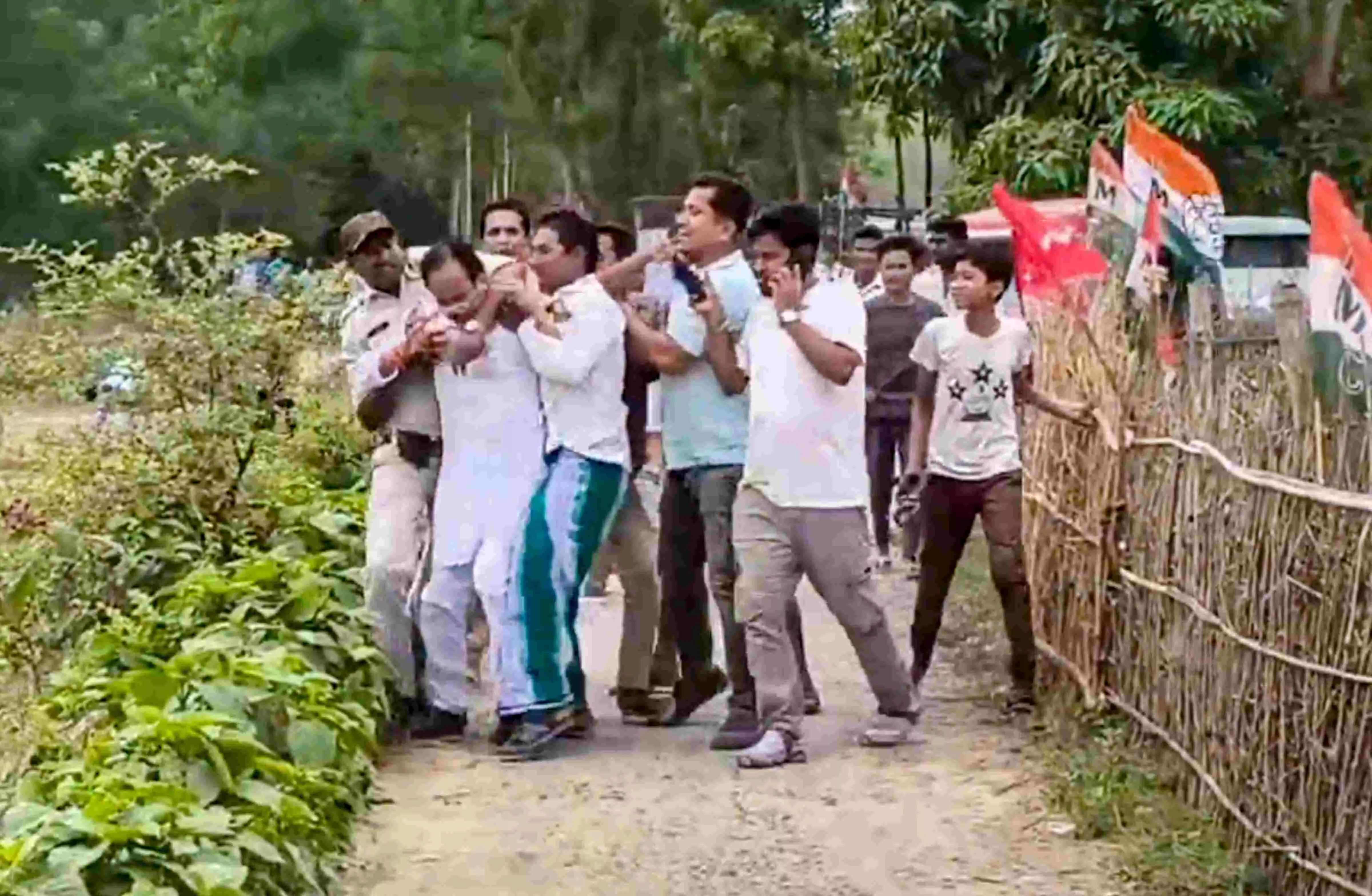
BJP candidate Suvendu Sarkar was manhandled while heading to a polling booth following reports of disturbances in Dakshin Dinajpur. Photo: PTI
Murshidabad blast, candidate assaults shadow Bengal's 90 per cent turnout
Analysts say the poll panel has failed to walk the talk despite the unprecedented number of security forces it deployed on the ground

A crude bomb blast in Murshidabad, attacks on candidates, reports of proxy voting and clashes echoed West Bengal’s familiar poll-day script on Thursday (April 23), despite unprecedented security measures by the Election Commission.
Violence across districts
The blast at the Nowda area left several people injured as polling was underway, triggering panic among residents. At least three security personnel were injured when angry voters pelted stones at them following allegations of EVM malfunctioning at a booth in Dubrajpur constituency in Birbhum district.
Also Read: Why 2026 Bengal election resembles a military operation, not a 'dance of democracy'
In Kumarganj in South Dinajpur, BJP candidate Subhendu Sarkar was chased across fields and assaulted while visiting booths.
Vehicles of the BJP’s Asansol (in West Burdwan) candidate Agnimitra Paul and the Aam Janata Unayan Party’s Beldanga candidate Humayun Kabir were vandalised.
Allegations over poll conduct
Unrest was also reported from Bharatpur in Murshidabad district, where opposition parties alleged that their polling agents were not allowed to enter several booths, raising concerns over the conduct of voting.
Congress workers claimed this effectively left booths unmonitored.
Also Read: Second disenfranchisement? Travel hurdles rob Bengal’s migrant workers of their votes
In neighbouring Baharampur, voting was disrupted in parts due to alleged EVM malfunctions, while the Congress also complained that its agents faced restrictions in accessing booths in some areas.
The party lodged formal complaints with the Chief Electoral Officer, seeking remedial action and, in some cases, demanding repolling, citing concerns over the integrity of the polling process.
And in pockets of Siliguri, some voters said they were turned away after being told their ballots had already been cast.
Heavy security, patchy presence
Taken together, the incidents painted a picture that many in West Bengal found all too familiar, a polling day marked by flashes of violence, allegations of intimidation and questions over the integrity of the process, despite elaborate security arrangements.
The poll panel had sought to project this polling as a break from the past, deploying over 2,000 companies, amounting to more than two lakh personnel, of central armed forces to maintain law and order during the first phase of polling across 152 constituencies.
Also Read: From land crusade heart, Nandigram emerges as Hindutva hub in Bengal | Ground Report
Augmenting the state police presence, central forces were stationed at polling booths, carried out area domination exercises, and conducted route marches in the run-up to voting.
Additionally, the commission ordered the transfer of over 400 state officials, including the chief secretary, home secretary and senior police officers, in what it described as a move to ensure neutrality and bolster voter confidence.
Yet on the ground, in most cases of violence, security forces were simply not present at the time, and where they were, they often appeared largely inactive.
Criticism and ground reality
“It did not rain as much as it thundered,” quipped CPI(M) leader Sayandeep Mitra, highlighting the stark mismatch between the scale of security arrangements and the reality on the ground.
Also Read: West Bengal polls: There is a BJP-TMC nexus, says ex-TMC leader Mausam Noor
Political analyst Amal Sarkar was more blunt in his criticism of the conduct of elections by the commission, even as it rolled out armoured vehicles of the central forces on the streets in what it claimed was an effort to create a sense of security.
“The poll panel has failed to walk the talk. The number of security forces it deployed on the ground is unprecedented, to say the least. The state is almost under siege, with the commission having effectively taken over the entire state machinery, and yet it could not deliver violence-free polling,” he pointed out.
Turnout and broader concerns
True, individually, many of these incidents were localised and did not significantly disrupt overall polling. But collectively, they contributed to a sense that the underlying dynamics of West Bengal’s elections, marked by intense booth-level turf wars, remain largely unchanged.
Prime Minister Narendra Modi, addressing an election rally, however, claimed that Bengal had not witnessed a more peaceful election in the past 50 years.
Also Read: Bengal polls: Peace returns to Jangalmahal, development yet to catch up
Along with sporadic incidents of violence, the fallout of the Special Intensive Revision of electoral rolls that left out many genuine voters from the electoral process further dampened the democratic spirit of the elections.
Meanwhile, according to media reports, four voters died on polling day due to suspected cardiac arrest and heatstroke-related causes, amid soaring temperatures and long hours of waiting in queues. As per the latest trends, the voter turnout in the first phase of polling had reached nearly 90 per cent.