LDF and UDF face-off over Kerala election narrative on development and welfare
Competing narratives on governance, development, and welfare increasingly shape Kerala’s high-stakes election campaign ahead of 2026 Assembly elections

With the Assembly election approaching in Kerala, the already set campaign narrative is increasingly revolving around competing claims on development and welfare by the ruling Left Democratic Front (LDF) and the opposition United Democratic Front (UDF).
Also read | Kerala’s ‘editorial-style’ government ads spark bitter election-season row
Over the past several months, the CPI(M)-led LDF government headed by Chief Minister Pinarayi Vijayan has built its campaign around development, contrasting its decade in power with what it describes as the lack of major initiatives during the previous UDF government between 2011 and 2016. The Congress, which leads the UDF, is attempting to counter the narrative with its own set of welfare promises and campaign messaging.
UDF promises, LDF counters
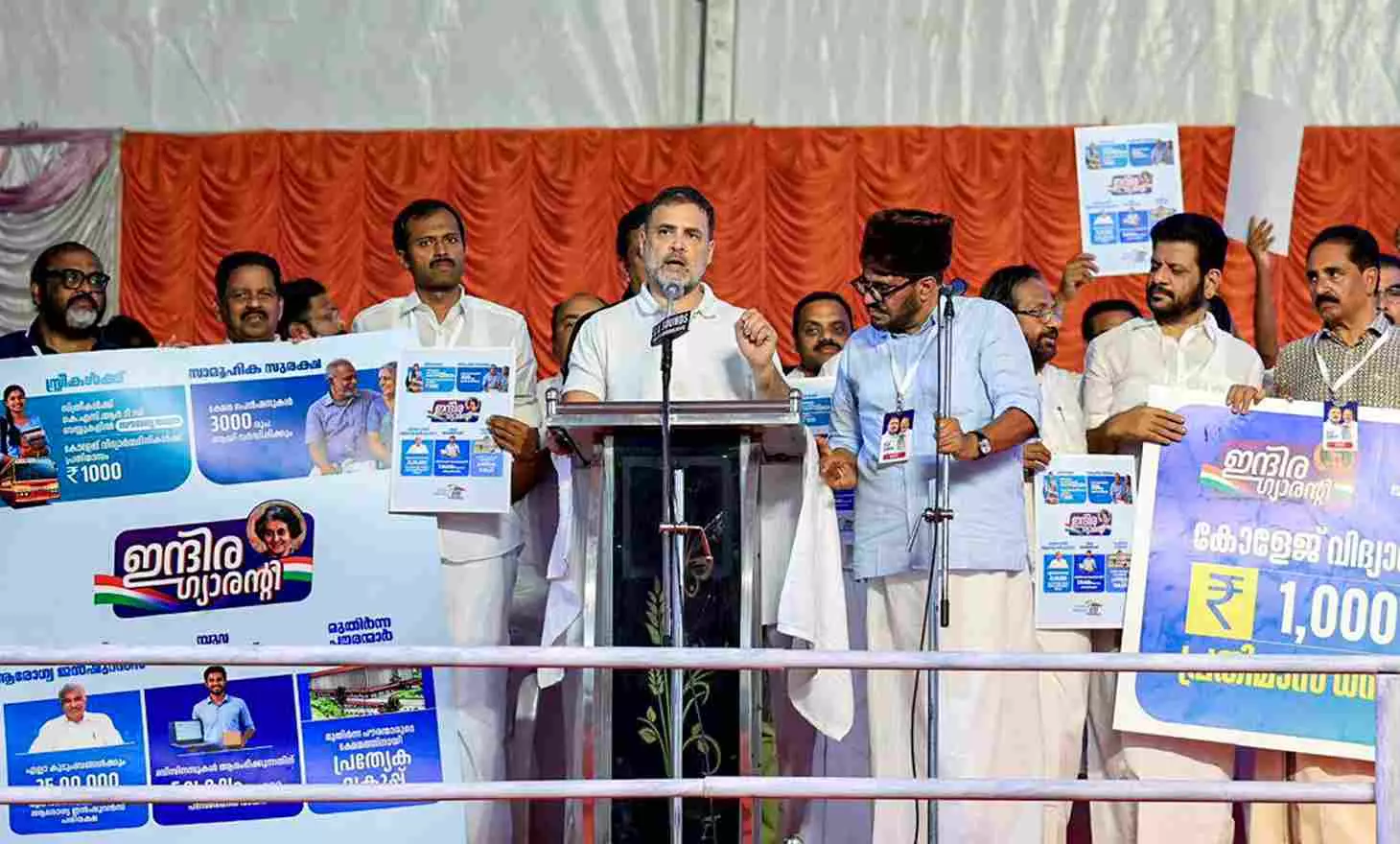
In an attempt to sharpen the UDF’s campaign pitch, Congress leader Rahul Gandhi announced five guarantees for the state, including free travel for women in buses operated by the Kerala State Road Transport Corporation and increasing welfare pensions to ₹3,000 a month if the UDF comes to power. The announcements also include interest-free loans, a health insurance scheme and a ₹1,000 monthly support for college students.
The announcements come as the LDF touts a development-focused campaign, structured around a simple comparison: ten years of the LDF versus the previous five years of the UDF government led by Oommen Chandy. Party leaders and campaign material repeatedly highlight projects initiated or accelerated during the current government’s tenure, presenting them as evidence of a decisive shift in governance and infrastructure expansion.
Among the projects prominently showcased are the proposed township development in Wayanad, the long-pending bridge connecting Perumbalam Island with the mainland in Alappuzha district, and the proposed tunnel road project in the Wayanad region intended to improve connectivity between the hill district and the plains. These projects have been repeatedly highlighted in speeches, publicity campaigns and public outreach programmes organised by the CPI(M).
The ruling front has also used digital platforms to reinforce its message. As part of the campaign, the CPI(M) launched a website titled “Dark Days”, which compiles what the party describes as shortcomings and stalled projects during the UDF government between 2011 and 2016. The platform documents infrastructure gaps, delays and policy decisions from that period while contrasting them with the development initiatives highlighted during the LDF’s tenure. A controversial newspaper advertisement designed to resemble a front page of Malayalam dailies, highlighting this contrast, was also seen as an extension of the campaign.
Shifting voter dynamics emerge
The campaign has found resonance among several beneficiary groups, particularly those who have directly benefited from welfare schemes and infrastructure projects implemented over the past decade. Political observers note that the messaging has helped the ruling front sustain a development-focused narrative in the public sphere, even as the state moves into the election cycle.
Interestingly, recent surveys conducted by several mainstream media organisations suggest that anti-incumbency sentiment in Kerala may be lower than what is usually expected after a decade of continuous rule. While Kerala’s political tradition has historically favoured alternating governments until 2021, early indicators suggest that voter dissatisfaction with the incumbent administration may not be as pronounced as in previous election cycles.
Also read | Kerala CM inaugurates Perumbalam Bridge, ending decades of wait of island residents
At the same time, the surveys and ground reports point to a more complex electoral picture. According to political analysts and campaign observers, the advantages currently enjoyed by the UDF appear to stem less from a strong anti-incumbency wave and more from shifting political alignments among key social groups.
In particular, the evolving political preferences within sections of the minority communities are seen as an important factor influencing the ground situation in several constituencies. These shifts have historically played a decisive role in Kerala’s electoral outcomes, given the state’s closely contested political landscape.
Congress targets voter concerns
Sources within the UDF say that these realities have also been discussed within the Congress leadership during internal campaign reviews. Poll strategists working with the Congress are understood to have advised the party leadership that the development narrative built by the CPI(M) has gained significant traction and cannot be ignored in the election campaign.
According to sources familiar with the discussions, the strategists suggested that the Congress must introduce a set of clear welfare promises that could directly address household-level economic concerns and shift the focus of the campaign. The recommendation, sources said, was to foreground tangible benefits that voters could immediately relate to.
It is in this context that senior Congress leader Rahul Gandhi stepped in with a set of welfare guarantees aimed at the electorate in Kerala. Addressing party workers and supporters ahead of the Assembly polls, Rahul Gandhi announced five major promises that the Congress says it will implement if the UDF comes to power.
Congress announces five guarantees
The first of these guarantees is free travel for women on buses operated by the state-run Kerala State Road Transport Corporation. The Congress leadership believes that such a measure could directly benefit working women and students who rely heavily on public transport.
Rahul Gandhi also announced that social welfare pensions would be increased to ₹3,000 per month if the UDF forms the next government. Welfare pensions constitute a major component of Kerala’s social security framework, benefiting elderly citizens, widows and persons with disabilities across the state.
Another key promise is the introduction of interest-free loans aimed at supporting small entrepreneurs and individuals seeking financial assistance for livelihood activities. While the detailed design of the scheme has yet to be finalised, the Congress has indicated that it will focus on improving access to affordable credit.
The fourth guarantee relates to the introduction of a comprehensive health insurance scheme designed to strengthen financial protection against medical expenses for families.
The fifth promise is a monthly financial assistance of ₹1,000 for college students, which the party says is intended to help young people manage educational costs and continue their studies.
Kerala polls narrative battle
“We are not taking this seriously, as they, especially Rahul Gandhi, had promised a NYAY scheme which offered more than this during the last elections. In fact, they have gone back on their promises. The 2021 promise had ₹6,000 for the underprivileged, but now it has been reduced by 50%. Moreover, while we put forward welfare measures, they have been offering freebies. There is a difference between the two, and that’s what we call Left politics. Our manifesto is yet to be released, and you will see what we envision in it,” a CPI(M) MLA told The Federal.
Also read | Pinarayi Vijayan urges PM Modi to increase Gulf flights, cap airfares amid West Asia crisis
Within Congress circles, the announcements by Rahul Gandhi are being viewed as an attempt to recalibrate the campaign and counter the development narrative that the CPI(M) has successfully built over the past several months. By focusing on guarantees and direct financial support, the party hopes to shift the conversation toward economic relief and social support.
As the election campaign gathers pace, the contest in Kerala is increasingly shaping up as a battle between competing narratives, one centred on infrastructure development and governance claims by the ruling LDF, and the other on expanded benefit promises being projected by the Congress-led UDF.
With both fronts intensifying their messaging across the state, the coming months are likely to see sharper political debate over development, welfare and governance as Kerala moves closer to yet another closely watched electoral contest.