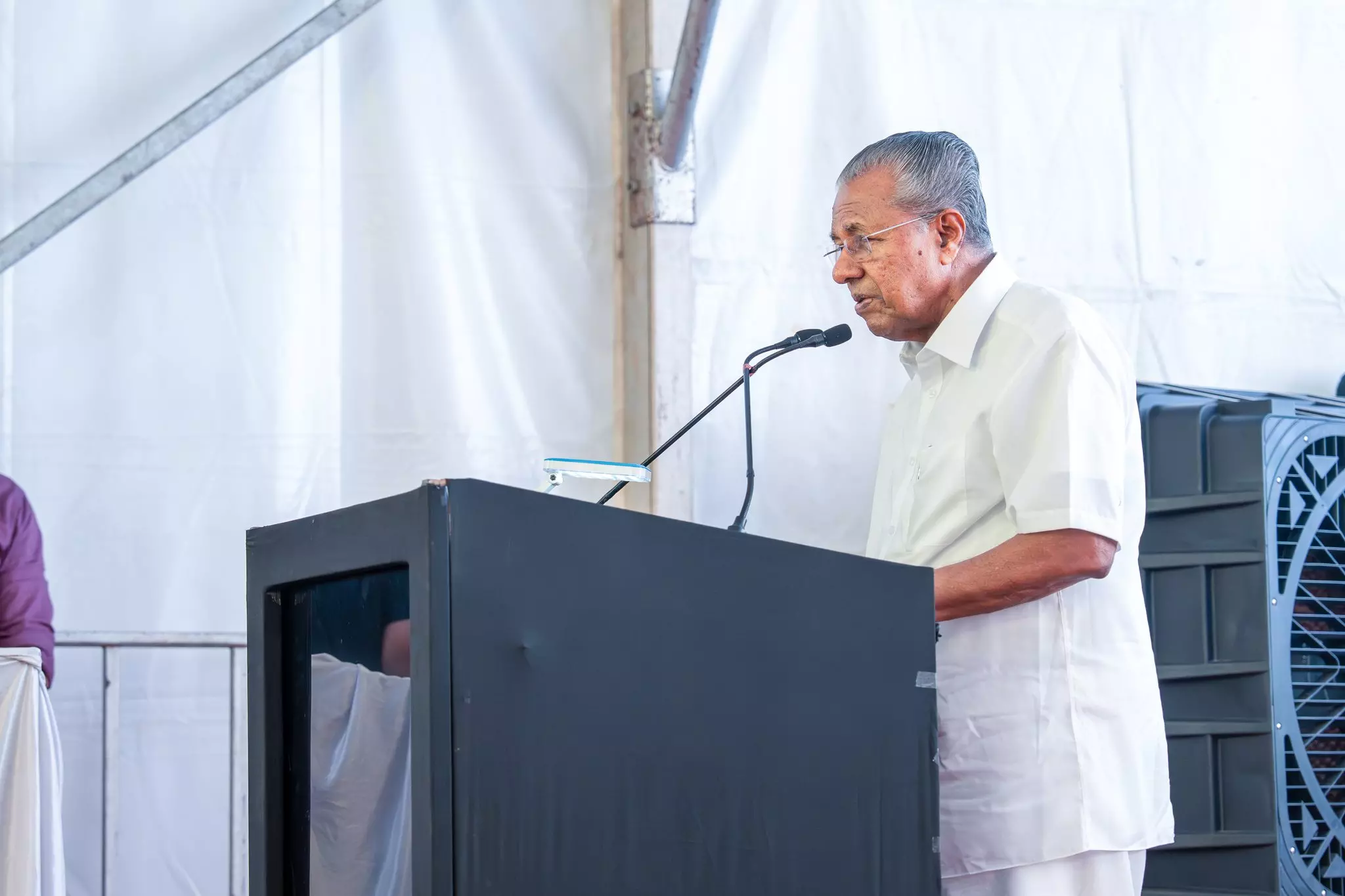
The latest advertisements issued by the Pinarayi Vijayan-led Kerala government have placed the spotlight back on the politics of public messaging during election season. Photo: X|@pinarayivijayan
Kerala’s ‘editorial-style’ government ads spark bitter election-season row
LDF government’s striking "then vs. now" newspaper campaign draws fire from Congress over alleged misuse of public funds and 'unethical' mimicry of news content

An election-season advertising battle has erupted in Kerala, after the Kerala government released a pair of striking full-page advertisements in leading Malayalam newspapers, presenting a stark political narrative that contrasts the Opposition's record with the achievements of the ruling coalition.
The advertisements, issued through the state’s Information and Public Relations Department, appeared prominently in newspapers on Thursday (March 5) morning. Readers opening their daily papers encountered what initially looked like a newspaper-style page in Malayalam designed to resemble editorial content.
Shaping political narratives
The layout carried headlines and visuals portraying the ‘gloomy’ period of governance when the United Democratic Front (UDF) led by the Indian National Congress was in power.
The page depicted a bleak picture of the past with headlines on the state struggling with power shortages, schools facing closure and public transport collapsing. The graphics and satirical illustrations reinforced the narrative, creating the impression of a state trapped in administrative decline.
But the next page delivered the counter narrative. In sharp contrast, the second page of the advertisement depicted a transformed Kerala, under the leadership of the Left Democratic Front government, headed by Chief Minister Pinarayi Vijayan. It highlighted improvements in infrastructure, progress in the public transport system, new school buildings and what the advertisement described as an emerging electricity revolution.
Also read: Pinarayi slams Congress ‘bulldozer raj’ in Telangana, Karnataka; calls it 'BJP replica'
Only on closer examination could readers find small disclaimer boxes stating that the pages were advertisements issued by the government and not editorial content of the newspapers themselves.
The campaign has quickly drawn attention in political and media circles because of its timing and format. With elections approaching in Kerala, critics describe it as part of an escalating advertisement war between political camps, where the battle for narrative increasingly unfolds on the pages of newspapers rather than on conventional campaign platforms.
Unethical, slams Congress
The Congress has come out against the advertisement, stating that it amounts to a waste of public money and is also completely "unethical".
“The government has stooped to a new low by using the Public Relations Department to malign previous dispensations. They are targeting former Chief Minister Oommen Chandy even after his death by cherry picking a few negatives from the previous administration. This is nothing but a waste of public money and moreover in contravention of the rules. Making the advertisement appear like news is unethical as well. We will challenge it in a court of law,” said V D Satheesan, Leader of the Opposition.
However, the government is maintaining its position that it has not made any claims that are untrue and has not levelled any accusations that are not based on facts. “The government says with firm conviction that the LDF came and set everything right. Yes, it is certain, it is the LDF," wrote M V Nikesh Kumar, a senior journalist turned CPI(M) leader, on his Facebook page, referring to the election slogans raised by the Left Democratic Front in the last two Assembly polls in Kerala.
“What has been portrayed in that advertisement is entirely based on reports that appeared in newspapers then and now. There are new voters who are not aware of those difficult days when there were power cuts, shortages of textbooks in schools, and even the closure of schools. These Gen Z voters spent most of their school years under the Pinarayi government and are now experiencing the benefits of those policies. So, it is important to address them through this kind of communication. That is how we arrived at such a design," Zain Ul Abid, the designer who created this advertisement told The Federal.
Also read: Pinarayi meets Mohanlal: Cultural moment or political PR?
The episode has also caused unease within sections of the bureaucracy, with some officials privately expressing concern that they could face scrutiny if there is a change of government.
Govt-funded ads
A senior official in the government secretariat said, “Using taxpayers’ money to shape political narratives through publicity is deeply problematic. The Left in Kerala used to criticise governments led by the Bharatiya Janata Party at the Centre and the United Democratic Front in the state for spending public funds on self-promotional advertisements. Now, they themselves appear to be adopting a similar approach.”
The issue has also gained traction because Kerala’s political parties had recently raised concerns about government-funded advertisements appearing outside the state. The controversy began when expensive jacket advertisements promoting welfare schemes of the government of Telangana started appearing in Malayalam newspapers.
The advertisements, highlighting initiatives of the government led by A Revanth Reddy, drew criticism from the Opposition, the Bharat Rashtra Samithi (BRS). The party alleged that large sums of public money were being spent in media markets outside Telangana, claiming the publicity had little relevance for readers in Kerala, who are not beneficiaries of those schemes.
BRS leaders even alleged that as much as ₹1,000 crore could be linked to political activities connected with the Kerala electoral landscape, though the Telangana government has not formally acknowledged such claims. The allegation quickly became a talking point in Kerala’s political discourse.
Telangana ads in Kerala
Leaders of the CPI(M) in Kerala also raised questions about why welfare schemes meant for Telangana residents were being advertised prominently in Malayalam-language newspapers with little direct connection to the target audience.
The Telangana Congress, however, dismissed the accusations and defended the advertising practice. Party sources said that cross-state advertising in multi-edition newspapers is a common practice followed by many governments.
Front-page jacket advertisments in Malayalam dailies highlighting the achievements of the Congress government in Telangana
“Giving all-India advertisements to newspapers is common. BRS leader K Chandrashekar Rao used to give advertisements in states such as Uttar Pradesh, Bihar, West Bengal and Odisha. This helps multi-edition newspapers as well,” a Congress party source said.
“Advertisements from the government of Uttar Pradesh led by Yogi Adityanath now appear in Telangana as well. Similarly, advertisements from the government of Punjab appear in Telangana newspapers,” added the Congress functionary.
Politics of public messaging
While the debate over Telangana’s publicity campaign continues, the latest advertisements issued by the Kerala government have placed the spotlight back on the politics of public messaging during election season.
The campaign clearly frames the political contest as a comparison between two eras. In its presentation, the years of governance under the UDF are depicted as a period of stagnation and administrative decline, while the successive LDF governments led by Pinarayi Vijayan are portrayed as a phase of revival and development.
Supporters of the government say the advertisements merely highlight achievements and remind voters of the contrast between competing political visions. Critics, however, argue that the design of the pages, deliberately resembling editorial content raises ethical questions about the boundaries between journalism and political publicity.
Media observers note that full-page and front-page advertisements are among the most expensive forms of print publicity, capable of reaching millions of readers simultaneously. During election seasons, such placements often become key instruments for shaping public perception.
In Kerala’s political narrative, the LDF has also drawn contrasts between welfare programmes implemented in the state and those promoted elsewhere in the wake of the Telangana government’s campaign on Indiramma housing. Party leaders cite the Kerala’s Life Mission housing initiative as an example of what they describe as a model that prioritises dignity and community ownership for beneficiaries.
This comparison has also been used to critique the Indiramma Housing Scheme in Telangana, which has been widely promoted through recent advertisements appearing in Malayalam newspapers.
No branding
The Left leaders said that the houses under the scheme carry Congress flag colours and often have plaques erected in front, identifying them as part of the programme. In contrast, Kerala’s Life Mission housing project avoids such branding.
The Kerala Chief Minister has refused to print the Prime Minister’s name on Life Mission houses despite the Centre’s insistence, stating that the government values the self-esteem and dignity of the beneficiaries.
For now, the dispute illustrates how political competition is increasingly moving into the media space.
With governments and parties investing heavily in high-visibility advertising formats, newspaper pages themselves have become a battleground, where competing narratives about governance, development and political legitimacy are being fought.