



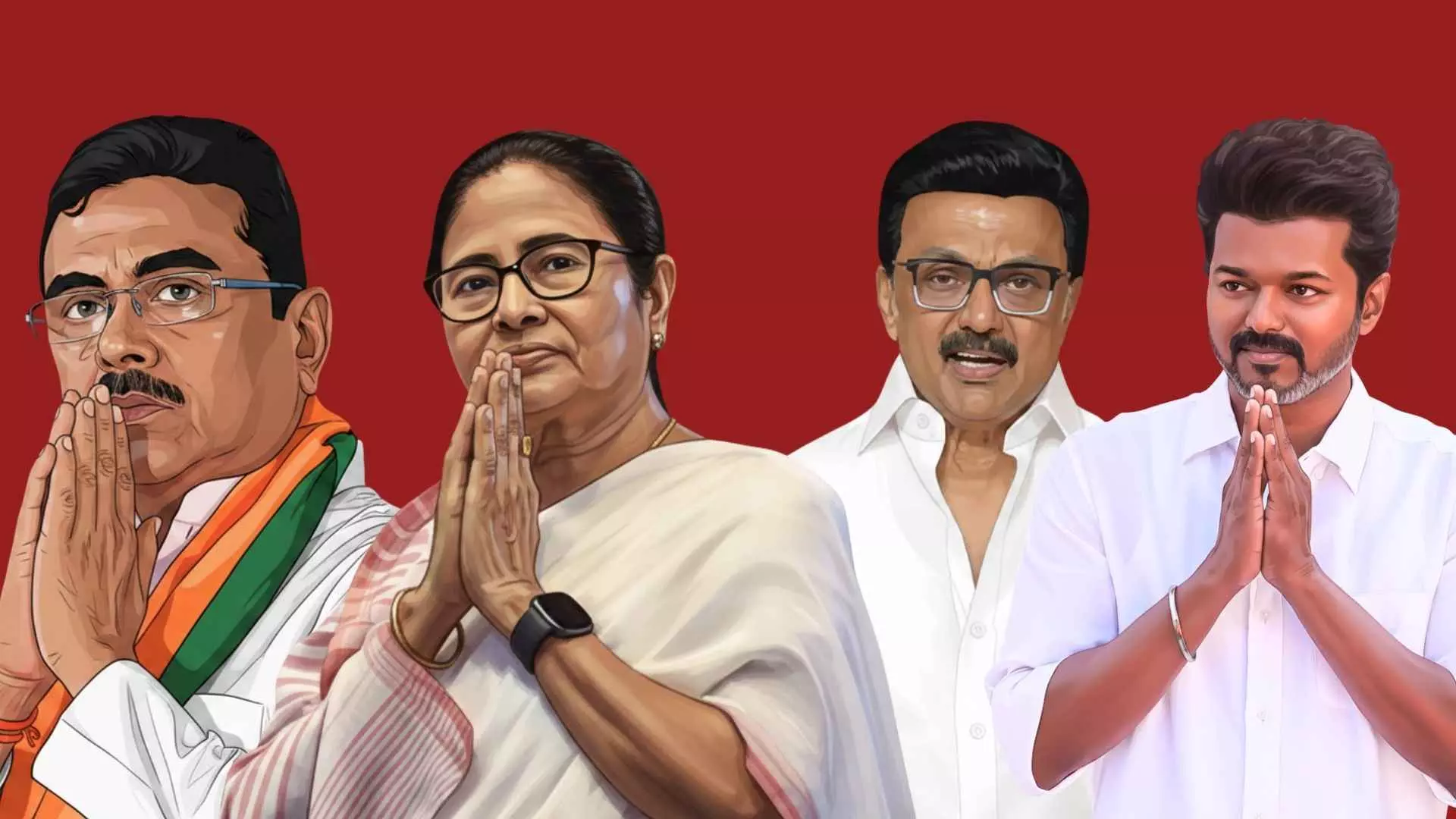
Key issues shaping voter sentiment in Bengal, Tamil Nadu as campaign ends
From SIR row, infiltration and corruption in West Bengal to welfare, identity politics and the Vijay factor in Tamil Nadu, here’s what defined the campaign trail

With campaigning drawing to a close in Tamil Nadu and for 152 constituencies of West Bengal heading to polls in the first phase on April 23, it is now over to voters to decide the fate of key contenders and set the tone for the high-stakes electoral battle.
Both Tamil Nadu and West Bengal are dominated by strong regional players – DMK and TMC – both seeking to retain power, while the BJP positions itself as the principal challenger, contesting solo in Bengal and in alliance with the AIADMK in Tamil Nadu. And there is the Vijay factor in Tamil Nadu, which no one seems to know what effect his party will have.
Also read | Bengal polls: Farmers’ distress in Malda turns into political ‘hot potato’ for TMC
The Federal breaks down the key issues that shaped the electoral discourse in both states over the past month, highlighting the narratives, flashpoints and voter concerns that defined the campaign trail.
WEST BENGAL
1. SIR row
The publication of post-SIR electoral rolls has stood out as one of the most significant pre-election developments in the state, with the revision removing nearly 91 lakh names from the voter list ahead of the Assembly polls.
With the electorate dropping from 7.66 crore to just over 6.75 crore, the exercise has markedly altered the electoral landscape, introducing a degree of uncertainty that continued to shape the campaign narrative.
This churn forced political parties to reassess their booth-level strategies, especially in districts that saw large-scale deletions. The removals have been concentrated in several border districts and urban belts, electorally sensitive and fiercely contested regions, ensuring the issue remained central to campaign debates.
2. Bengali sub-nationalism
Before the SIR row took centre stage, the TMC mounted an aggressive campaign, on the streets, in courts and in Parliament, against alleged targeting of Bengali-speaking migrants in BJP-ruled states.
Building on its ‘bohiragoto’ (outsider) plank, the party framed the issue as one of Bengali identity and sub-nationalism, positioning itself as the defender of “asmita” against the BJP.
Mamata Banerjee led protests, including a major Kolkata rally, and slammed the BJP over alleged detention and deportation of migrants. She consistently targeted the BJP over alleged cases of torture, detention and deportation of Bengal’s migrants across the country on suspicion of being Bangladeshis.
3. Infiltration
In contrast, the BJP anchored its campaign around the issue of infiltration, accusing the TMC of enabling illegal migration that altered demography and fuelled unrest.
The party strongly backed the SIR “roll-cleansing” exercise, projecting it as an effort to identify “Bangladeshis and Rohingyas” in the state. The TMC, in turn, dismissed the exercise as politically driven, alleging it disproportionately targeted Muslim citizens and lacked any factual basis.
4. Matua factor
The Matuas, a Scheduled Caste Hindu refugee community with decisive influence in around 50 Assembly seats across Bengal, remained a key electoral bloc through the campaign. In the 2021 Assembly elections, a majority of these seats went to the BJP, helping it secure 77 seats, with that support base largely holding during the 2024 Lok Sabha polls as well.
However, the large-scale deletion of names during the SIR unsettled voters in Matua-majority belts, reviving anxieties over identity, documentation and electoral inclusion among community members who migrated from present-day Bangladesh over decades, and keeping the issue alive during the campaign.
5. Corruption/urban anger
Allegations of corruption raised by Opposition parties against the TMC dispensation continued to dominate Bengal’s political discourse through the campaign, with the school jobs scam remaining a central issue.
The Supreme Court’s decision to cancel the appointments of more than 25,000 teachers and staff recruited by the state School Service Commission over irregularities in the process was repeatedly invoked by the Opposition to target the ruling party.
Alongside corruption allegations, a persistent jobs crisis, concerns over investment and ongoing brain drain have contributed to a broader anti-incumbency sentiment confronting the Mamata Banerjee government as campaigning drew to a close.
6. Religion and polarisation
As the campaign draws to a close, communal rhetoric and identity-driven mobilisation have emerged as key undercurrents in Bengal’s electoral narrative. A state once relatively insulated from overt communal politics has seen sharper ideological contestation between the TMC and the BJP.
Also read | Is BJP electoral juggernaut deciding the shape of women’s quota, delimitation bills?
Both sides have traded charges, with the BJP alleging minority appeasement and the TMC accusing it of stoking division. This polarisation has been more pronounced in demographically mixed districts.
7. Law and order/women’s safety
The issue of law and order, particularly women’s safety, remained a key political flashpoint throughout the campaign in Bengal, drawing sharp responses from both the ruling establishment and the Opposition.
The government cited official data and highlighted measures such as dedicated women police stations, increased night patrolling and helplines to bolster safety. However, incidents like the rape-murder of a medical intern at RG Kar Hospital were repeatedly raised by the Opposition to argue that cases of assault, harassment and trafficking continue to rise in the state.
8. Women’s reservation
In the final leg of the campaign, the issue of women’s reservation in Parliament and state Assemblies emerged as a major flashpoint, with the BJP accusing the TMC of aligning with the Congress to block the Women’s Quota Amendment Bill in the Lok Sabha. The BJP alleged that the TMC had “betrayed” the women of West Bengal.
Countering the charge, the TMC highlighted that over 40% of her party’s MPs are women, the highest in Parliament, and noted that the party has fielded 52 women candidates in the Assembly polls, the highest among all parties.
9. Industry and employment
The BJP centred its campaign on allegations of industrial decline, calling Bengal an “industrial graveyard” and claiming large-scale exit of companies, low investment conversion and a steady movement of workers to other states.
The TMC countered with its “Bengal model,” highlighting MSME growth, infrastructure push, lower unemployment and higher projected GSDP growth.
10. Social welfare schemes
A slew of social welfare schemes rolled out by the TMC government remained central to its campaign outreach. Targeting unemployed youth, women, farmers, students, workers and marginalised communities, these initiatives have delivered strong electoral returns in the past and are expected to influence the outcome this time as well.
TAMIL NADU
While identity, citizenship and governance dominated the discourse in Bengal, Tamil Nadu’s campaign revolved around a mix of Dravidian politics, alliance equations and welfare-driven narratives.
1. Vijay factor
There may be no dramatic leadership vacuum, but the space for alternatives is drawing attention. While the DMK is seeking a mandate on continuity, stability and delivery, and the Opposition is framing the contest around corruption, law and order and governance gaps, newer entrants are trying to disrupt this binary. Actor Vijay’s TVK, in particular, is attempting to channel voter fatigue with the traditional choices and position itself as a credible alternative. The massive crowd he has managed to draw in across the state has hit headlines nationwide, but it remains to be seen what impact he will have electorally. Political pundits believe it is an ''unpredictable election'' mostly because of the Vijay/TVK factor. Many believe his presence could influence margins and reshape electoral equations.
2. Welfare vs jobs
Free electricity, cash transfers and subsidised essentials continue to anchor how parties seek to build voter trust. The ruling DMK has defended its record on delivering these schemes, while the Opposition has promised to match or even surpass them.
Also read | Are DMK’s poll promises and Vijay’s charm shaking AIADMK’s hold over Kongu belt?
At the same time, there is a perceptible shift, particularly among younger voters, with growing emphasis on jobs, private investment and sustained income growth. Welfare remains central, but it is no longer seen as sufficient on its own, and parties are yet to fully strike a balance between immediate support and long-term economic opportunities.
3. Identity and federalism
Every election cycle, Tamil Nadu circles back to a familiar question: Who defines the state’s identity?
Language remains at the heart of this debate, with resistance to Hindi imposition, opposition to centralised policies like NEET, and friction with the Union government once again shaping the campaign narrative.
The DMK has framed this as a defence of federal rights, while the BJP has sought to shift the focus toward development and national integration.
Voters are weighing both arguments, but history suggests that questions of identity tend to resonate more deeply here than policy debates.
4. Law and order/women’s safety
The AIADMK-BJP alliance and other Opposition parties flagged law and order as a key concern, alleging widespread availability of drugs and a deterioration in women’s safety under the DMK government.
The DMK rejected these claims, highlighting stricter laws, faster investigation timelines and improved conviction processes in cases involving crimes against women. It also asserted that Tamil Nadu remains among the safer states, citing governance measures and workforce participation by women as indicators.
5. Women’s quota/delimitation
The women’s reservation issue emerged as a key flashpoint just days before polling, with the BJP describing its bill as a progressive step that was derailed due to opposition from the DMK and Congress, and accusing them of politicising the move and resisting greater representation for women.
The DMK, however, framed the bill’s defeat as a victory for Tamil Nadu and other southern states, arguing that it was tied to a delimitation exercise that could weaken their political representation. It positioned its stand as part of a broader defence of federal rights and regional identity, casting the debate as one of state autonomy versus central dominance.