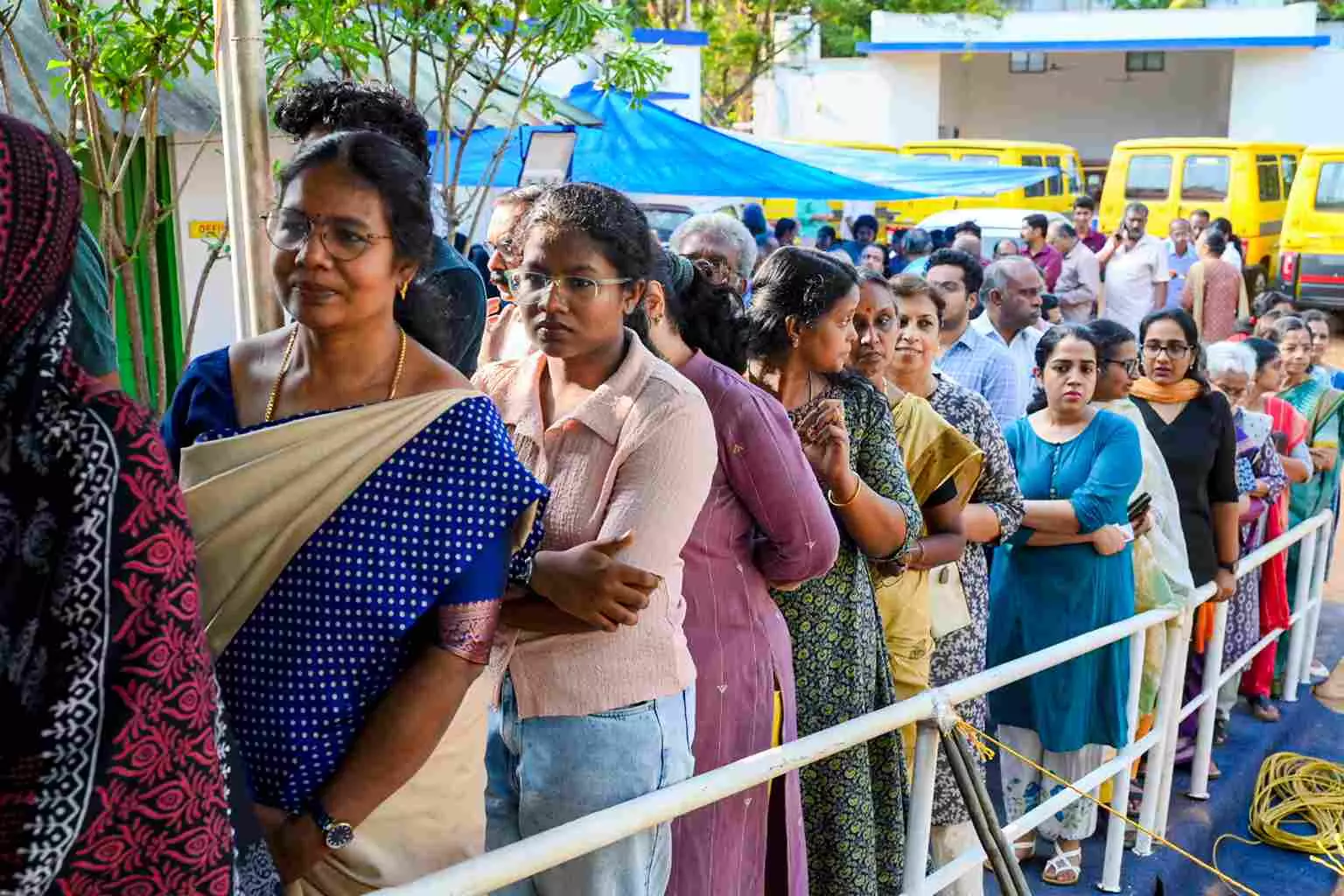
Kerala voters turn out in record numbers after SIR overhaul; 78% polling
High participation across districts, led by Kozhikode, Palakkad, and Ernakulam, reflects a more accurate voter base after the Special Intensive Revision (SIR)

Kerala has voted, and the first picture emerging from the 2026 Assembly election is one of unusually high participation across the state. Turnout has settled at a strong 78.01 per cent (as per data available till 8 pm), marking a clear jump from the previous election cycle. What stands out is not just the statewide figure, but the consistency across districts, with most regions comfortably crossing the mid to high seventies.
Strong turnout across districts
Northern Kerala led the surge. Kozhikode has recorded the highest turnout at 80.83 per cent, closely followed by Palakkad at 80.36 per cent. Ernakulam, the state’s commercial hub, has also posted an impressive 79.63 per cent, indicating that urban apathy has not set in. Malappuram at 79.47 per cent and Wayanad at 78.80 per cent continue their tradition of strong political participation, while Kannur and Kasaragod remain in the high turnout bracket with 78.21 per cent and 78.30 per cent respectively.
Also read | What high voter turnouts in Kerala, Assam, Puducherry mean | Capital Beat
In the central and southern regions, the pattern holds steady. Idukki has recorded 77.14 per cent and Alappuzha 77.19 per cent. Thiruvananthapuram and Thrissur stand at 76.95 per cent each, while Kollam has touched 77.04 per cent. Kottayam, traditionally a politically aware district, is slightly lower at 74.49 per cent. Pathanamthitta is the only clear outlier, recording the lowest turnout at 70.70 per cent.
This spread tells a clear story. The 2026 election is not defined by isolated spikes but by a broad-based rise in participation. The gap between the highest and lowest districts exists, but even the lowest figure remains above 70 per cent, which underlines the overall engagement.
Voter list undergoes overhaul
However, these numbers gain real meaning only when placed against the backdrop of the Special Intensive Revision (SIR) of electoral rolls that preceded this election.
Before the revision, Kerala’s electoral roll was estimated to be around 2.85 crore voters based on the continuous additions over the years since the 2021 Kerala Legislative Assembly election. That election itself was conducted with roughly 2.74 crore voters on the rolls and recorded a turnout of about 74 per cent. The system at that time carried the usual baggage of Indian electoral databases, including duplicate entries, voters who had migrated, and names that had not been removed after deaths.
The SIR changed that base significantly. After the exercise, the final electoral roll for 2026 stands at about 2.69 crore voters. This means that more than 15 to 16 lakh names have been removed from the list from 2021. The scale of this correction is substantial in a state like Kerala where population growth is relatively stable.
What this effectively does is redefine the denominator of voter turnout.
Accurate rolls boost turnout
“In 2026, the rolls are tighter. The removal of inactive or ineligible voters means that the electorate is closer to the actual resident and eligible population. When 78 per cent turnout is recorded on such a roll, it represents a higher level of real participation than a similar or even slightly lower percentage in the earlier election,” said an election official who was managing the data.
Also read | Kerala elections: Huge wave for UDF, will cross 100 seats, says VD Satheesan
The district-wise data reinforces this. High participation in districts like Kozhikode, Palakkad, and Ernakulam suggests that mobilisation has been effective across both rural and urban segments. Malappuram and Wayanad continuing their high turnout trend show that traditional voting patterns remain intact, but now operate on a more accurate electoral base.
The 2026 election therefore cannot be read as a routine continuation of Kerala’s voting trends.
Kerala has always been a politically active state. What 2026 shows is that after the clean-up of its electoral rolls, that participation looks even stronger when measured against a more precise and credible list of voters.