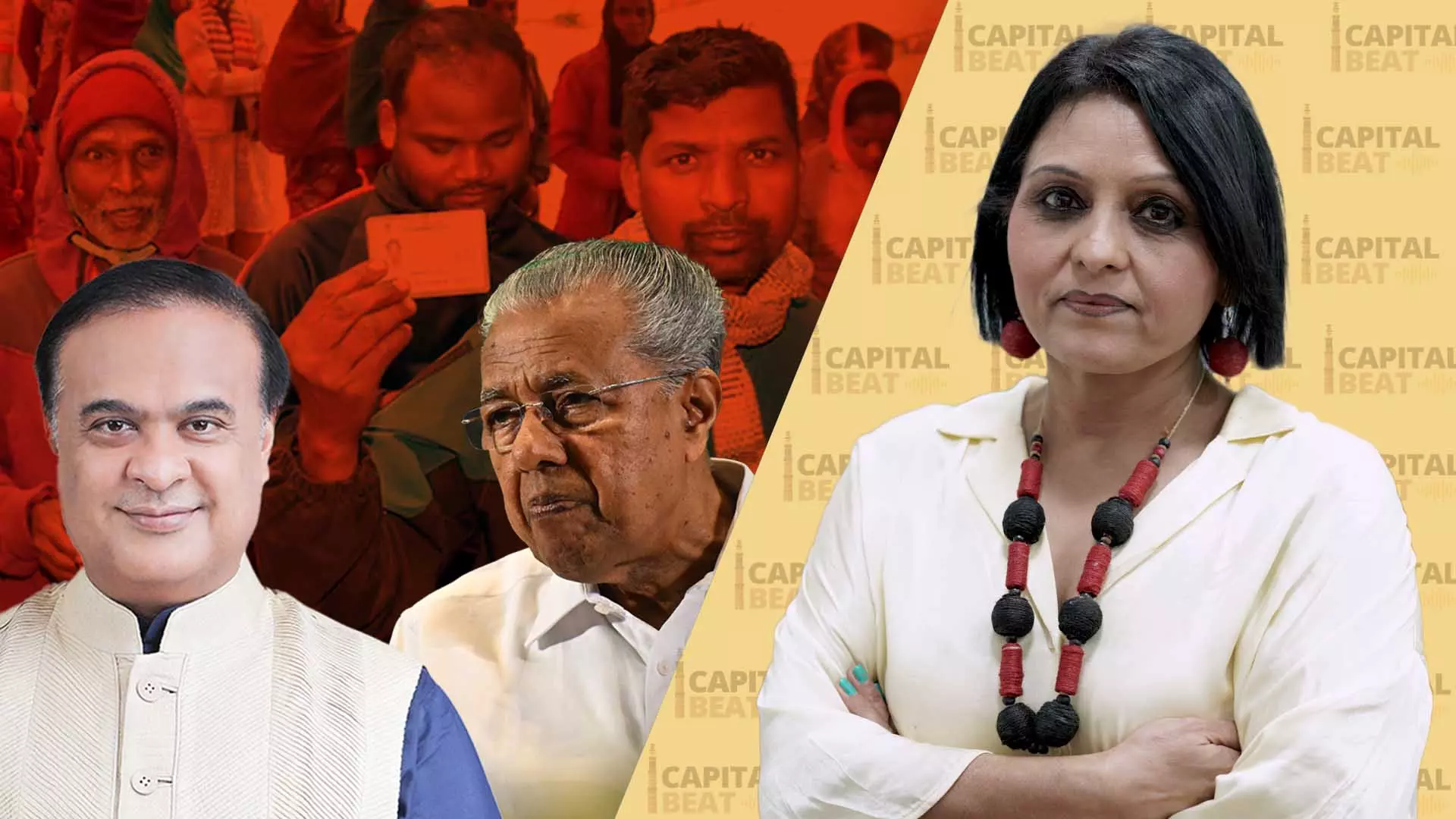
What high voter turnouts in Kerala, Assam, Puducherry mean | Capital Beat
It is a high-stakes battle for the BJP, Congress and the Left. Who has the upper hand in all three states? What does the voter turnout indicate?

The latest episode of The Federal's Capital Beat brought together AR Bhuyan, advocate at the Guwahati High Court, MG Radhakrishnan, senior journalist, and Mahalingam Ponnuswamy of The Federal to examine the voter turnout trends in today's (April 9) Kerala, Assam, and Puducherry Assembly elections.
The discussion centred on voter participation figures reported during polling, with Kerala recording 62.71 per cent (75.01 per cent till 5 pm), Assam 75.91 per cent (84.41 per cent till 5 pm), and Puducherry 72.40 per cent (86.92 per cent till 5 pm) turnout by the afternoon, as per the Election Commission (EC).
Also read: High polling in Kerala elections: Can it beat all-time turnout record?
The panel addressed what the turnout percentages indicate, particularly in contests involving the Congress, the Bharatiya Janata Party (BJP), and Left parties, with each state presenting distinct political dynamics.
Kerala turnout and electoral patterns
Radhakrishnan stated, “It is not possible in Kerala, looking at its history, to extrapolate the polling percentage to the outcome. There is absolutely no connection with this.”
He cited historical examples, noting, “There are occasions when high polling meant the LDF lost and there are occasions when the LDF actually won. In 1987, an 80 per cent plus voting percentage was recorded when the LDF won.”
Also read: Kerala elections: Huge wave for UDF, will cross 100 seats, says VD Satheesan
He added that recent electoral performances, including local body elections, reflected dissatisfaction with the ruling Left Democratic Front (LDF), stating, “There appears to be an anti-incumbency sentiment.”
Anti-incumbency versus continuity in Kerala
Radhakrishnan identified the central theme of the Kerala election as “change or continuity”, with competing alliances framing campaigns accordingly.
He stated, “The most important issue in this election was change or continuity. While the UDF and the NDA called for a change, the LDF fought based on the performance of its last 10 years.”
He also highlighted Kerala’s electoral pattern, saying, “Kerala is known for its alternation, voting out the incumbent government every five years. This pattern was broken in 2021.”
Stakes for political parties in Kerala
The discussion noted the significance of the election for all major parties. Radhakrishnan said, “Kerala remains the last red outpost in India. If it loses Kerala, the Left will be out of power in every state.”
He also pointed to the Congress’s position, stating, “Kerala happens to be the place where it can actually come back as a major power in South India. They have been out of power for the last 10 years.”
On the BJP, he noted its expanding vote share, stating, “They have been increasing their percentage, from 5 per cent in 2011 to about 20 per cent in 2024”, while also referencing fluctuations in recent local elections.
Assam turnout and voter sentiment
Bhuyan described Assam’s turnout as significant, stating, “Voter turnout percentage means people are very conscious about the present situation. There is no doubt anti-incumbency is there.”
He added that voter sentiment remained difficult to predict, saying, “The mood of the voters is very difficult to guess, whether it is pro-incumbency or anti-incumbency.”
Bhuyan linked turnout to governance concerns, stating, “The debt is very high in our state. Being a very poor state, it is very difficult to maintain.”
Campaign issues and political messaging in Assam
Bhuyan stated that campaign narratives included allegations and counter-allegations, but questioned their impact. He said, “The issues that have been raised are not very mature issues; these are personal attacks.”
He added, “These are all allegations and are not yet being proved. The BJP has again counterattacked that these are all false, manufactured documents.”
He highlighted governance-related concerns.
Welfare schemes and electoral influence in Assam
Bhuyan pointed to welfare schemes as a factor in voter mobilisation. He added that such measures influenced voting patterns within households, stating, “In one household, the female members are supporting the BJP government, the male members are supporting the Congress.”
He described the strategy as a targeted approach, stating, “The government has used financial resources to attract voters by giving these benefit schemes.”
Puducherry turnout and campaign dynamics
Mahalingam highlighted turnout trends, stating, “So far, till 3 pm, voter turnout is 72.4 per cent, 12 per cent higher than the previous Assembly elections.”
He added that polling remained smooth, stating, “There is no law and order issue, no major technical issue in EVM machines, voting is happening very peacefully.”
He also linked turnout to new political entrants, stating, “Because of TVK's entry, more number of people, especially youngsters, came forward and they voted for the first time.”
Key issues shaping Puducherry elections
Mahalingam identified governance and structural issues, stating, “The main problem was about the power tussle between the chief minister and governor.”
He added that statehood remained a campaign promise, stating, “Congress says that once it comes to power, it will announce statehood.”
Corruption allegations and voter response
Mahalingam outlined allegations raised during the campaign. He added, “Poll observers are saying there is a huge anti-government wave. That’s why the polling percentage is also historically high.”
The discussion noted that exit polls remain restricted until the final phase of elections concludes, leaving outcomes uncertain across the three regions.
(The content above has been transcribed from video using a fine-tuned AI model. To ensure accuracy, quality, and editorial integrity, we employ a Human-In-The-Loop (HITL) process. While AI assists in creating the initial draft, our experienced editorial team carefully reviews, edits, and refines the content before publication. At The Federal, we combine the efficiency of AI with the expertise of human editors to deliver reliable and insightful journalism.)