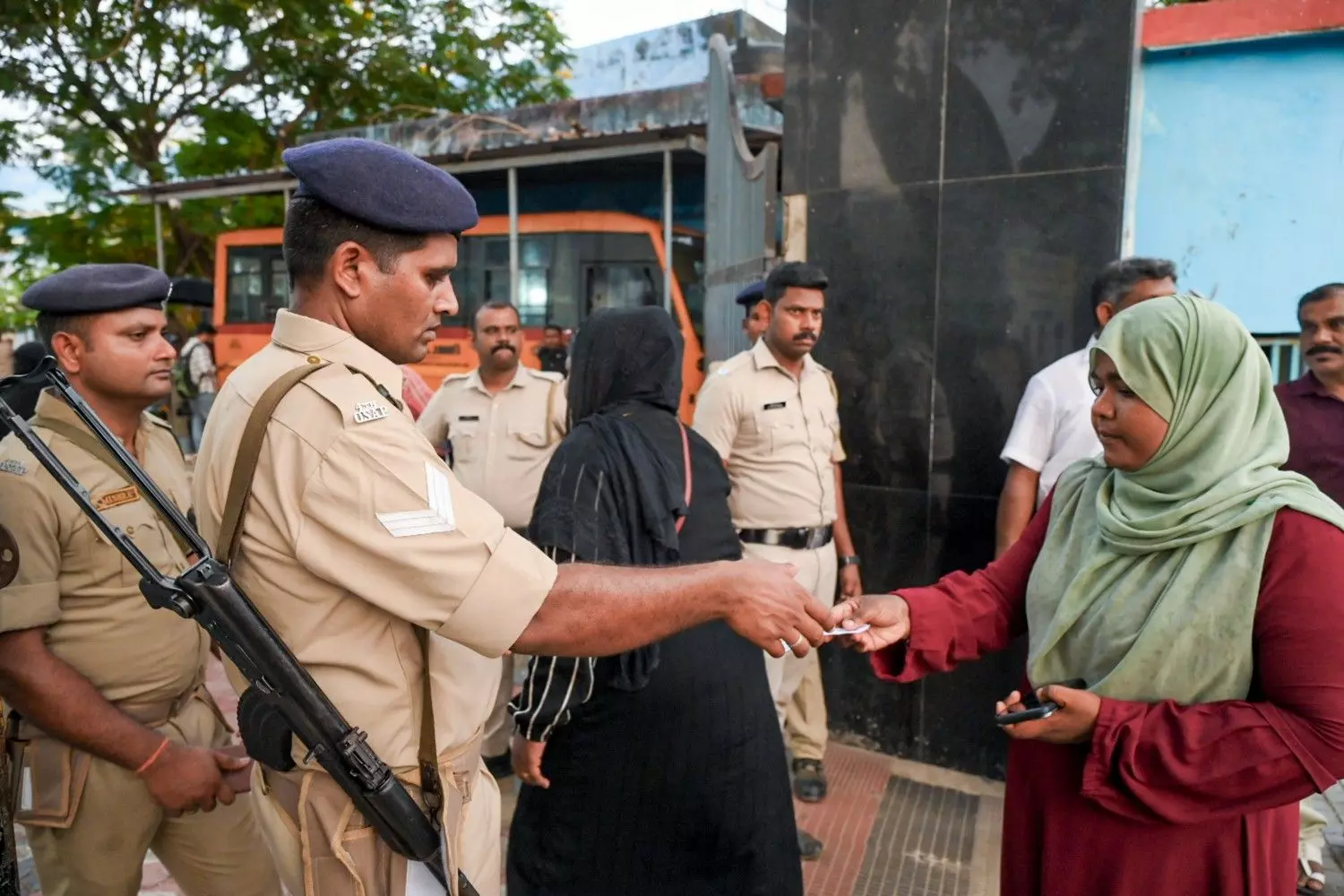
A police personnel checks the ID cards of voters during the Kerala Assembly elections, in Thiruvananthapuram, on Thursday, April 9. PTI
Contrasting claims in Kerala: UDF talks wave; LDF counts on strongholds
UDF expects to secure at least 88 seats; LDF says it can bag 75-80 seats

The day after polling in Kerala, the UDF camp appears upbeat, pointing to what it describes as a strong wave of anti-incumbency and consolidation of minority votes in its favour. Early discussions within the front have informally shifted towards government formation. An online meeting of candidates has been convened on Friday evening (April 10).
According to sources, the UDF expects to secure at least 88 seats, with internal projections stretching towards the 100-mark. The front is seen as confident in districts such as Wayanad, Malappuram, Ernakulam, Idukki and Pathanamthitta, which together account for a significant chunk of seats.
Congress, LDF both confident
Kerala Pradesh Congress Committee (KPCC) president Sunny Joseph and Leader of the Opposition VD Satheesan both expressed confidence about returning to power after a decade.
Also read: Kerala elections: Huge wave for UDF, will cross 100 seats, says VD Satheesan
“All the social groups that moved away from us have come back. The unusual polling patterns in certain areas point to that. It was with this confidence that I said I would go into political exile if we lost. That is not the situation now,” Satheesan said.
The LDF camp, however, has also expressed confidence about retaining power, with estimates ranging between 75 and 80 seats. The state leadership is currently compiling ground-level feedback, with a detailed review expected in the coming days.
CPI(M) says LDF has advantage
According to district-level assessments, the Communist Party of India (Marxist) believes the LDF has an advantage in Thiruvananthapuram, Kollam, Alappuzha, Thrissur, Palakkad and Kannur, which together account for a large number of seats. A key concern remains the consolidation of minority votes, particularly among Muslim voters. Kozhikode is being closely watched, with the Congress expecting gains and the Left acknowledging a more competitive contest.
Also read: Kerala voters turn out in record numbers after SIR overhaul; 78 pc polling
“Ahead of this, we had faced a setback in the local body elections, so workers are cautious in sharing firm assessments. There is concern about a repeat. At the same time, the situation is not as difficult as it was in December 2025. Some social groups that had not supported us earlier appear to have done so this time. The backing of the Sunni faction led by Kanthapuram A. P. Aboobacker Musliyar is also seen as steady,” said a district-level leader from the Malabar region.
In Thrissur and Palakkad, the LDF is confident of retaining its sitting seats. KV Abdul Khader, CPI(M) district secretary in Thrissur, said initial assessments do not indicate any significant minority consolidation in favour of the UDF in the district. “The situation is more favourable compared to the local body elections,” he said.
Differences in voter turnouts
Polling data shows a clear gap between high and low turnout constituencies. At the higher end, mostly concentrated in north Kerala, with a few exceptions in central and southern regions, Kunnamangalam recorded 84.85 per cent, followed by Chittur (84.63), Kunnathunad (84.09), Beypore (83.75), Aroor (83.35) and Eranad (83.29). Manjeri (82.52), Kondotty (82.48), Elathur (82.45), Mattannur (82.24) and Cherthala (82.07) also reported strong turnout. At the lower end, almost all in central and southern Kerala, Kaduthuruthy recorded 69.34 per cent, followed by Konni (70.01), Punalur (70.99), Chengannur (71.05) and Mavelikkara (72.61).
There is no clear political pattern in this. The differences in turnout do not point to any fixed trend. The only noticeable aspect is that some minority-dominated areas show slightly higher and more consistent voting, but this alone is not enough to draw conclusions.
While the sharp rise in polling has emerged as a point of concern for a section within the LDF, there is also a view within the front that higher turnout alone may not significantly influence the final outcome, as past electoral trends in Kerala have not shown a consistent pattern linking turnout to results. However, the UDF camp and a section of media has projected a possible wave against the government.
But the counter question is whether it is possible to read the nature of polling and determine in advance whether there is a favourable or unfavourable wave for any side?
What rise in polling indicates
However, a common assumption is that a rise in polling indicates voters turning out with a clear and determined intent, which could translate into a broader electoral trend. In Kerala, another widely circulated view is that lower polling benefits cadre-based formations like the LDF, while higher turnout favours the UDF. This argument, often traced back to electoral patterns of the 1980s, continues to be repeated in television discussions, even while acknowledging that political conditions have evolved since then.
Historical data present a more complex picture. Since the LDF-UDF contest took shape in 1980, one of the highest polling percentages was recorded in 1987 at 80.54 per cent. The election took place in a politically charged environment, including the aftermath of the Shah Bano case and sustained political campaigns targeting the Left. Despite the high turnout, the outcome did not align with the assumption that increased polling would favour the UDF. The LDF formed the government.
Assessments remain speculative
In contrast, the 1996 election recorded one of the lower polling figures at 71.16 per cent. The election followed major policy decisions such as prohibition, which had generated significant public debate. Here too, the outcome did not conform to the expectation that lower turnout would necessarily benefit cadre-based parties. The LDF won the election.
These instances indicate that both high and low polling have, at different points, resulted in similar electoral outcomes in Kerala.
More broadly, electoral trends or so-called waves have not historically been preceded by clear indicators in polling percentages alone. The assumption that higher turnout automatically signals a wave, or that it structurally favours one formation over another, does not consistently hold when examined against past elections.
At present, there are also claims that social groups which moved away from the Congress in earlier elections have returned, leading to projections of a significant UDF victory. Such assessments remain speculative.
The actual outcome will become clear only when the results are declared on May 4.