Kerala elections: Why MA Baby thinks Left is winning a record third term
In an exclusive interview, the CPI(M) leader defends Pinarayi govt's record, rejects dissent claims and counters UDF’s allegations ahead of high-stakes Assembly polls

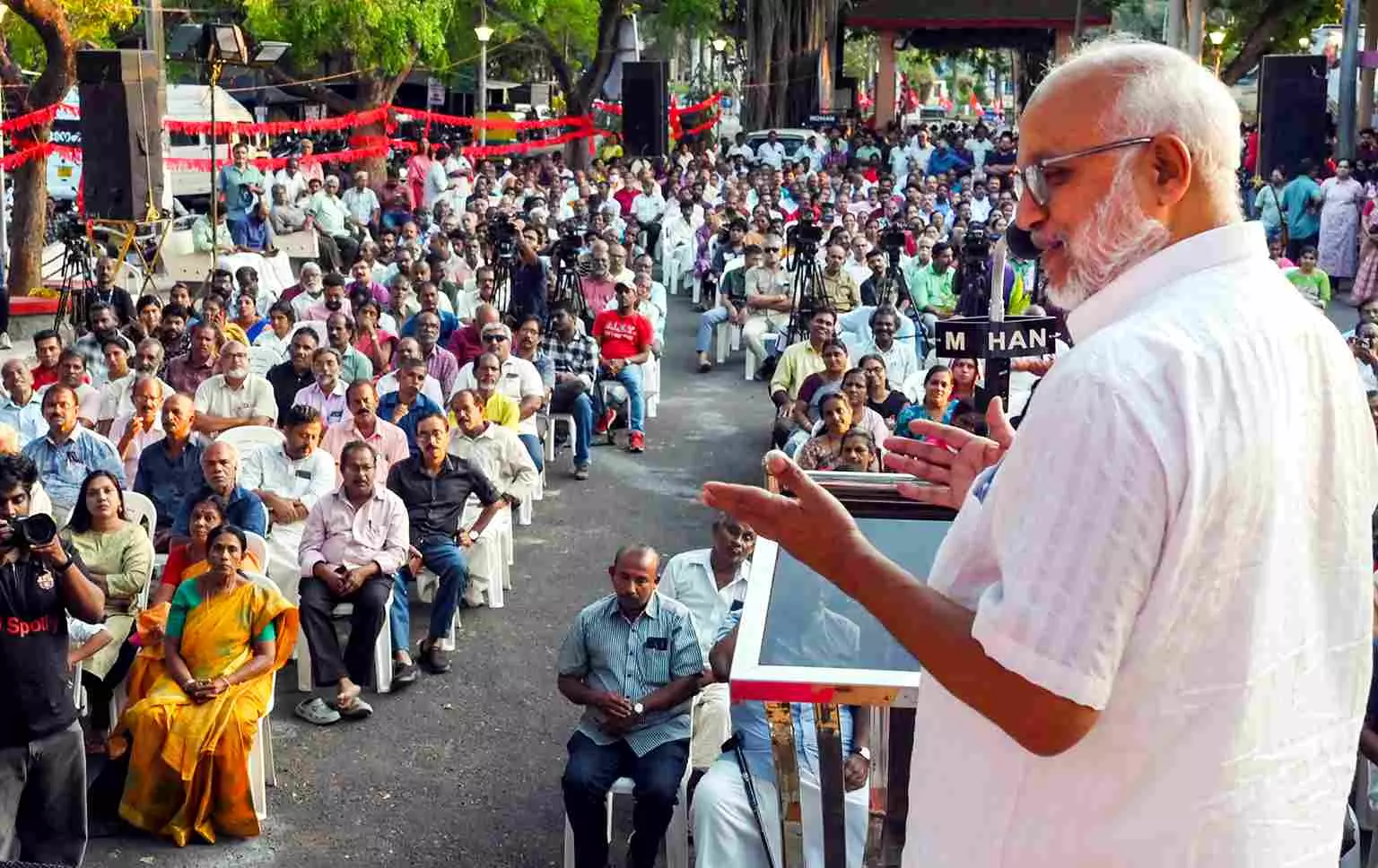
As Kerala heads into a high-stakes election, CPI(M) general secretary MA Baby argues for continuity, pitching the Left Democratic Front’s record as a counter to anti-incumbency.
In an exclusive interview with The Federal, he says that with the LDF seeking an unprecedented third consecutive term under Chief Minister Pinarayi Vijayan, its performance in welfare, public health, education and infrastructure strengthens its re-election bid.
Also read | Kerala elections: Congress alleges BJP-CPM deal, Left hits back
Addressing concerns over recent local body setbacks, leadership centralisation, and internal dissent, Baby dismisses these as limited or “manufactured” narratives, while taking aim at the United Democratic Front (UDF) for what he calls a lack of governance credibility. He also defends the party’s collective decision-making structure and its strategy of balancing organisational work with electoral politics, even as the campaign increasingly spotlights Vijayan’s leadership.
Edited excerpts
The LDF is seeking an unprecedented third straight term. Traditionally, Kerala has swung between fronts. Are you genuinely not seeing any anti-incumbency on the ground, especially when local body polls and recent by-elections seem to indicate a shift towards the UDF?
Five years ago, Kerala witnessed a shift in its pattern of alternating governments, with the LDF not only retaining power but increasing its tally to 99 seats, just one short of 100. That mandate reflected the government’s pro-people policies and its handling of crises, which people continue to appreciate.
While there were some setbacks in local body polls and certain by-elections, these were limited. The UDF did not take away any seats won by the LDF in the previous Assembly election, except Nilambur, which had specific local factors. The panchayat-level setbacks were analysed, and corrective steps have been taken.
In Kerala, voters often differentiate between elections, and local results do not necessarily indicate trends in Assembly elections. We see the local body outcome as an aberration, partly due to overconfidence and other factors. We are confident there is no significant anti-incumbency, and that we will retain the confidence of the people.
There’s been criticism over Pinarayi Vijayan’s interview with Mohanlal, particularly the use of state resources. For a party that has historically criticised personality-driven politics, doesn’t this blur the line between governance and PR? Has even the Left now accepted that optics are central to winning elections?
The chief minister’s interview with Mohanlal was meant to show not just his contributions as a leader, but also his personal journey, his humble working-class background, upbringing, and the values he inherited. Coming from a poor family and working while studying, he rose through rigorous effort to become a mass leader. Many people told me the interview helped them understand this side of him better.
At the same time, there are organised attempts to portray him and the LDF in a negative light. Campaign professionals have been brought in to run what we see as a disinformation campaign. But we believe the politically aware people of Kerala can see through such efforts.
We’re hearing of dissent even in Kannur, long considered the ideological backbone of the party. Is the LDF heading into this election more internally divided than it’s willing to admit?
There is a certain degeneration happening in political life today, driven by the desire for power, visibility, and positions. Traditionally, the CPI(M) and the Left have maintained a distinct approach, not being driven by such factors.
However, this broader societal trend is influencing Kerala as well. While the party has tried to resist it, I admit that in some isolated cases, such tendencies have affected a few cadres and leaders. But this is not the general trend within the CPI(M) or the Left, and it remains manageable.
Also read | Kerala Assembly elections 2026: Shashi Tharoor says BJP a ‘zero-seat party’
Places like Kannur, with their strong legacy of the revolutionary movement, will uphold that tradition. We are confident that local disruptions will not impact the overall outcome.
In constituencies like Palakkad, Manjeswaram, and Konni, the UDF alleges that candidate selection by both the LDF and NDA seem to indirectly benefit each other. How do you respond to the perception that the CPI(M)’s claim of being the principal anti-BJP force is being compromised?
This is a well-concocted narrative aimed at minorities to suggest a link between the CPI(M) and the BJP.
But the facts don’t support that. In Nemom, where the BJP won five years ago, it was due to a decline in UDF votes. Later, we closed that account and the seat was won by the CPI(M). In Thrissur too, the BJP’s Lok Sabha win came as the Congress vote share dropped significantly, while the LDF improved its vote share.
Historically as well, there have been instances of Congress aligning with the BJP to defeat the Left. More recently, in local body elections in Thiruvananthapuram and Kollam, there was clear cooperation between the Congress and the BJP to counter the LDF.
Critics are using the term ‘Pinarayism’ to describe a concentration of power. Is this election becoming a referendum on one leader rather than the Left’s collective ideology?
In the CPI(M), decisions are not taken by any single individual. There is a structured, collective process where policy matters are discussed through free and frank debate before decisions are made.
Even senior leaders, including the chief minister, are part of this collective. Decisions, whether on policy or candidates, are taken collectively, and the majority prevails. There have been instances in the past where top leaders held a view that did not become the final decision because the majority differed. That is how the party functions.
There are whispers about sidelining leaders like KK Shailaja and M Swaraj. Is there no succession plan?
For us, electoral politics is important, but it is not the only arena of political activity. The party is continuously engaged in broader political and ideological work beyond elections.
Unlike other parties, we ensure that a majority of our leadership remains engaged in organisational work. Not everyone is pushed into parliamentary roles.
Also read | Kerala CM Vijayan calls Congress' allegations of CPI(M)-BJP tie-up ‘baseless’
In this election, we have fielded a good mix of candidates, including young leaders. At the same time, we are consciously building a second line of leadership, bringing more young and women leaders into key party structures.
After two consecutive terms, why should a Kerala voter choose continuity over change?
We are placing before the people the LDF government’s achievements across sectors such as welfare, health, education, culture, infrastructure, and large-scale development initiatives. These are concrete and visible.
In contrast, the UDF has little to show from its past record and is relying on promises. People remember that when the UDF was in power, it could not even pay the Rs 600 montly pension for 18 months. It was the LDF that cleared those arrears.
Now, promises like Rs 3,000 per month are being made. We believe voters will judge based on performance rather than assurances.