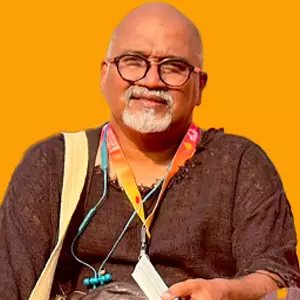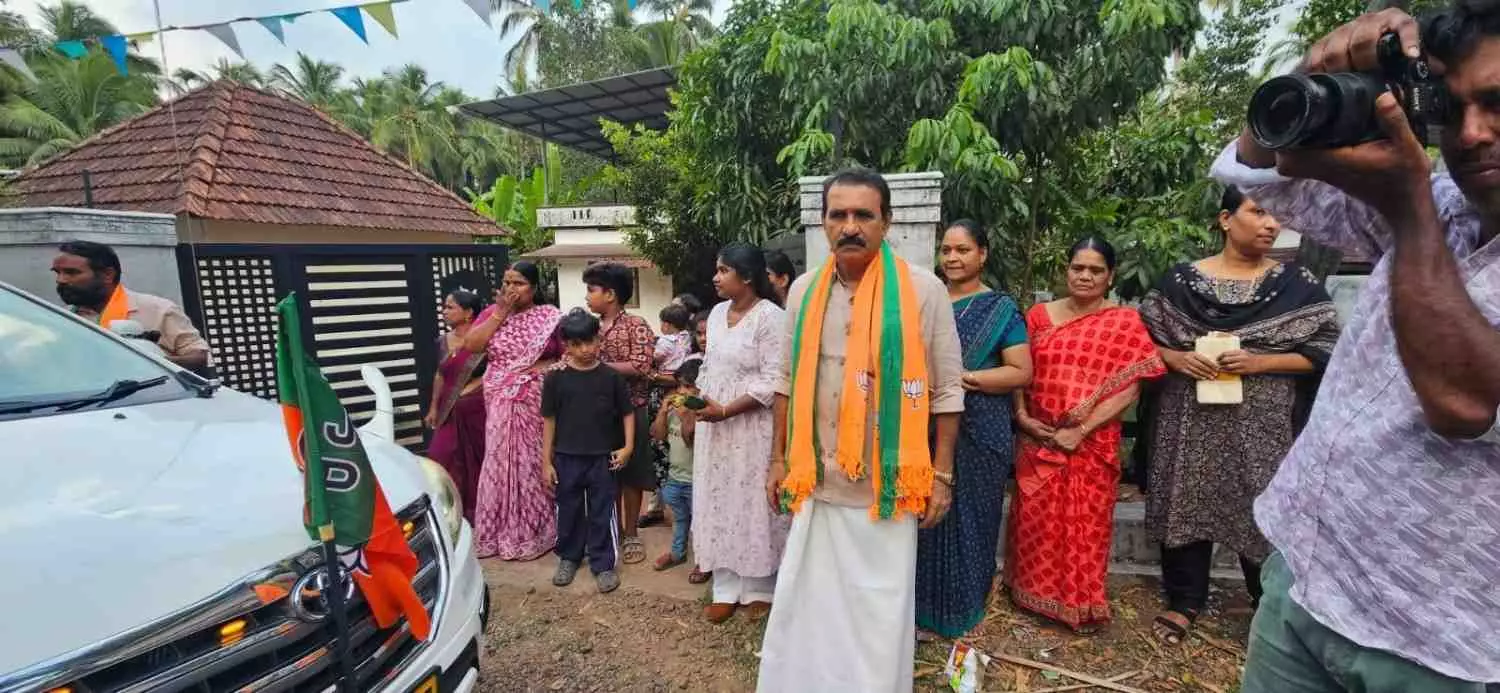
Complaints were filed before the Election Commission of India against Gopalakrishnan, alleging that the remarks violated the Model Code of Conduct by invoking religion in an election campaign. Photo: The Federal
Guruvayur row: BJP candidate’s ‘Hindu MLA’ remark triggers political and legal storm
Gopalakrishnan’s controversial pitch on religious representation in Kerala’s temple town sparks sharp backlash, court scrutiny, and a wider debate on identity, coexistence, and electoral politics

It began, as many political controversies do, with a video and a carefully-chosen moment.
Soon after he was announced as the BJP’s candidate in the temple town Guruvayur, B Gopalakrishnan released a video that would ripple across Kerala’s political scene. Standing in front of the temple, before the camera, he made a pointed claim about his constituency that houses the revered Guruvayur Temple. He alleged that the temple town had not elected a Hindu MLA in recent decades.
“Why does this constituency, an international pilgrimage centre, not have a Hindu MLA? I have been called upon by Guruvayurappan to rescue this land from a half-century-long imprisonment in the hands of temple looters and temple-opposers,” said Gopalakrishnan, in his now-deleted video.
The statement was direct, political, and designed to provoke a response. Within hours, it began circulating widely, drawing sharp reactions from rival parties and sparking conversations far beyond the constituency.
Also Read: Kerala CEO says legal opinion received on BJP candidate's 'Hindu MLA' remark
Even as the criticism mounted, Gopalakrishnan reiterated his position, sharpening the argument rather than retreating from it.
“I stand by my word. If someone can claim himself as a ‘Muslim’ League MLA, why can’t I claim Hindu MLA. Hindu is a culture rather than religion.”
BJP state president Rajeev Chandrasekhar publicly endorsed Gopalakrishnan’s position, with some outrageous and logic-defying claims defending the remarks and drawing parallels with global religious centres.
“Can you have a non-Muslim representative in Mecca or a non-Christian one in the Vatican?” he asked, drawing widespread astonishment.
BJP’s strategy after Suresh Gopi’s win
The political context further shaped the BJP’s strategy. In the recent Lok Sabha election, actor-turned-politician Suresh Gopi, who won from Thrissur, put up a notable performance in segments including Guruvayur, polling 45,049 votes there despite finishing third (the only assembly segment in which he trailed). However, the significant increase in vote share in the temple town belt was seen within the party as a sign of growing acceptance, prompting a more assertive pitch around identity and representation in the subsequent Assembly election.
Also Read: Kerala elections: Why MA Baby thinks Left is winning a record third term
The constituency includes Guruvayur and Chavakkad Municipalities and surrounding panchayats like Engadiyoor, Orumanayur, Kadappuram, Punnayur, Vadakkekad, and Punnayurkulam. The region is socially mixed, with Hindus, Muslims, and Christians living in close proximity, sharing markets, institutions, and public spaces.
Constituency’s varied political lineage
Leaders from different communities and political formations have represented the constituency over the decades. Among the early figures associated with the region was PK Koru, a Hindu by birth who was supported by the Communist movement, being the first MLA in 1957. He was followed by leaders such as KG Karunakara Menon, Varkey Vadakkan, and VVS Thangal, each representing different political streams and communities.
The pattern continued through the decades with figures like PM Aboobacker, PKK Bava, PT Kunhumuhammed and KV Abdul Khader before the seat was won by the current MLA, NK Akbar of the Communist Party of India (Marxist).
Batting for coexistence and secularism
Speaking amid the controversy, NK Akbar did not merely deny Gopalakrishnan’s claim but offered a different point rooted in public memory of coexistence.
“When the Guruvayur temple caught fire in November 1970, it was the nearby mosque that used its azan speakers and the church that tolled bells to gather people. That is the tradition of coexistence and secularism we follow,” he said.
Also Read: Thomas Isaac interview: Is CPI(M) facing a minority challenge in Kerala?
Akbar went on to list the political lineage of the constituency, emphasising that leaders from multiple communities and parties had represented Guruvayur without affecting the functioning of the temple or the experience of devotees.
“We have Mammiyoor temple, Manathala mosque, and the Palayur Church around us. That is the tradition we have. I do not have anything to say in response to Gopalakrishnan’s communal rants. He has to prove his relevance, that is why he is doing these sorts of antics.”
Speaking amid the controversy, NK Akbar of the CPI(M) did not merely deny Gopalakrishnan’s claim but offered a different point rooted in public memory of coexistence.
When religious boundaries dissolved
The reference to the 1970 fire was not incidental. It is an episode that still lives in local memory, often retold as a moment when religious boundaries dissolved in the face of crisis. For many residents, it stands as a reminder that Guruvayur’s identity cannot be reduced to a single religious marker.
Also Read: Kerala elections: Congress alleges BJP-CPM deal, Left hits back
“This present-day development of Guruvayur has nothing to do with the party of B Gopalakrishnan. The BJP and the Sangh Parivar had taken positions against the Guruvayur temple entry movement and socially opposed it. That is the legacy Gopalakrishnan represents. It is the secular parties that have played the key role in Guruvayur’s development. What he is attempting now is divisive politics aimed at creating rifts among the people,” said KV Abdul Khader, a three-time MLA from Guruvayur and currently the Thrissur district secretary of the CPI(M).
“Communal divisions will not emerge in Guruvayur just because B Gopalakrishnan says so. Even if fascist forces attempt it, they will not be able to foster communalism here,” said CH Rasheed, the UDF candidate.
CH Rasheed, the UDF candidate, said communal divisions will not emerge in Guruvayur just because B Gopalakrishnan says so.
Complaints to ECI, Kerala HC
As the political exchanges intensified, the controversy moved beyond rhetoric. Complaints were filed before the Election Commission of India, alleging that the remarks violated the Model Code of Conduct by invoking religion in an election campaign. The Commission sought explanations, bringing the issue into a formal regulatory framework.
At the same time, the matter reached the Kerala High Court. Petitioners from the CPI(M) and Congress argued that the claim was factually incorrect and had the potential to disturb communal harmony in a sensitive constituency. The court, while considering the matter, observed that the issue was serious in nature and directed that the Election Commission take appropriate action within a time-bound period of months.
Also Read: Kerala elections 2026: 10 issues that can determine results
These interventions did not immediately settle the debate, but they shifted its tone. What began as a campaign assertion was now being tested against legal and constitutional standards.
Guruvayur – a shared space
On the ground, however, the political battle continued.
Public meetings as part of the election campaign in the constituency began to reflect the divide. While development issues such as infrastructure, tourism, and civic amenities remained central, the controversy is finding its way into speeches and conversations. Yet, beyond the speeches and statements, there was a quieter response unfolding among the people.
In tea shops near the temple, in the busy streets of Chavakkad, and in the coastal panchayats, conversations often returned to the same point. Guruvayur, many said, had always been a shared space. The temple might define its identity to the outside world, but everyday life within the constituency was shaped by religious coexistence.
Also Read: Kerala elections | Rahul Gandhi bats for UDF, says state ready for change
As the election approaches, the question remains open. Will Guruvayur’s voters accept a reframing of their political identity, or will they reaffirm the patterns that have defined the constituency for decades?
Amid all this, the debate triggered by a single video continues to echo, testing not just political claims, but the very idea of what Guruvayur represents.