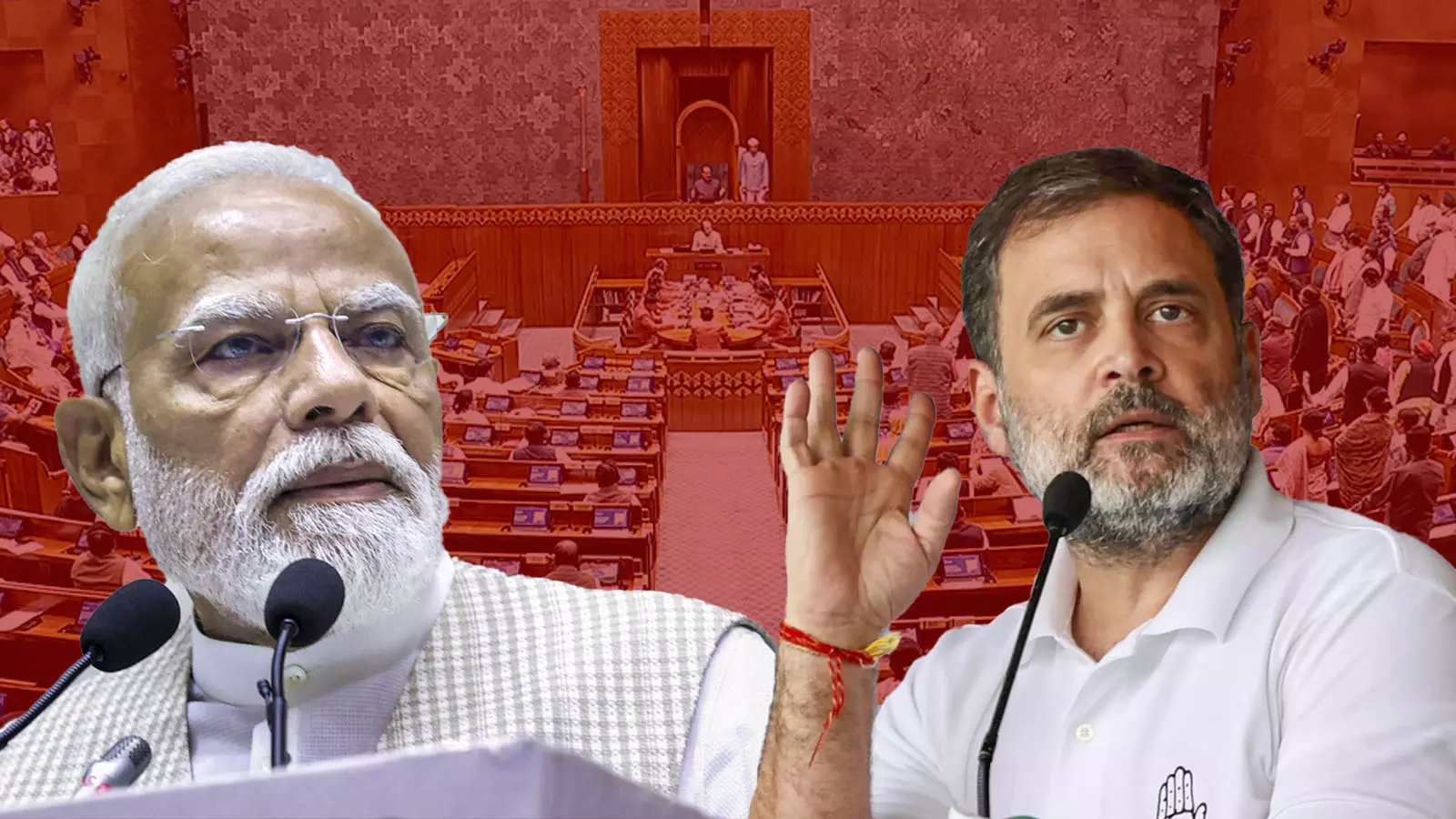
The government led by Prime Minister Narendra Modi and the Opposition spearheaded by LoP Rahul Gandhi has come on a collision course after the women's quota amendment bill hit a wall in the Lok Sabha on April 17, 2026.
Women's quota: Opposition has not averted delimitation danger, only deferred it
After blocking the BJP's delimitation 'trap', the Opposition now faces a political minefield of 'anti-women' rhetoric and constitutional deadlocks

A united Opposition may have stalled the Centre’s wily attempt at altering the country’s political map under the garb of expediting the rollout of women's reservation, but, in doing so, may have created fresh challenges for itself.
The immediate hurdle before the Opposition’s Indian National Developmental Inclusive Alliance (INDIA) bloc, which collectively stalled the passage of the Constitution (131st Amendment) Bill in Lok Sabha on Friday (April 17), is to counter the Bharatiya Janata Party's (BJP) cacophonous diatribe.
Also read: PM Modi to address nation at 8.30 pm tonight; focus may be on women’s quota
The ruling party and its National Democratic Alliance (NDA) allies have lost no time in dubbing the Opposition as “anti-women” for derailing a Bill that intended to “empower Naari Shakti” with an earlier-than-scheduled implementation of women’s reservation.
Prime Minister Narendra Modi is expected to further sharpen this rhetoric when he addresses the nation on Saturday (April 18) night.
The Opposition, so far, has been steadfast in rejecting the Centre’s charge. From Congress MP Priyanka Gandhi to Dravida Munnetra Kazhagam (DMK) chief MK Stalin, top Opposition leaders have asserted that the Modi government had “deliberately” tethered early implementation of women’s reservation, already included in the Constitution in September 2023 with the unanimous passage of the Naari Shakti Vandan Adhiniyam, to a “deceptive and unfair delimitation exercise”, as a nefarious design to “weaponise” the women’s quota for electoral gains in poll-bound Tamil Nadu and West Bengal, without actually hastening its rollout.
The Opposition parties have also dared the Centre to demonstrate its seriousness on early implementation of the quota by “decoupling the reservation rollout from the 2027 Census and a subsequent delimitation exercise” through amendments in the Adhiniyam and “implement the 33 per cent reservation within the existing strength of the Lok Sabha (543 MPs).”
BJP plans wide protest against Opposition
The BJP, sources said, has already drawn up a “nationwide protest plan” against the Opposition. In the cabinet meeting he chaired on Saturday morning, Modi, it is learnt, instructed all members of his NDA cabinet to “ensure that the Opposition’s role in preventing women reservation” must be taken to the people at the grassroots through extensive door-to-door campaigns.
Also read: Stalin hails Opposition after Delimitation Bill defeat, calls it ‘turning point’
Whether the Opposition, particularly the inertia-prone Congress, is able to respond with equal alacrity and acuity and sustain its counter-offensive beyond the current round of press conferences and news bytes, will decide how this clash of rhetoric eventually pans out. At least some signs about which of the two sides has prevailed may be visible when results for the Bengal and Tamil Nadu polls are announced on May 4.
Opposition's next challenges
The next challenge before the Opposition, however, is both complex and riddled with severe electoral consequences.
Over the past two days of discussion on the Constitution (131st Amendment) Bill and the Delimitation Bill that the Centre entwined with it, the Opposition vociferously asserted its commitment to the “immediate implementation” of the 2023 Adhiniyam.
What the Opposition had grave objections to was the legislative roadmap the Centre had laid down in the proposed constitutional amendment to achieve an early rollout of a reservation already mandated in the charter 30 months ago.
Opposition's three-point objections
The Opposition’s objections were, primarily, on three counts.
First, the Constitution (131st Amendment) Bill made the women’s reservation rollout contingent on a hike in the Lok Sabha’s strength from the current cap of 550 seats to 850 seats following a delimitation exercise.
Second, this delimitation exercise (as well as similar exercises done subsequently), as per the text of the Bill, was to be conducted based on a Census of the government’s choosing (in the instant case, the 2011 Census, as per the Bill’s Statement of Objects).
Also read: Women's Quota Amendment Bill fails: Here are the key takeaways
Lastly, a delimitation involving recasting the Lok Sabha and the legislatures would both marginalise the share of southern and smaller states compared to Hindi Heartland states such as Uttar Pradesh and Bihar, and would be open to a gerrymandering exercise politically influenced by the BJP.
With the defeat of the Constitution (131st Amendment) Bill, Opposition parties claimed they had prevented all these three things from happening and, in doing so, saved democracy from a ‘federal imbalance’ that would have leaned heavily in the BJP’s favour.
The BJP, as expected, has rejected the Opposition’s arguments. During his reply to the discussion, Union Home Minister Amit Shah had, in a clear show of brinkmanship, even urged Lok Sabha Speaker Om Birla to “adjourn the House for one hour”, claiming “I will return with an amended Bill that says the share of all states will be increased by 50 per cent uniformly and proportionate share of states will remain the same as in the current Lok Sabha”.
The dare, in all probability, was as much a red herring as the Opposition’s claim that it would support the Bill if the proportionate share of seats for all states is guaranteed to remain the same. After all, long before the Bill was taken up for discussion in the Lok Sabha, Shah was well aware of the valid apprehensions of the Opposition, particularly of parties such as the DMK, about the five southern states being pushed to the margins in an 850-member Lower House, and could have weaved the 50 per cent formula into the Bill’s text right at the start.
In any case, Samajwadi Party chief Akhilesh Yadav’s retort, that given the Opposition’s experience with the Centre’s assurances over the past 12 years, “we would not believe you even if you gave in writing that a woman would be made Prime Minister”, summed up the widening gulf of mistrust between the Opposition and Treasury Benches, which the proposed constitutional amendment has only widened.
Also read: What is gerrymandering, and why is everyone suddenly talking about it?
The Opposition has now decided to collectively write to Modi demanding that the one-third reservation promised to women in Lok Sabha and the legislatures in the 2023 Act should be implemented immediately.
What the Opposition, however, is conveniently overlooking now is that the Naari Shakti Vandan Adhiniyam it had helped pass unanimously in Parliament in September 2023, had made implementation of women’s reservation contingent on the publication of the 2027 Census and a delimitation exercise conducted on its basis.
Additionally, the Opposition has demanded that any women reservation rollout must not exclude a ‘quota within quota’ for Other Backward Classes (OBCs). Simultaneously, the Congress and its allies have also asserted that the government was trying to revert to the 2011 Census as reference data for a quota rollout to evade granting OBC women a ‘quota within quota’.
Opposition's minefield
This formulation by the Opposition of its current stand on reservations creates a minefield of its own.
Firstly, if the Centre is to implement women’s reservation immediately, as the Opposition is demanding, it can’t do so with a ‘quota-within-quota’ as the 2011 Census, like all enumeration exercises conducted since 1941, did not include caste data.
If the Opposition’s demand for a quota-within-quota is to be met, the Opposition must wait for a fresh delimitation exercise based on the ongoing Census, which, as per Census Commissioner Mritunjay Narayan, is expected to be completed within 2027 and will include caste enumeration.
Secondly, unless it is amended, the 2023 Adhiniyam that the Opposition had backed cannot be implemented in its present form without a delimitation exercise based on the 2027 Census.
Also read: Is BJP electoral juggernaut deciding the shape of women’s quota, delimitation bills?
Thirdly, the freeze on readjusting seats in the Lok Sabha, implemented in 1976 by the 42nd Amendment to the Constitution and subsequently extended till 2026 by the 84th Amendment to the Constitution, is now over. This, by itself and also when read with the mandate enshrined in the Naari Shakti Vandan Adhiniyam, makes a delimitation exercise inevitable.
The only question regarding the exercise is whether such a delimitation will see both a readjustment of seats and a reshaping of constituencies (gerrymandering)—as per the delimitation scheme mandated in the Constitution before 1976—or just the latter, as was made possible through the Delimitation Act of 2002 when the then Atal Bihari Vajpayee government amended the Constitution to allow a change in the boundaries of Lok Sabha and Assembly constituencies without changing the overall seat count of the Lok Sabha and Legislatures.
Fourthly, if the Centre agrees at all to the Opposition’s demand of extending the freeze on readjustment of seats in the Lok Sabha by another 25 years, the issue of gerrymandering to allow both women and OBC reservation will continue to linger.
The Congress’s communications department chief, Jairam Ramesh, has repeatedly said that since the census commissioner has expressed confidence of completing the ongoing population-cum-caste enumeration within 2027, a delimitation exercise based on the 2027 Census could still be completed within 2028 to enable the rollout of women’s reservation on the existing 543 Lok Sabha seats.
Since the Modi government is unlikely to achieve, by any just means, a two-thirds majority in the Lok Sabha in the remainder of its current term, it may not be able to bulldoze a constitutional amendment that revises the seat-count in the Lok Sabha and State Legislatures.
Lack of numbers not a deterrent
The lack of numbers, however, will not prevent the Centre from pushing a Delimitation Bill, based on the 2027 Census, on grounds that delimitation is imperative for rolling out women’s reservation as per the 2023 Adhiniyam, and more so if a quota-within-quota is also to be granted to satisfy the Opposition.
By committing itself simultaneously to the 2023 Adhiniyam and the campaign for a ‘quota-within-quota’, the Opposition has, thus, unwittingly committed itself to delimitation too. Do not be surprised if the BJP throws this argument at the Opposition as soon as the 2027 Census is completed and then argues afresh for a delimitation exercise. If the Opposition dithers then and demands decoupling the reservation rollout from delimitation, the BJP will lap up the chance to assert again that ‘we told you they are anti-women’.
Also read: Women’s reservation a smokescreen for delimitation, warns activist Anjali Bhardwaj
Agreeing to a delimitation exercise based on the 2027 Census will continue to pose the same threat to the Opposition that agreeing to a similar exercise based on the 2011 Census does now. The Congress has already suffered the adverse electoral consequences of gerrymandering in both Assam and Jammu and Kashmir in the 2024 Lok Sabha polls. Similar consequences may await other Opposition parties in the 2029 Lok Sabha polls if conducted based on a delimitation exercise.
The defeat of the Constitution (131st Amendment) Bill and the Delimitation Bill in the Lok Sabha may have given the Opposition some reason to cheer for now. It hasn’t averted the bigger challenge that awaits.