Beyond empowerment, India needs women leaders for its own good
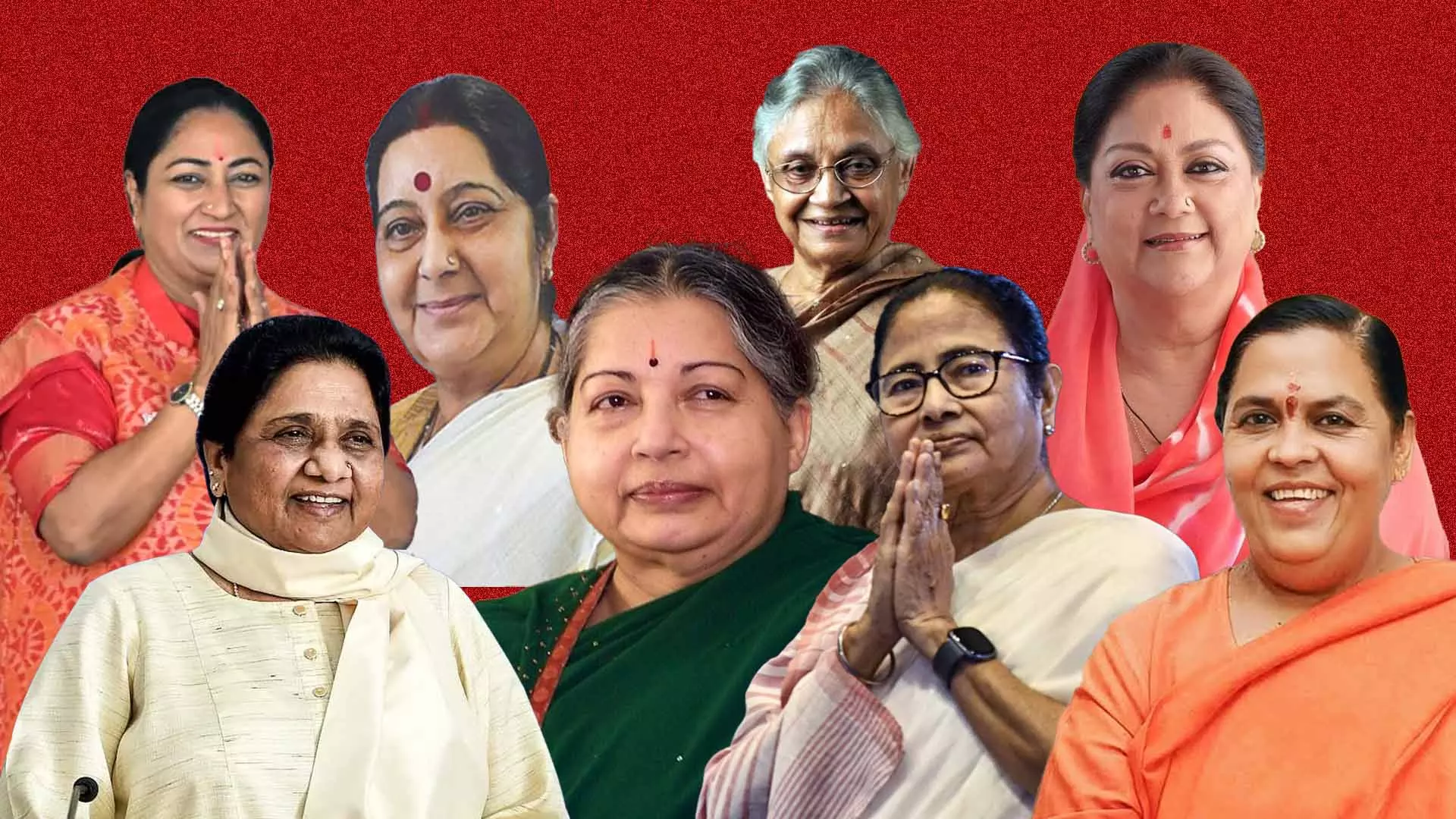
Be it Jayalalithaa or Mamata or Uma Bharti or Sheila Dikshit, women CMs have shaken governments and governance with true nari shakti

Women's reservation is dominating Indian politics right now. A Constitution Amendment Bill to implement quotas by 2029 hit a wall in the Lok Sabha on April 17. The government and Opposition immediately traded blame. Each accused the other of either blocking women's progress or using the quota as cover for a delimitation agenda.
But amid the noise, a simpler question lingers. How much have India's political parties actually allowed their women members to rise? And what difference have the few women who did reach the chief minister's chair truly made?
Also read: Nari Shakti: A convoluted stratagem to preserve male dominance
According to one report, India has more than 1.4 million elected women who actively take part in local self-government institutions (urban and rural), suggesting that their status in politics has transformed significantly. But yet, after all these years, women representatives in the country mostly remain eclipsed by a patriarchal structure, and are promoted more as mothers, daughters, wives or proteges of male faces.
Since we are trying to understand the role of women in politics from the federal perspective, we are not including names that have excelled at the central level, such as Indira Gandhi or Sonia Gandhi, in this space. We take a bottom-up approach instead.
India has seen 18 women CMs so far
India, since Independence, has seen 18 women chief ministers. Starting from Sucheta Kripalini (the first woman to become the chief minister of an Indian state) in the 1960s to Nandini Satpathy to J Jayalalithaa to Mayawati to Sushma Swaraj to Sheila Dikshit to Uma Bharti to Mamata Banerjee and Rekha Gupta today, India has seen many state-level women leaders who have had a varied impact on federal politics. But one thing is common for most of them: Rising through the ranks has never been a cakewalk for these leaders, despite their potential and performance.
Jayalalithaa, Mayawati, Mamata
Three most significant women state leaders who have had a decisive impact on the national level are Jayalalithaa (Tamil Nadu), Mayawati (Uttar Pradesh) and Mamata Banerjee (West Bengal). Despite being regional (though Mamata had a long stint at the Centre before becoming the chief minister in 2011), these three leaders have arguably been the most consequential in India’s federal politics. And all of them—firebrand by nature—have the common story of taking on a male-dominated political system.
Also read: Congress, DMK, TMC, SP 'crushed women's dreams', says Modi
All three were targeted physically by their political opponents in their respective states in the 1990s, which only strengthened their resolve to take the male adversaries by horns and defeat them repeatedly in elections. Although she was never a part of Delhi’s power corridors herself, Jayalalithaa was effective enough to pull the strings from Chennai to bring down a central government in 1999. Mamata and Mayawati were no less threatening to coalition governments’ survival at the Centre. In their respective states, too, Jayalalithaa, Mayawati and Mamata significantly influenced the political discourse.
Jayalalithaa, for instance, made the women a decisive voting bloc in Tamil Nadu, something which continues even a decade after her death. Despite all the corruption charges, the former All India Anna Dravida Munnetra Kazhagam (AIADMK) supremo’s populist “Amma brand” of governance turned into an administrative model which became widely imitated, even beyond Tamil Nadu’s borders.
Mayawati, the political successor to Bahujan Samaj Party (BSP) founder Kanshi Ram, is still remembered for her social engineering that gave a poll-winning rainbow coalition of Dalits and Brahmins in 2007. Although she has not been a force she once was, the BSP chief's contribution towards mainstreaming Dalit assertion into electoral arithmetic to overcome the powerful Hindu and male chauvinism of opponent parties such as the BJP and Samajwadi Party is undeniable.
Mamata never had a mentor like Jayalalithaa (in MGR) or Mayawati (in Kanshi Ram), but that never stopped her from clinching political power. Though former prime minister Rajiv Gandhi had played a significant role in guiding her in her early days, his untimely death saw Mamata getting cornered in the Congress, resulting in her pulling out and forming her own Trinamool Congress in the late 1990s.
While she prioritised Bengal politics after single-handedly toppling the regimented Left from power after 34 years, her party’s influence in Delhi politics has not faded. The streetfighter in Mamata plays the role of an opponent perfectly, even at 70-plus and is considered one of the main anti-BJP forces in the country. It was not easy for her either, while fighting the Left and her critics in the original party, the Congress, once, but Mamata prevailed, just like Jayalalithaa and Mayawati.
Sheila Dikshit, Vasundhara Raje: The efficient CMs
Though less effective than the above three leaders, Sucheta Kripalini (UP), Sheila Dikshit (Delhi), Sushma Swaraj (Delhi), Vasundhara Raje (Rajasthan) and Rabdi Devi (Bihar) made a big mark in their respective states. Kripalini, who belonged to the Congress, is still seen as one of the top women leaders that the country has produced, who helped draft the Constituent Assembly and founded the All India Mahila Congress.
Sheila Dikshit, who passed away in 2019, is still recalled as a face of an efficient administrator. As a former chief minister of Delhi, she is perhaps the last face the Congress presented in governance. It was never easy for Sheila, who ruled the national capital for 15 years (1998-2013) despite having uneasy terms with her party often. But by navigating the challenges with a calm and warm disposition, Sheila proved that women are no less capable of handling complex and high-stakes administration.
Also read: Sheila Dikshit: Chief minister who redefined Delhi's destiny, paid for it
Her popularity had dipped little even when the Commonwealth corruption hurt the Congress much, but eventually she lost to a movement against corruption that gained momentum under Arvind Kejriwal. The Congress even roped her in to counter Modi’s appeal as an able administrator in the run-up to the 2014 general elections.
If Sheila became bigger than her party in Delhi, Vasundhara Raje did something similar in Rajasthan. The two-time BJP chief minister of the state. Her Bhamashah Scheme for women’s uplift is widely discussed. Her contributions included both Rajasthan’s development and the saffron party’s stronger clout (it was under her that the BJP formed its first majority government in the state in 2003). But differences with the RSS and the BJP’s top brass ultimately diminished the role of Raje, perhaps the party’s biggest asset in the desert state.
Rabri Devi, accidental CM but politically able
Another less-discussed woman leader who made an impact in a state is Rabri Devi, who landed in the hot seat after her husband, Lalu Prasad, had to resign following the fodder scam. While she is often written off as a little-educated proxy for the RJD supremo, one cannot deny her role as the last chief minister of undivided Bihar. Elitism was never her forte, but she served a bridge between the Lalu and Nitish Kumar years in Bihar and kept her party while her husband was far and the children were feuding.
Sushma Swaraj is another chief minister that the BJP produced, but for less than two months. A product of the Vajpayee-Advani era, Sushma survived far too short as the CM, not because of her own folly but more because she was sacrificed in an unsalvageable situation. She replaced Shahib Singh Verma amid challenges, and the prevailing onion crisis made things no easier for her. Sushma’s better days came much later when she became the external affairs minister, but in her brief term as the CM, the gifted orator had succeeded in smashing the BJP’s glass ceiling to become the party’s first woman chief minister.
Uma Bharti, once Hindutva's poster girl
One should not also lose sight of Uma Bharti, another firebrand saffron leader, who many considered the poster girl of the Hindutva movement, particularly that related to the Ayodhya agitation. What made Uma an exceptional woman leader from the BJP is not only her saffron identity, but also her capacity as a mass mobiliser, a saadhvi, an OBC face in a party dominated by the upper castes, who also went on to become a chief minister (Madhya Pradesh) and a central minister in charge of the Ganga’s rejuvenation.
Also read: Women's Quota Amendment Bill fails: Here are the key takeaways
Though her administrative roles did not last that long, Uma signifies a moment when religious populism, caste aspiration, and female agency collided in an unprecedented way. She is nowhere near the prominence in Modi’s BJP as she was in Vajpayee’s, and something even confronts the saffron party today on issues related to the women’s reservation bill (she wants reservation for OBCs in that) or the water-poisoning episode in Indore.
Atishi, more a stopgap CM?
There are also leaders such as former Delhi chief minister Atishi Marlena and her successor, Rekha Gupta, who have also remained in the shadow of their respective parties—the Aam Aadmi Party and the BJP. While there are reasons for their promotion, including a clean image and background and grassroots connections, in reality, the elevation of these leaders suggests that it is either done as a stopgap measure or that the party is okay to sacrifice them in case the decision backfires.
Left has given little space to women
Even in the Left, such instances are not unusual. Although no woman in India’s Left has ever become a chief minister, there has been no dearth of rewarding candidates. In Kerala, K R Gouri Amma and K K Shailaja are some such names. In Bengal also, the Left has been seen fielding a number of new women faces for elections to defeat Mamata, but experts believe they are not given much backing by the Left’s male-dominated leadership.
Also read: Women's quota: Opposition has not averted delimitation danger, only deferred it
In such a political reality where women can make it big only after facing the system and hitting back, how much the reservation idea can really help them thrive is a question to ponder over.