BJP may flag ‘infiltrators’ but Bengal border villages tell a different story | Ground report
Despite proximity to Bangladesh, locals say ‘outsiders’ are rare, questioning political narrative amid voter roll scrutiny and SIR exercise

In the border areas of West Bengal, often cited as having witnessed demographic change due to alleged illegal infiltration from Bangladesh, “ghuspethiyas” (infiltrators) remain a phantom, omnipresent in the BJP’s political narrative but invisible on the ground.
In Bansabati, under Jangipur subdivision of Murshidabad, which is close to the India-Bangladesh border, even Hindu residents who claim to be supporting the BJP do not subscribe to the narrative.
‘No communal issues’
Pointing towards his customer, Mobarak Hossain, sitting on a wooden bench at his tea stall-cum provisions shop, Nikhil Kumar Dutta said, “I am 67 years old. We have known these families since childhood. We have seen their fathers and grandfathers. How can they suddenly be called Bangladeshis?”
In our village, we know who belongs here. There are no Bangladeshis in Bansabati. If someone tries to label them that way, we cannot accept it.”
Also read: Amit Shah, Mamata Banerjee clash over infiltration, SIR in West Bengal
Dutta maintained that there was no communal tension between Hindus and Muslims in this mixed village, adding that even if the BJP comes to power, it would have no impact on communal harmony.
He said many Hindu voters may lean towards the BJP, not out of support for a divisive agenda, but believing that it can deliver development in the state.
“If I do not have any problem with my neighbour, who can create one? Our houses, mine and a Muslim family’s, stand just across the road. Our fathers and grandfathers have lived here side by side, and there has never been any trouble. People will vote as they wish, and that has never affected how we live together,” said another Bansabati resident, Tapan Kundu, suggesting that the issue of illegal migrants is more political rhetoric than lived reality.
Mobarak Hossain (seated in the middle in the picture on the right) inside Nikhil Kumar Dutta's (left) shop
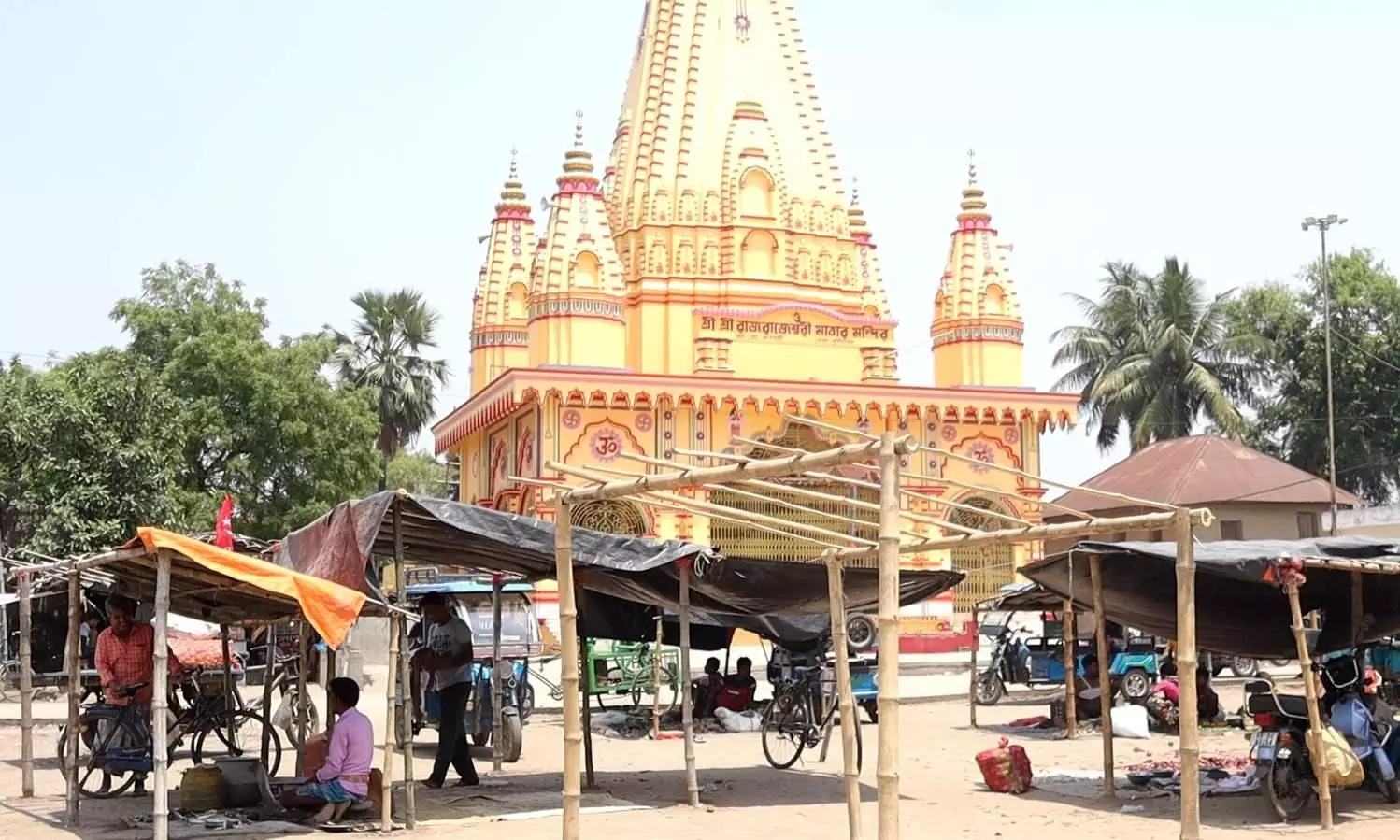
Many Muslims even contributed funds towards the construction of a new structure for the village’s Raj Rajeswari Mata temple, which was completed a couple of years ago.
Issue of illegal immigrants
Bansabati village is located roughly 5 to 11 nautical miles from the Bangladesh border, placing it among the frontier settlements where cross-border infiltration would presumably be most visible.
The India-Bangladesh border near Bansabati, part of Murshidabad’s roughly 125-km-long border stretch, is partially fenced, with significant unfenced riverine gaps that could, in theory, allow illegal cross-border movement.
I am 67 years old. We have known these families since childhood. We have seen their fathers and grandfathers. How can they suddenly be called Bangladeshis? — Nikhil Kumar Dutta, resident of Bansabati
The Special Intensive Revision (SIR) exercise, carried out by the Election Commission (EC), has triggered widespread scrutiny and anxiety, particularly among those whose names have been placed under “adjudication” or removed from voter lists.
While the EC has maintained that one of its objectives is to cleanse the rolls of non-citizens, it has not publicly clarified how many of those excluded are actually illegal migrants.
Unanswered RTI query
It is yet to respond to an RTI query filed on March 2 by Murshidabad-based social worker Asif Faruk seeking details on how many voters were marked as “Bangladeshi” during the SIR exercise.
Instead of giving a state-wide figure, the RTI application was forwarded to the Electoral Registration Officer (ERO), the authority responsible for the preparation and revision of the electoral roll of a constituency.
Also read: Why Tathagata Roy is confident BJP will oust Mamata Banerjee
Faruk said the ERO has not yet responded.
That absence of data has helped the BJP further push its hypothesis in this election.
BJP’s ‘zero-tolerance’ push
Prime Minister Narendra Modi has repeatedly warned in his election speeches of what he describes as a demographic shift driven by infiltration, saying the country must “safeguard the nation’s borders and demography” and cautioning that “infiltrators” pose a threat to social harmony and internal security.
Union Home Minister Amit Shah, too, has alleged that illegal migration from neighbouring Bangladesh is changing the demographic profile of West Bengal’s border regions.
Also read: Modi in Malda: Infiltration biggest challenge for Bengal, refugees need not worry
The BJP in its manifesto has promised a “zero-tolerance” approach to illegal migration, proposing a “detect, delete and deport” policy and fast-tracking border fencing, while terming infiltration as a threat to the state’s demographic and territorial integrity.
Narrative vs reality
Yet, as in Bansabati, the gap between political assertions and ground reality becomes apparent.
Travel north to Bhabuk village in the Maldaha assembly constituency of Malda, and a similar picture emerges, with ‘phantom’ infiltrators more evident in political rhetoric than in everyday life.
Some people are said to have come from Bangladesh many years ago in the municipal area, but they are Hindus — Sanjit Rajbangshi, resident of Bhabuk village in Malda
Sanjit Rajbangshi, a resident from a Scheduled Tribe community, is unequivocal. “We people from the ST and SC communities live here and in nearby villages. They say Bangladeshis are entering. No, not a single infiltrator has entered our Habuganj region,” he said.
He gestured towards the direction of neighbouring villages, many of them Muslim-majority.
“Take Jatradanga or Moshbathan. There’s nothing of that sort there either. In our Old Malda block, so close to the Bangladesh border, we have not seen any Rohingyas or infiltrators entering the area.”
The nearest India-Bangladesh border is within about 10 km of the village, and here too it is only partially fenced.
“Some people are said to have come from Bangladesh many years ago in the municipal area, but they are Hindus,” Sanjit added, a detail that further complicates the BJP’s infiltration narrative.
Sanjit Rajbangshi (left) said not a single infiltrator had entered Habuganj region as his friend Kartik Rajbangshi (right) agreed.
‘No outsiders’
Such views are not isolated.
From tea stalls and marketplaces to village corners across the border region, people express a similar scepticism about sweeping claims, based on what they observe in everyday life.
Also read: Mamata govt provided identity cards to infiltrators, says Giriraj Singh
“In villages like ours, everyone knows everyone,” said Nimai Adhikari, who runs a tea stall at Malda’s Malatipur bazar. “You know their families, their land, and their history. It is not easy for an outsider to come and live here unnoticed. There are no Bangladeshis here.”
Nimai claimed to be a BJP supporter.
Personal attack
For Muslim residents who often find themselves at the receiving end of this narrative, the issue is not abstract or ideological, it is personal.
Md Sharif Ahmed of Murshidabad’s Dakshin Mahadeb Nagar, Mobarak Hossain of Bansabati, and lakhs of others find their names under scrutiny even though they have lived in their respective villages for generations.
Also read: Living on the Zero Line: Why life is a daily struggle for residents of Bengal's Hakimpur village
“My father and grandfather and their fathers and grandfathers lived here,” Ahmed said. “We have documents, land records, dating back to 1924. Still, we are being asked to prove ourselves again.”
What unsettles them more than the process, they say, is the narrative that most of those whose names are deleted are Bangladeshis.
Identity beyond papers
Several Hindu residents express empathy for such concerns, even if they are not directly affected.
“Documentation is not always easy, especially for the poor,” said Uday Mandal, a teacher and a social worker from Malda’s Balarampur village. “Many people do not have all the papers. That does not make them outsiders or infiltrators.”
Identity is not just determined by documents or political claims, but by memory, recognition, and years of shared living.
And for many residents of villages hugging the border, lived knowledge carries more weight than political rhetoric or the hurried and haphazard bureaucratic exercise called the SIR of the electoral roll.