



Bengal election: Will AIMIM-AJUP alliance split minority votes?
West Bengal heads into a tight election with no clear wave. The AIMIM-AJUP alliance targets minority voters in key districts, potentially splitting votes in close contests

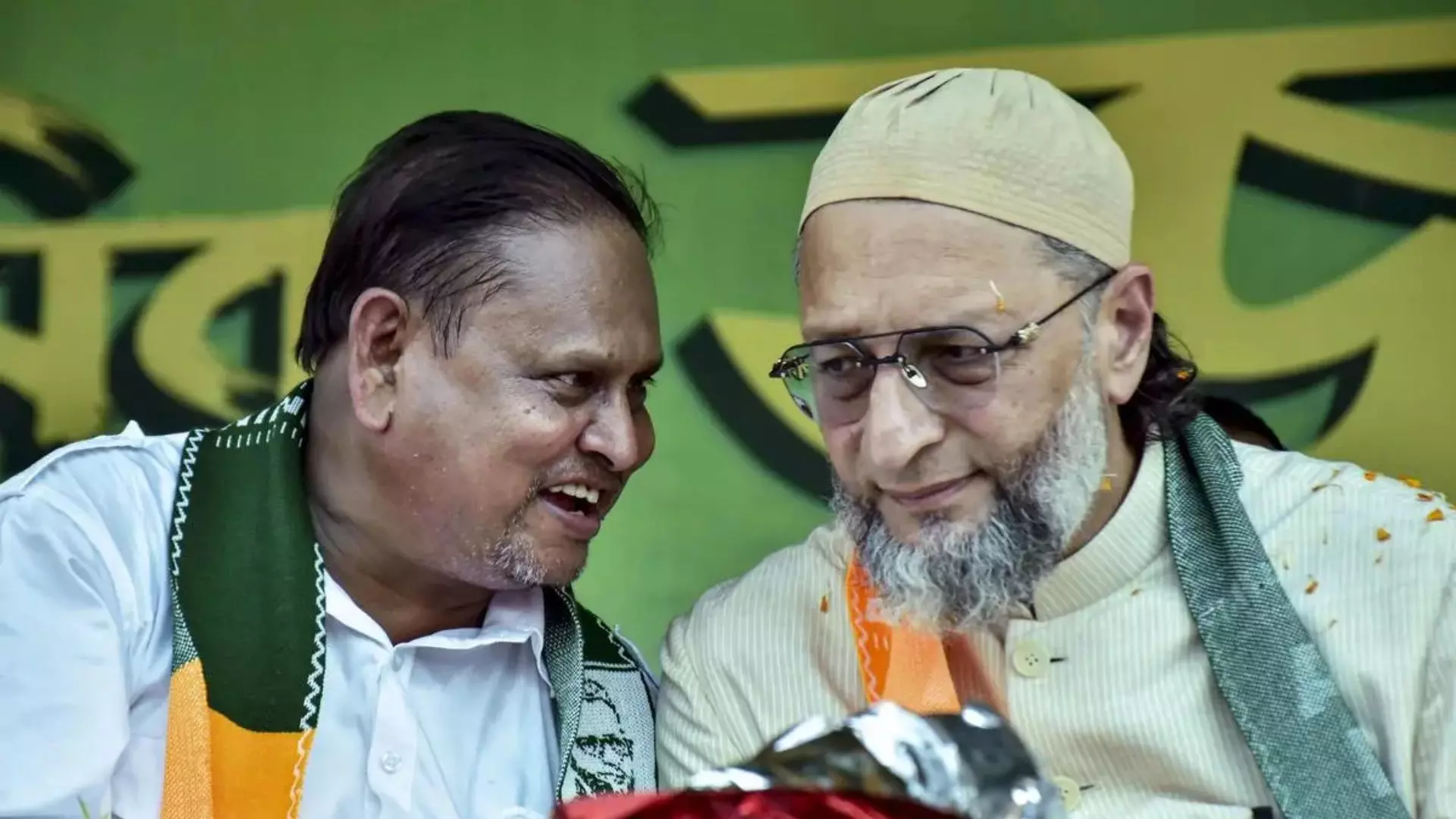
West Bengal is heading into an Assembly election where no party has the wind clearly at its back. Into that uncertainty, a brand new alliance between Asaduddin Owaisi's All India Majlis-e-Ittehadul Muslimeen (AIMIM) and Humayun Kabir's Aam Janata Unnayan Party (AJUP) has entered — one that could redraw the state's electoral map, not by winning big, but by splitting votes in exactly the right, or wrong, places.
For the first time in a long time, a poll-bound Bengal is not seeing a strong wave for or against the ruling Trinamool Congress (TMC). Political analysts see the AIMIM-AJUP partnership as a calculated move to bridge two distinct Muslim voter groups — the Urdu-speaking Muslims, where AIMIM has a growing footprint, and the Bengali-speaking Muslims, where Kabir's party holds limited influence, mostly in pockets of Murshidabad district.
Also read: Bengal polls: 20 days to go for phase 1, chaos continues over missing names after SIR
The Indian Secular Front (ISF) is another group that could make an impact in southern Bengal, further complicating the electoral arithmetic.
Tight margins
The numbers tell a delicate story. In the 2021 Assembly elections, 35 seats were decided by margins of fewer than 5,000 votes, while close to 70 more were decided by fewer than 15,000 votes. Most of these were in mixed constituencies where minority voters made up between 9 and 31 per cent of the electorate.
If the new alliance manages to peel away even a small share of minority votes in these tight contests, it could shift outcomes — particularly in seats where the margin between winning and losing is razor-thin. For context, the BJP won 22 of those 35 closely-contested seats in 2021, including very narrow victories in places like Dinhata in north Bengal and Kulti in south Bengal, even as minorities overwhelmingly backed the TMC.
Also read: Drone seen near Mamata's helicopter in Malda; CM asks police to identify source
On the other end, the TMC's biggest wins — by margins exceeding 90,000 votes — came from seats with substantial minority populations of between 22 and nearly 80 per cent. Analysts say that in those strongholds, a small vote shift is unlikely to threaten the party.
Muslim frustration
The alliance is banking on a real, documented frustration. West Bengal's Muslim community makes up around 30 per cent of the state's population. But according to state government data published in 2016, Muslims accounted for just over 6 per cent of state government employees, with a large proportion of the community concentrated in informal or low-income work.
Owaisi highlighted this gap when announcing the alliance, pointing out that only 7 per cent of the state's 30 per cent Muslim population are in government jobs. There is also anger over a revised OBC list, where a significant number of Muslim sub-communities have been moved from the higher-reservation OBC-A category — carrying 10 per cent reservation — down to OBC-B, which carries only 7 per cent. Thirty-seven Muslim groups were removed from the lists entirely.
Protests broke out in several minority-dominated areas over these changes. Kabir described the new OBC policy as a complete letdown, saying the Muslim community would not forgive the TMC for it.
Defensive voting
Yet analysts caution against reading too much into this frustration. In seats where the BJP is the main challenger, Muslims are likely to continue backing the TMC as a bloc, to keep the BJP out. That defensive instinct is unlikely to disappear — especially after the recent Special Intensive Revision (SIR) of electoral rolls, an exercise that has disproportionately affected Muslim voters and deepened anxieties about political exclusion.
Congress spokesperson Chandan Ghosh Chowdhury pushed back on the idea that minority voters would drift away from Congress. "The consolidation for Congress is going to remain — rather, it's going to grow more. That is what our belief is," he said.
He pointed out that Congress has always been the natural alternative for minority voters in these districts — not the BJP — and that the community's faith and beliefs have historically aligned with Congress, not with newer political formations.
Congress in the crossfire
However, in seats where the BJP is not a significant factor, some Muslim voters may look beyond the TMC. It is no coincidence that the AIMIM-AJUP alliance is largely concentrated in Murshidabad, Malda, and North Dinajpur — districts that are Muslim-majority and historically Congress strongholds, not TMC citadels.
And here is the twist: the party most likely to be hurt by this new alliance is not the TMC — it is the Congress. Those three districts are precisely where Congress once had deep roots and where it now hopes to capitalise on Muslim discontent. The AIMIM-AJUP alliance entering that exact space creates a three-cornered contest within the minority vote itself. Instead of anti-TMC sentiment consolidating behind Congress, it risks being split — benefiting no one, and possibly the TMC by default.
Chowdhury, however, was dismissive of this threat. "That particular spoiler may work largely on TMC. But for Congress, it is going to be intact because for a long time, Congress has been doing the best on ground in those districts," he said. He further argued that the AJUP is confined to some pocket areas of Murshidabad and cannot work widely on the ground, with the general public already recognising the alliance as a spoiler.
Ground reality
Chowdhury also pointed to the structural limitations of the new alliance, arguing that the Bengali-speaking and Urdu-speaking Muslim populations are concentrated in different areas, making it difficult for the AIMIM-AJUP combine to effectively bridge the two communities on the ground. He noted that Congress currently holds one Member of Parliament from Malda — a sign, he argued, that the party's base in the region remains intact.
He also drew a warning from history — pointing to the Bihar elections, where the AIMIM had worked as a spoiler in the Seemanchal region, which has a significant Congress-leaning Muslim population. He said the electorate in Bengal is now alert to this pattern and will factor it in when voting.
"This kind of bridge cannot happen because the population sizes have been scattered. The ground reality is something different, and these parties have very limited access to the areas," he said.
What lies ahead
Bengal's elections have never been simple arithmetic. Identity, fear, and loyalty all weigh in. The AIMIM-AJUP alliance is a new variable in an already complex equation — one that could matter enormously in close fights, or barely at all in strongholds.
How minority voters ultimately choose to exercise their vote will be one of the defining factors in what is shaping up to be one of the most unpredictable Bengal elections in recent memory.
(The content above has been transcribed from video using a fine-tuned AI model. To ensure accuracy, quality, and editorial integrity, we employ a Human-In-The-Loop (HITL) process. While AI assists in creating the initial draft, our experienced editorial team carefully reviews, edits, and refines the content before publication. At The Federal, we combine the efficiency of AI with the expertise of human editors to deliver reliable and insightful journalism.)