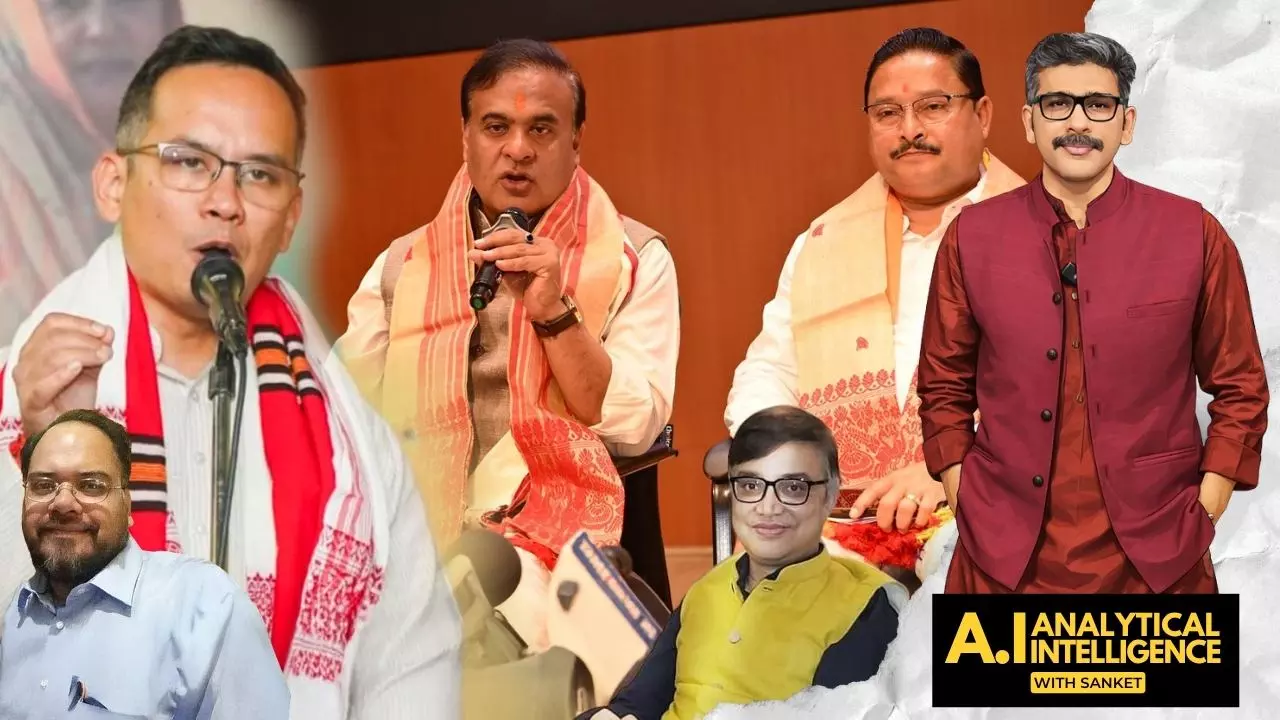
Assam: Can attrition-ridden Congress stop Himanta 2.0? | AI With Sanket
Can Himanta Biswa Sarma retain his dominance in Assam, or can Gaurav Gogoi turn the tide? Analysts decode Assam's political scenario

“It is designed in a way to polarise the election… when you bring identity to the fore, it actually helps you beat some of that anti-incumbency.”
This sharp observation frames the central debate around the upcoming Assembly elections in Assam.
In this episode of AI with Sanket, The Federal spoke with senior journalist Sandeep Phukan and Northeast Live TV Editor-in-Chief Wasbir Hussain to decode whether identity politics, governance claims, and opposition disunity will determine the outcome of the high-stakes state battle.
Also read: Assam elections: Congress, Raijor Dal finalise alliance; state party gets 11 seats
The discussion centred on Chief Minister Himanta Biswa Sarma, whose political dominance and campaign strategy have made him synonymous with Assam’s electoral landscape. He is looking to bag his second successive chief ministerial term.
While the conversation examined whether the emphasis by Sarma's ruling Bharatiya Janata Party on identity and infiltration would outweigh anti-incumbency concerns after a decade in power, a key question also remained whether the Congress, led by Gaurav Gogoi, MP and its state chief, can overcome internal divisions to mount a credible challenge.
Congress' challenges
Phukan rejected the outright characterisation of the Congress as weak but acknowledged deep organisational issues.
“I wouldn’t entirely agree with your description of the challenger being weak… but yes, Congress has lots and lots of organisational issues,” he said.
He pointed to leadership decisions taken close to the election as a major concern.
“You don’t change your general midway or in the middle of a battle. That’s what Congress did,” he said, referring to leadership changes involving Gogoi and the state leadership.
Also read: BJP's Assam gamble: Fresh faces, turncoats displace party heavyweights in 88-candidate list
Phukan highlighted that the transition could have been handled earlier or delayed until after the elections. “Either they should have done that way back in 2024… or they should have continued… until this assembly election was over.”
Gogoi factor
Despite internal turmoil, Phukan cited Gogoi’s 2024 Lok Sabha victory from Jorhat as evidence that the Congress retains electoral strength. “He won, and won by a very good margin,” he noted, adding that the BJP had held the seat in 2014 and 2019.
The Congress leader's shift from Kaliabor to Jorhat following delimitation was described as a significant political move. The victory was framed as a direct contest against the BJP's efforts to defeat him.
At the same time, the broader trend of defections from the Congress to the BJP was highlighted as a structural weakness. Senior leaders and MPs leaving the party were seen as contributing to instability in the run-up to the elections.
Identity politics
Phukan placed the current campaign rhetoric within Assam’s historical context, particularly the anti-foreigner movement and the Assam Accord of 1985. The agreement established a cutoff date of March 24, 1971, for identifying illegal immigrants.
He explained that identity politics has long shaped electoral discourse in the state. “This is part of Assam’s identity politics… You have to see these comments in the context of what the state has gone through in the past 50 years.”
The use of controversial terms such as “Miya”, which Biswa has used frequently in recent times to refer to Bengali-speaking Muslims, was described as rooted in this historical and political backdrop. The issue of undocumented migrants from Bangladesh, which the Biswa government has vehemently targeted, continues to influence political narratives.
BJP's strategy
Phukan argued that the BJP’s messaging is deliberate and strategic. “It is not an off-the-cuff remark… it is designed in a way to polarise the election,” he said, referring to statements made by Sarma.
He added that such messaging positions Congress as supportive of “outsiders” while portraying the BJP as a protector of indigenous identity. This framing was described as central to the party’s campaign.
Also read: Bordoloi exit : Has Congress lost the plot in Assam?
The strategy also serves to deflect scrutiny on governance. “When you bring identity to the fore, it actually helps you beat some of that anti-incumbency,” Phukan said.
Congress response
On Congress’s response, Phukan noted a calibrated approach. “The Congress is responding, but it cannot respond beyond a point,” he said, explaining that aggressive counterattacks could play into the BJP’s narrative.
He described the situation as a “tightrope walk”, where the Congress raises issues of governance and corruption without engaging directly on identity politics.
“They would not want to be seen on the wrong side of the identity debate,” he said, emphasising the constraints faced by the opposition in Assam’s political environment.
Political trajectory
Hussain outlined Sarma’s long political journey, beginning with his first election in 1996 and continuing through successive victories since 2001. He also highlighted Sarma’s shift from Congress to BJP in 2015.
“Ever since the next election… There has been no looking back,” Hussain said, noting Sarma’s consistent electoral success and rise to chief minister in 2021.
Also read: Five elections, and a moment of reckoning for Congress, BJP and EC
He also pointed to the BJP’s continuous campaign mode. “They are on an election mode almost 24/7,” he said, adding that national leaders have been actively campaigning in Assam.
Campaign contrast
Contrasting the BJP’s campaign strength with the Congress’s organisational struggles, Hussain said, “The Congress has not been able to forge a big alliance… they are not in a campaign mode at all.”
He detailed seat-sharing arrangements, noting that the BJP allocated 37 seats to allies, while the Congress finalised alliances late and allocated fewer seats.
The absence of the top Congress leadership in the campaign was also highlighted. The situation was described as limiting the party’s ability to mobilise voters effectively.
Development narrative
Hussain emphasised infrastructure and development as key strengths of the BJP government. “Unprecedented infrastructure development” was cited, including a semiconductor plant near Guwahati and airport expansion projects.
He noted that the state government exceeded its job creation target. “He has ended up… by giving jobs to 1,65,000 people,” referring to employment initiatives under Sarma.
Welfare schemes, particularly those targeting women, were also highlighted as contributing to the government’s outreach and public connect.
'No counter narrative'
Hussain pointed to the lack of a strong counter-narrative from the Congress. “The counter narrative is just not there,” he said, adding that allegations against the government lacked specificity.
Also read: Dissent brews in Congress over Assam seat-sharing even as party releases 2nd poll list
He described instances where opposition claims of corruption were not backed by detailed evidence. This gap was presented as weakening the opposition’s campaign.
Electoral outlook
On the impact of controversial remarks, Hussain said they were unlikely to hurt Sarma electorally. He noted that the chief minister clarified references to “Miya” as targeting illegal migrants rather than a community.
He also highlighted the deletion of 2.5 lakh names from electoral rolls during a special revision, linking it to the broader issue of citizenship verification.
Hussain added that the chief minister has attempted to distinguish between indigenous Assamese Muslims and migrant populations, framing it as part of the political narrative.
Key challenge
Hussain identified rising public expectations as the biggest challenge for the incumbent government. “The expectations… are increasing by the day,” he said.
He argued that sustaining development momentum would be critical if the BJP returns to power. The focus would shift from electoral competition to governance delivery.
Also read: Assam polls: 5 key issues set to headline campaign rhetoric
The absence of a strong opposition challenge was contrasted with the pressure of meeting voter expectations, described as the primary test for the leadership.
(The content above has been transcribed from video using a fine-tuned AI model. To ensure accuracy, quality, and editorial integrity, we employ a Human-In-The-Loop (HITL) process. While AI assists in creating the initial draft, our experienced editorial team carefully reviews, edits, and refines the content before publication. At The Federal, we combine the efficiency of AI with the expertise of human editors to deliver reliable and insightful journalism.)