- Home
- India
- World
- Premium
- THE FEDERAL SPECIAL
- Analysis
- States
- Perspective
- Videos
- Sports
- Education
- Entertainment
- Elections
- Features
- Health
- Business
- Series
- In memoriam: Sheikh Mujibur Rahman
- Bishnoi's Men
- NEET TANGLE
- Economy Series
- Earth Day
- Kashmir’s Frozen Turbulence
- India@75
- The legend of Ramjanmabhoomi
- Liberalisation@30
- How to tame a dragon
- Celebrating biodiversity
- Farm Matters
- 50 days of solitude
- Bringing Migrants Home
- Budget 2020
- Jharkhand Votes
- The Federal Investigates
- The Federal Impact
- Vanishing Sand
- Gandhi @ 150
- Andhra Today
- Field report
- Operation Gulmarg
- Pandemic @1 Mn in India
- The Federal Year-End
- The Zero Year
- Science
- Brand studio
- Newsletter
- Events

Why new BJP government in Bengal has brought both hope, apprehension to Bengali film industry
Over the past decade-and-a-half, the industry, popularly known as Tollywood, had become deeply entwined with the Mamata Banerjee-led Trinamool Congress. At the centre of this ecosystem was the now-arrested Swarup Biswas, brother of former TMC minister Aroop Biswas, who allegedly ran the industry as a 'mafia'. But will the coming of the BJP bring creative control, wonder filmmakers.

It's pure coincidence that a Bengali film that released in theatres this past weekend is called Abar Hawa Bodol, which loosely translates to “there is a change in the air again”. A sequel to a 2013 comedy about friends whose lives get swapped, the film has nothing to do with the political drama unfolding in West Bengal ever since last month’s assembly election results ushered in a...
It's pure coincidence that a Bengali film that released in theatres this past weekend is called Abar Hawa Bodol, which loosely translates to “there is a change in the air again”. A sequel to a 2013 comedy about friends whose lives get swapped, the film has nothing to do with the political drama unfolding in West Bengal ever since last month’s assembly election results ushered in a new government in the state. Yet, the title could be an apt description of not just the mood in the state, but the Bengali film industry, popularly known as Tollywood.
When the Trinamool Congress (TMC) first came to power in the state in 2011, defeating over three decades of Left rule, it was with the promise of “poriborton” or change. Now with the Bharatiya Janata Party (BJP) defeating the Trinamool Congress to form its first-ever government in West Bengal, ‘change’ is what the state is poised for again.
And one sector where this shift is already becoming apparent is the Bengali film industry.
Over the past decade and a half, Tollywood had become deeply entwined with the Mamata Banerjee-led Trinamool Congress. The relationship went far beyond proximity to power. Some of the industry’s biggest names formally entered politics through the party, contesting elections and serving as MPs or MLAs. The list included Mimi Chakraborty, Nusrat Jahan and Raj Chakraborty, to name a few.
Now, actors, directors and producers, who had grown accustomed to toeing one political line, are suddenly finding that they must pay their obeisance at another altar.
According to reports, some Tollywood names are among the list of rebel Trinamool members now voicing support for the BJP-led National Democratic Alliance (NDA). This reportedly includes the likes of June Malia, Saayoni Ghosh and Dev. The Federal has reached Saayoni and Dev on WhatsApp for comment. The article will be updated if a response is received.
“It’s unfolding like a ten-episode web series,” says actor and interdisciplinary artist Sujoy Prosad Chatterjee, of the real-life political drama in the industry.
Also read: 50 years of Ebola virus: Why, despite 'zero cases', low risk, 'take no chances' is India’s strategy
At the centre of Tollywood’s political entanglement was Swarup Biswas, a longtime ‘strongman’ of the Bengali film industry’s federation network and brother of former sports ministers in the Trinamool government, Aroop Biswas. Till recently, Swarup served as the president of the Federation of Cine Technicians & Workers of Eastern India (FCTWEI). But in the days following TMC’s defeat in the 2026 assembly elections, Swarup was arrested by police on charges of extortion and molestation and has been remanded in custody till June 18.
Almost everyone in the industry the Federal spoke to has a Swarup Biswas story to narrate. “There’s no doubt that he ran the industry like a mafia,” says a filmmaker, who does not want to be named.
Filmmakers, actors and technicians have accused the federation under Biswas of functioning as a parallel power centre, one that could stall productions, interfere in hiring decisions and effectively blacklist those who challenged its authority.
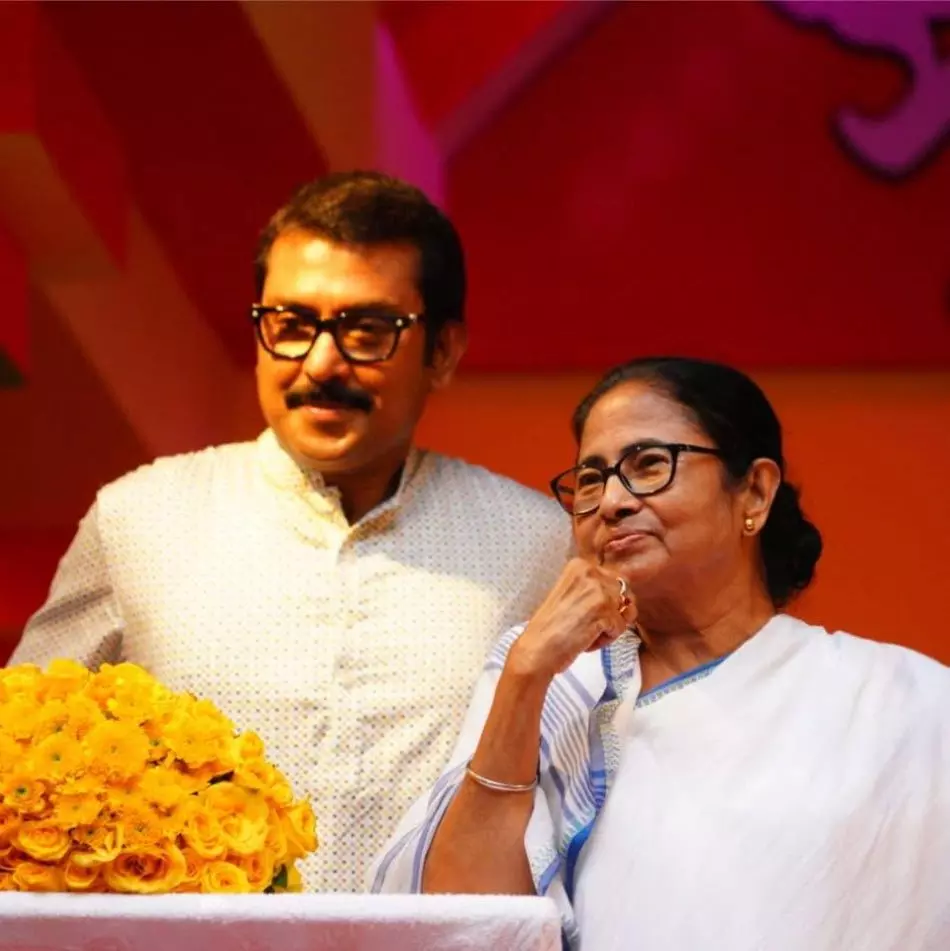
File photo of Swarup Biswas with former CM Mamata Banerjee. Facebook photo
The story of how Biswas came to wield such influence over Tollywood is a complex one. Industry insiders acknowledge that he initially introduced reforms that benefited workers. Studio floors were upgraded, working conditions improved and insurance schemes introduced for technicians, which proved invaluable during the Covid pandemic of 2021-22. The problems began when welfare measures “slowly gave way to control”.
Through the FCTWEI, Biswas allegedly presided over a growing web of rules governing how productions were staffed and run. Filmmakers argue that many of these regulations, ostensibly introduced to protect workers, often left little room for creative or logistical flexibility.
"We were often made to take on a stipulated number of technicians even when shooting for, say, a 'phone cut' [a scene with one character on telephone] in a limited space. There was no provision made for a small unit, even when shooting with one character on the run,” says filmmaker Sudeshna Roy.
Roy also points to rules that mandated the presence of specific categories of workers even when a production had no practical use for them. Instead of training technicians to adapt to changing production practices, filmmakers claim the system often required them to hire workers they did not actually need. A catwalk technician, for instance, is essential on a studio set, where lighting is rigged from overhead catwalks. But directors say they were frequently expected to employ such technicians even when shooting entirely on real locations, where their services were unnecessary.
Filmmakers explain that such requirements inflated production costs at a time when Bengali cinema was already struggling financially. As budgets came under pressure, producers responded by squeezing shooting schedules. Over the past decade, an unwritten norm emerged in the industry: most films had to be completed in roughly two weeks, regardless of their creative demands. Filmmakers, independent and mainstream alike, were affected.
Sumon Mukhopadhyay recalls shooting his debut feature, Herbert, over 45 days back in 2004. Such schedules, he says, had become virtually unthinkable by the final years of the Trinamool era. "For someone trying to make a film on his own terms, in his own language and aesthetics, it became more and more difficult because of the strange rules of the industry," he alleges.
Also read: Why Google’s new AI Mode search engine is good news for users, not for businesses
These complaints remained an open secret until 2024, when finally around a dozen actors and filmmakers — among them Parambrata Chattopadhyay, Anirban Bhattacharya, Sudeshna Roy and Indranil Roychowdhury — publicly challenged the federation's authority. The filmmakers first met then Chief Minister Mamata Banerjee, who promised a committee to resolve the dispute. When that failed to materialise, they moved the Calcutta high court. The episode exposed the federation's influence: some of the protestors, including Chattopadhyay, publicly apologised later in order to resume work; those who didn’t, like Bhattacharya, Roy and Roychowdhury, have claimed over the years that they have had little, to no work, since.
Significantly, dissatisfaction with Swarup's methods cut across political lines. Dev, in an interview in April this year, just ahead of the TMC poll debacle, had also spoken up against the ‘cancel culture’. “I’m against cancel culture. Banning people also deprives technicians of work. In the larger interest, betterment of the industry and the image of the state, it is important to cancel the cancel culture,” he had been quoted as saying.
But the end of the TMC era has thrown up a new set of questions.
Papia Adhikary, the actor-turned-politician and newly-elected MLA from Tollygunge, who now finds herself at the centre of the industry's restructuring, has reportedly spoken about “dismantling or reorganising the existing guild structure”.
Her remarks have generated confusion and alarm among technicians and workers, who argue that while the federation had become deeply compromised under Swarup Biswas, the need for representative bodies remains unquestionable. "The guild and federation were run like a syndicate. That was a misuse of the guild," says a filmmaker, speaking on condition of anonymity. "But that doesn't mean the guild itself is the problem. It's like saying you had an authoritarian government, therefore the idea of government itself should be abolished.”
Others question whether Adhikary even has the authority to make such declarations. One filmmaker described the move as legally dubious, arguing that decisions concerning trade unions fall within the jurisdiction of the labour and information departments, not individual legislators. More broadly, critics allege echoes of the same logic that enabled Swarup's rise: the assumption that whoever represents Tollygunge politically is somehow entitled to run Tollywood as well.
The presence of a BJP government, identified by its Hindutva ideology and politics, also raises apprehensions of creative and cultural control.
Also read: What ‘bulldozer politics’ could change for Kolkata’s iconic New Market
While both Adhikary and BJP’s other representative in Tollywood, actor-MLA Rudranil Ghosh, have been quoted in the media as saying that there will be “no ban culture”, or that “there will be an end to hooliganism in Tollywood”, across India, the party, at power at the Centre and across a majority of states, has faced allegations of influencing cultural institutions. The Federal has reached out to Rudranil on WhatsApp for comment; the article will be updated if a response is received.
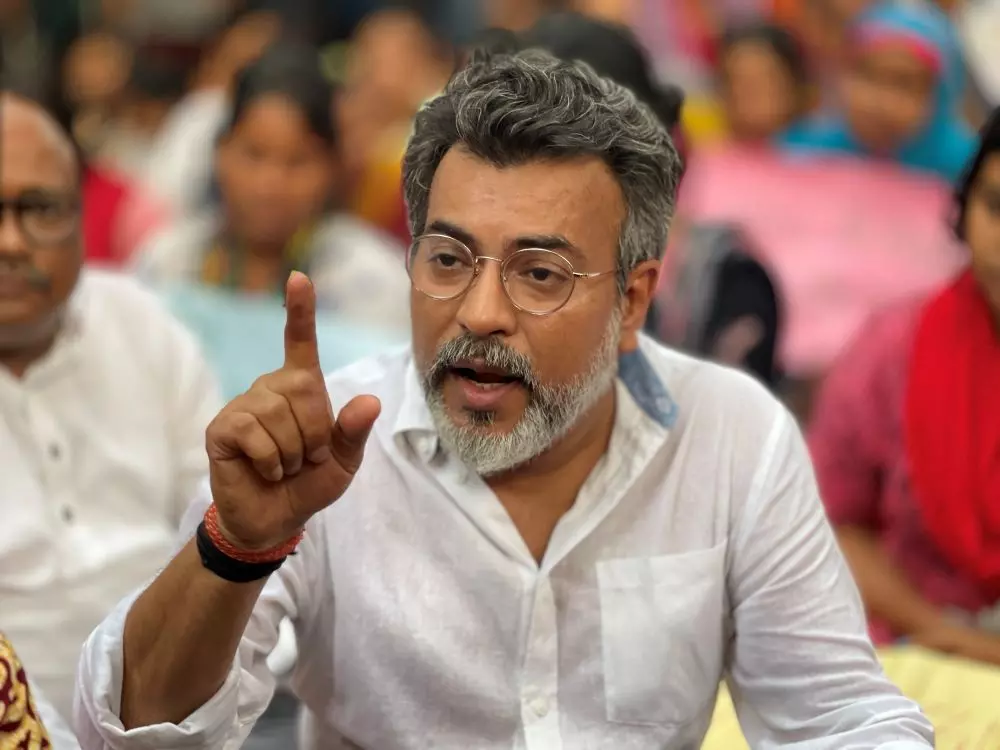
File photo of actor and BJP MLA Rudranil Ghosh. Photo: Wikimedia Commons
“We don't know whether we have boarded the Titanic [the ship which sank on its maiden voyage] or the Carpathia [known for rescuing Titanic survivors]. If the TMC looked like the Titanic in the end, the BJP looks like Carpathia at the moment. But it’s too early to know,” says Chatterjee.
If the Trinamool Congress exerted influence over the industry's institutions, many filmmakers fear the BJP could seek influence over its imagination. "If something is happening for the good of cinema, it's always welcome," says Mukhopadhyay. "But given the history of this party and its cultural policies elsewhere, I cannot be immensely hopeful." Mukhopadhyay's own career spans successive political dispensations. Herbert (2005) ran into trouble during the Left Front era, while Kangal Malsat (2013) faced resistance after the Trinamool came to power.
There is already speculation about projects designed to align with the new political climate. Yet the concern among many filmmakers is not direct censorship. The Central Board of Film Certification has been under the Union government's control for years. Industry insiders talk of potential “informal pressures” — from organised groups, political networks and extra-constitutional actors — creating an environment in which certain stories become harder to tell.
As filmmaker Pradipta Bhattacharyya puts it: "There are elements outside the censor board that might stop you from making or showing films that hurt their sentiments.”
Interestingly, Tollywood’s dependence on political patronage is a relatively recent phenomenon.
According to scholar and author Sayandeb Chowdhury, while many artistes and filmmakers in the past were personally sympathetic to Left politics, the industry itself maintained a certain distance from the government. That changed under Mamata Banerjee, who actively brought actors, directors and television personalities into electoral politics. Over time, that proximity became normalised.
"The entire film industry being, in some way, betrothed to a political party had no real precedent before Mamata," says Chowdhury. The change in government, he argues, could have offered Tollywood an opportunity to rethink that relationship. "This could have been a moment of liberation. The chains are gone. The claws are gone. The industry could have learned to thrive on its own." Instead, he fears, it has become too accustomed to political patronage to imagine functioning without it.
Roychowdhury, one of the directors who had challenged the federation in court, too, talks of the “squandered opportunity”. "A mature industry would get together, figure out a procedure for themselves and then go to the government with concrete proposals," he says. "Instead of doing what the industry needs, people are measuring the opportunity of aligning themselves.”
In the end, all the ‘Hawa Bodol’ in Tollywood may only be in its political alignment and not in its core character after all.