What ‘bulldozer politics’ could change for Kolkata’s iconic New Market
Opened to the public in 1874, for more than a century, New Market remained Kolkata's bustling 'elite' market. In recent years, the growing number of hawkers outside has been a peeve point for both traditional shoppers and shop owners. Now, a day after the BJP's Bengal election victory, bulldozers 'mounted by BJP flag waving crowds', reportedly flattened 'makeshift offices of TMC-backed hawker unions' in the area.

“Ekhane bagher dudh o paowa jeto”. That is what old Kolkatans still say with a fond smile, when talking of the city's iconic Colonial-era New Market — “where you could find even tiger’s milk if you knew where to look”.For generations, the saying captured the market’s charm. You came here for everything — Christmas cakes from Nahoum & Sons, imported cheese, Bandel...
“Ekhane bagher dudh o paowa jeto”. That is what old Kolkatans still say with a fond smile, when talking of the city's iconic Colonial-era New Market — “where you could find even tiger’s milk if you knew where to look”.
For generations, the saying captured the market’s charm. You came here for everything — Christmas cakes from Nahoum & Sons, imported cheese, Bandel cheese (originating in the erstwhile Portuguese colony of Bandel, it is salty, with a crumbly, dry texture), winter pullovers from M. Noshkar, hand-stitched shoes, rare spices, fountain pens and things you did not know you needed until you saw them displayed under the high Victorian roofs.
The red-brick arcades, the imposing clock tower, the narrow lanes smelling of spices, meat, leather, roasted peanuts and paneer all felt like one giant, living cupboard.
But over the past two weeks, another conversation has begun taking over these streets.
Just a day after the Bharatiya Janata Party’s (BJP) sweeping victory in the 2026 West Bengal assembly elections, bulldozers — which have come to be identified with the party’s strongarm politics across the country — rolled into Kolkata’s Hogg Street, Bertram Street and the stretch near Charlie Chaplin Square, “flattening the makeshift offices of Trinamool Congress-backed hawker unions”. Some street vendors shut shop in panic, others quietly shifted allegiance to the BJP-aligned union. According to reports, mounted on the bulldozers were men waving BJP flags.
Also read: Why the new-age version of PM Modi’s austere lifestyle comes with a price tag attached
Inside the 152-year-old Sir Stuart Hogg Market (New Market is officially named Sir Stuart Hogg Market, after the former chairman of the then Calcutta Corporation), many traders suddenly found themselves talking about something they had spent years demanding: space, air, visibility.
Ashok Kumar Gupta has been waiting for that possibility for a long time.
Gupta, president of the SS Hogg Market Traders Association, runs a home appliances store that has been in his family for more than seventy years. The shop sits just inside one of the arched entrances.
“The uncontrolled increase of hawkers has been really detrimental to business,” he says. “People can’t park their cars anywhere near. Some shops are practically not even visible. This has led to many store owners selling their space or moving out of New Market.”
Footfall at his own store has slowly dropped over the years. Loyal customers still return, helping the business survive through strong personal relationships built across decades. “We have very strong relationships with our customers which helps us stay afloat,” Gupta adds. “But many others have suffered badly. Where we now see Manyavar earlier used to be two other stores, you will see many other similar examples.” He points the finger squarely at years of inaction by the previous Trinamool Congress-led state government and local police.
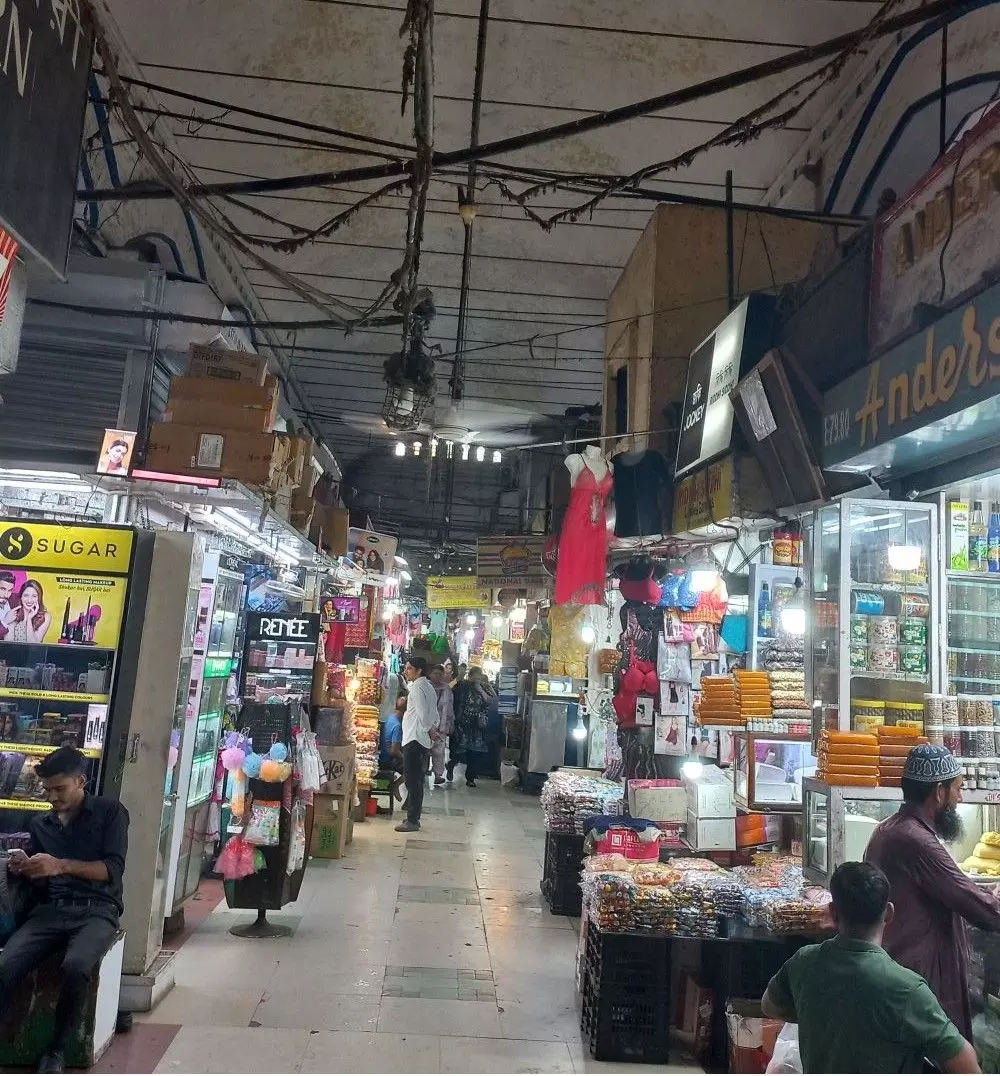
Shops inside New Market. Photo: Dipanjan Sinha
A few shops away, in a corner stall selling paneer and ghee, Dilip Bagui nods in agreement but hesitates over the answer. The business came down from his grandfather to his father and now to him — three generations of the same quiet corner, the same brass scales, the same early-morning deliveries to restaurants across the city.
“I supply to different restaurants and customers. But particularly after the pandemic we saw a massive surge in hawkers and now practically the whole street is blocked,” he says.
Yet Bagui, like many old-timers here, also sees the human cost. “Hawkers are basically unemployed youth. Removing them without proper arrangements will be cruel and may not help anyone eventually.”
This contradiction sits at the centre of New Market’s problem. Traders inside the covered arcade pay rent, maintenance charges and taxes. They complain that pavements have disappeared under temporary structures, fire lanes are blocked and storefronts hidden. Hawkers outside say they are simply trying to survive and the city’s streets have always been their workplace.
Shaktiman Ghosh, general secretary of the Hawker Sangram Committee and the National Hawker Federation, knows both sides of this battle better than most. He has been at the forefront since the Left Front government’s evictions of 1996, titled Operation Sunshine, when thousands of hawkers were cleared from Kolkata’s streets in a single dramatic drive. Ghosh helped organise the protests that eventually forced authorities to recognise legitimate vendors and set up town vending committees under the Street Vendors Act.
“The streets around New Market need to be cleared for pedestrians and vehicles. That is non-negotiable,” he says firmly. But he argues that any action has to happen fairly, within the framework of the law, through proper identification cards, designated vending zones and rehabilitation plans for those displaced. He also rejects the idea that traders and hawkers necessarily stand on opposite sides.
“We are not enemies, we are part of the same ecosystem,” Ghosh says. He recalls how traders in Gariahat, after initially opposing hawkers, later came out in open support once they realised that crowded pavements often drew larger numbers of people into the wider market. “They realised hawkers actually draw bigger crowds to the entire market. Footfall rises when the streets are alive.”
Iftekhar Ahsan, founder of Calcutta Walks and a heritage curator who has spent decades guiding visitors through the city’s layered history, sees an even longer story unfolding beneath the immediate politics. When the British started New Market in 1874, they wanted it to be an exclusive space for Europeans. Post-independence it became the haunt of the city’s ‘elite’ and remained a mostly ‘posh’ shopping area till the ‘90s and even early 2000s. While popular with the middle classes too, it retained a degree of ‘upscale’ identity. Over time, that has changed dramatically.
“It has been democratised a lot and has been taken over by what I would say is the 'masses',” Ahsan says. He remembers a time when the market was the undisputed address for the best clothes, the best shoes, the best vegetables, fruits, cheese, meat, chicken and eggs. “Now it’s come down to the point that it’s the masses and the price consciousness of the average person that’s dictating what’s available. It’s come down from being the elite market that it used to be and has become a very pedestrian market that everyone can afford and everyone can go to.”
Ahsan is quick to add that the market still retains its diversity and a massive range of products. “The well-to-do already have their refuges in shopping in the malls for branded or elitist shopping. But what New Market retains is the quality of the produce. If it is regulated and managed well, it still is one of the most beautiful markets anywhere in the world.”
Also read: How coaching institutes in Kota, Sikar are preparing for NEET-UG re-test
Part of the change in the market’s fortunes, as Ahsan points out, is because of the coming of the modern-day malls; the other, as many old shoppers say, is chaos introduced by the hawkers.
The tension here is real because the problem is old. For decades shopkeepers have complained that hawkers spill onto roads, block fire lanes and hide storefronts. Post-pandemic the surge was huge. Hawkers’ groups once floated the idea of turning surrounding streets into a regulated night market after 8.30 pm. The traders insist daytime clearance is essential for parking and footfall.
The new BJP government has not yet spelled out a detailed policy, but the swift demolition of Trinamool union offices and fresh meetings with traders signal that change is coming. The Federal has reached minister in-charge of Urban Development and Municipal Affairs, Agnimitra Paul for comment. The article will be updated if a response is received.
Demolition drives are not new for BJP. Call it optics or partisan politics, but the party has been known to target ‘encroachment’ in every state where they come to power. While it's been repeatedly alleged that the move by the party, which made 'Hindutva' the core identity of its politics, is targeted at minority communities, there have been instances of Hindus becoming, what's been termed, "collateral damage".
In a report last, the rights movement, Citizens for Justice and Peace, reviewed such demolition drives across Delhi, UP, Maharashtra, Gujarat and Telangana to assess how courts are “adjudicating the multiple, layered questions of land, law, and justice that these demolitions now represent”.
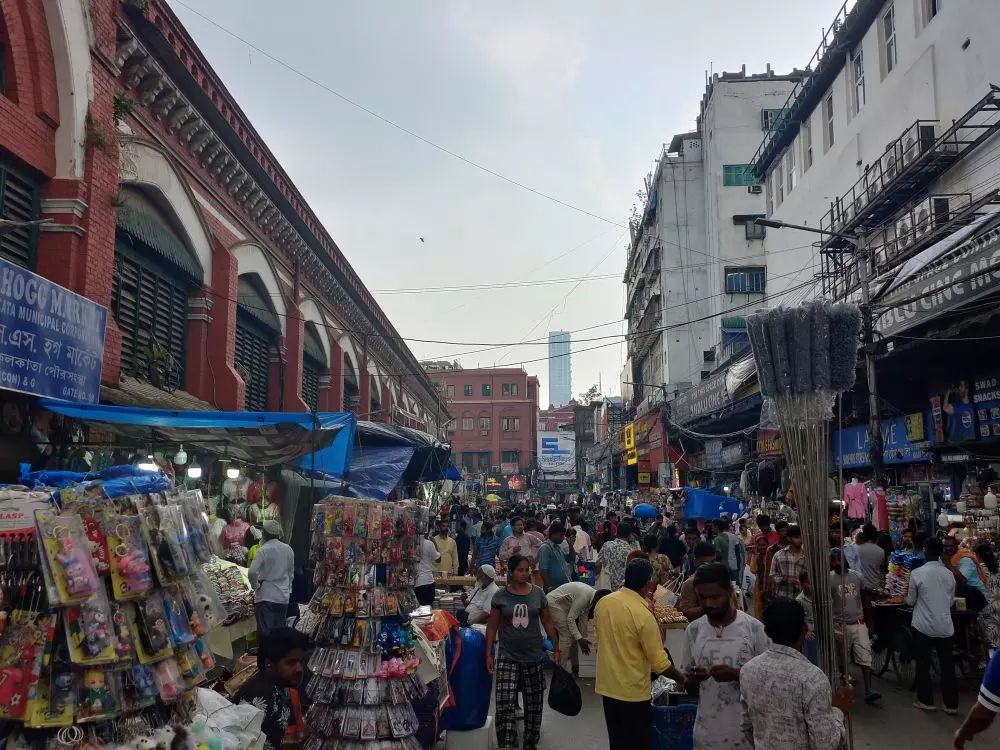
Hawkers outside New Market. Photo: Dipanjan Sinha
Talking about the recent action, professor Maidul Islam, a political scientist at the Centre for Studies in Social Sciences, Calcutta, notes that a significant section of the hawkers around New Market come from Muslim minority communities, adding a sensitive layer to the debate. “The question is whether New Market is the only target area or are they going to do the same thing with Gariahat or Tollygunge,” he wonders. “Hawkers are everywhere.”
Eviction drives are not new in the city, Islam points out. They began with Operation Sunshine in the mid-1990s under the Left Front and have been repeated since, yet hawkers always return. Previous attempts by the Kolkata Municipal Corporation to clear the area also failed, largely because proper rehabilitation was never carried out, he adds.
On the new BJP government’s early moves, Islam observes that the signalling is clear, enforce the “rule of law” after years of what the party calls Trinamool-enabled anarchy. “The middle-class constituents of the BJP will demand these kinds of things. And at the same time, the BJP also wanted to get the support of the traditional Baniya shop-owning class too," he says.
Inside the market, shopkeepers are tightlipped on any potential Muslim-targetting. For generations, the market which has a fair share of Muslim shopowners, have carried out business in harmony. Whether the BJP’s bulldozers will demotion that camaraderie along with encroachment around the market is, for now, a matter of political and academic debate.
But for many Kolkatans, the relationship with New Market extends beyond shopping or politics. As classical musician and researcher Navonil Hazra puts it, the place is not just a destination but “a living memory of Kolkata”.
“Every corridor carries old conversations, smells, memories, sounds,” he explains. “In many ways, New Market is where colonial Calcutta, middle-class emotions and everyday survival still meet and fit each other. It has always represented a continuity for me, a city that changes constantly but still remembers its older rhythm.”
Hazra has been coming here for more than three decades, first with his parents for puja shopping, Christmas visits or winter pullovers. Today walking through the lanes feels like “returning to an old archive or rather old repository of memories”. What moves him most is its layered character: luxury showrooms alongside cows, nostalgia, street culture, Anglo-Indian history and Bengali festive life all existing in one place.
Especially during Christmas, the market transforms emotionally. Families from every community flock in for trees, decorations, lights, candles, bells and cakes from Nahoum & Sons.
“Unlike the new age malls, New Market still has that human interaction, that human touch,” Hazra says. “Shopkeepers remember your faces, bargaining becomes a conversation and shopping becomes a form of storytelling. That is why New Market for me is not merely a commercial space but it is more a part of Kolkata’s emotional as well as cultural identity.”
Change, if any, could decide much more than traffic movement around one of Kolkata’s oldest landmarks. Shopkeepers like Ashok Kumar Gupta hope for breathing space. Hawkers worry about sudden loss of livelihood. Cultural voices like Ahsan and Hazra want to preserve the character that made the market what it is.
For now, however, New Market still looks much as it always has. Customers bargain over prices, the aroma of kathi rolls from eateries like Nizam’s wafts in the air, shopkeepers call out to passersby and people continue squeezing through narrow lanes between stalls and storefronts.
The old saying still survives too. You may no longer find tiger’s milk here. But New Market continues to make room for almost everything else.