- Home
- India
- World
- Premium
- THE FEDERAL SPECIAL
- Analysis
- States
- Perspective
- Videos
- Sports
- Education
- Entertainment
- Elections
- Features
- Health
- Business
- Series
- In memoriam: Sheikh Mujibur Rahman
- Bishnoi's Men
- NEET TANGLE
- Economy Series
- Earth Day
- Kashmir’s Frozen Turbulence
- India@75
- The legend of Ramjanmabhoomi
- Liberalisation@30
- How to tame a dragon
- Celebrating biodiversity
- Farm Matters
- 50 days of solitude
- Bringing Migrants Home
- Budget 2020
- Jharkhand Votes
- The Federal Investigates
- The Federal Impact
- Vanishing Sand
- Gandhi @ 150
- Andhra Today
- Field report
- Operation Gulmarg
- Pandemic @1 Mn in India
- The Federal Year-End
- The Zero Year
- Science
- Brand studio
- Newsletter
- Elections 2024
- Events

How ‘Khela Hobe’ went from an election slogan to one of India's most defining political battle cries
From TMC's 2021 'Khela Hobe' war cry to 2026's 'Khela Abar Hobe' and BJP's 'Ebar Khela Sesh Hobe' countering — underlying the playful-sounding challenge, is West Bengal's charged political reality. Meanwhile, the slogan's two-word simplicity has helped it find resonance beyond the state's borders.

"Builye, ebar khela hobe bawtey" (Take it from me, the game is on this time), said Parashar (identified by first name only). The farmer had paused his work, his spade held mid-stroke, at his small, sun-baked plot of land in West Bengal’s Birbhum district, as he had made the emphatic claim.That was in 2021. Rarh Bengal — the ancient, south-western stretch of West Bengal defined by its...
"Builye, ebar khela hobe bawtey" (Take it from me, the game is on this time), said Parashar (identified by first name only). The farmer had paused his work, his spade held mid-stroke, at his small, sun-baked plot of land in West Bengal’s Birbhum district, as he had made the emphatic claim.
That was in 2021. Rarh Bengal — the ancient, south-western stretch of West Bengal defined by its red laterite soil, rich culture and history — was humming with the tension of a fiercely fought Assembly election. The catchphrase ‘Khela Hobe’ was in the air, with many like Parashar having adopted it as their own.
Vigorously promoted by the state’s ruling Trinamool Congress (TMC), the slogan had transcended political rallies to reach paddy fields and tea stalls, seemingly striking an instinctive chord with the voters. Ultimately, the TMC clinched the “game” over its principal rival, the Bharatiya Janata Party (BJP).
Five years on, as Bengal votes for a new assembly, the ‘khela’ appears to be potentially fiercer than last time’s. The plot remains familiar: the BJP eyeing Mamata Banerjee's ‘throne’, and ‘Khela Hobe’ back in the air. The slogan, it appears, has embedded itself permanently into Bengal's political DNA. With allegations of voter list manipulation and the upheaval over the contentious special intensive revision (SIR) of electoral rolls, the TMC has once again unsheathed its sharpest verbal weapon.
In February 2025, months before the SIR controversy erupted, Mamata had already fired the opening shot — declaring “Khela Abar Hobe” (the game will be played again), and promising a more aggressive fight in 2026. The chorus only became shriller, with TMC leaders across the ranks amplifying the war cry, transforming what began as a catchy poll slogan into something of a battle hymn.
From TMC MP Sagarika Ghose uttering ‘Khela Hobe’ outside Parliament to Anubrata Mandal, a local strongman in Bengal’s Birbhum district, saying “Bhoyonkor Khela Hobe” (the game will be dangerous), the language has remained the same, but the degree of menace behind the words has intensified.
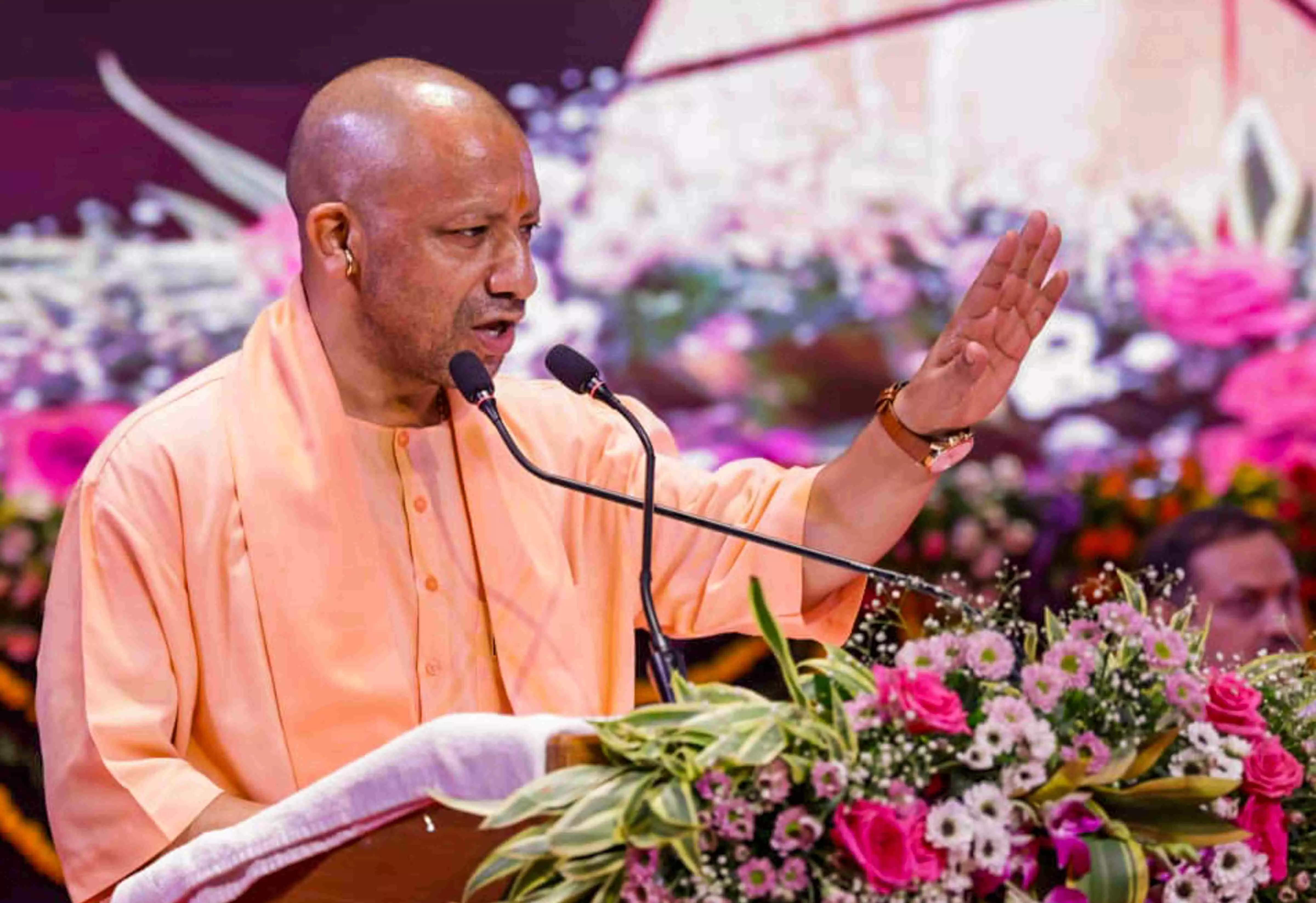
Campaigning for the BJP in West Bengal, UP Chief Minsiter Yogi Adityanath said 'Ebar Khela Shesh Hobe'. File Photo
The BJP has not taken things lying down. Since 2021, top national leaders — Prime Minister Narendra Modi, Union Home Minister Amit Shah, and recently, UP Chief Minister Yogi Adityanath — have actively countered the slogan at rallies, despite their far-from-perfect Bengali pronunciation. State leaders echoed the sentiment. Between the 2021 Assembly battle and the 2024 Lok Sabha election, Bengal’s former BJP president Sukanta Majumdar warned that the game would continue in future elections. The party crafted pointed counter-slogans — “Vikash hobe, chakri hobe, haspatal hobe, school hobe”, emphasising development, jobs and hospitals over political theatrics — uttered by none other than PM Narendra Modi. Recently, Adityanath raised the stakes at a rally, declaring, “Ebar Khela Sesh Hobe” (this time the game will be definitely over).
Political slogans are no novelty in West Bengal. Mamata herself coined "Ebar, noy never" (either we do it this time or it won’t happen ever) during her party's debut in the Assembly polls in 2001. According to political observers, most such slogans, however, fade quickly, overtaken by newer ones. “Khela Hobe” proved to be a remarkable exception. Its resonance travelled far beyond Bengal's borders — in Uttar Pradesh, the Samajwadi Party adapted it as ‘Khadeda Hobe’ (drive them out) against the ruling BJP ahead of the 2022 Assembly elections, while in Assam, opposition parties, including the Congress, wielded it, also against the ruling BJP in 2021, underscoring the slogan's extraordinary pan-India political appeal.
The slogan's origins, interestingly, trace back to Bangladesh. There, ahead of the 2014 national elections, former Awami League parliamentarian Shamim Osman first used ‘Khela Hobe’ to counter rampaging opposition forces. Nearly a decade later, another senior League leader, Obaidul Quader, revived it against the opposition, who fired back with ‘Ashen, Kheli’ (come, let's play). The slogan swept Bangladesh's political landscape. When a politician questioned what kind of game had no players, venues, or spectators, a Bangladeshi media outlet said — this game is perhaps about muscle power and capturing ground.
Also read: Why rush to appropriate late Kanshi Ram in UP reflects broader lack of unifying Dalit face
As in Bangladesh, it’s the ruling side which has issued the challenge in Bengal.
Bengalis have always cherished binary rivalries — in politics, sports, food, cinema, culture, or even travel. East Bengal versus Mohun Bagan defines sporting passion; Hilsa versus prawn captivates food lovers. Cinema enthusiasts endlessly debate Uttam Kumar versus Soumitra Chatterjee, or Satyajit Ray versus Ritwik Ghatak. Even holidaying Bengalis face the perennial dilemma — hills or sea. Binary choices are deeply embedded in the Bengali soul.
And true to the argumentative Bengali nature, even an innocuous roadside tea discussion early in the morning can turn volatile in moments, as consensus rarely comes easily. The widely recognised idiom says it best — "Three Bengalis mean two political parties" — a truth that resonates well beyond Bengal's borders.
“The term “Khela” invokes a certain kind of passion that is part of everyday politics in Bengal and also embedded closely with the social life of average Bengalis — especially the ones living in urban areas. Whether it is football, cricket, food, sweets, festivals, international relations, or even foreign policy, the passion that drives the average Bengali’s interest and engagement in everything is depicted by the term ‘Khela’ and its use in politics captures that element of passion,” says Sarthak Bagchi, a political commentator and researcher based in Ahmedabad, Gujarat.
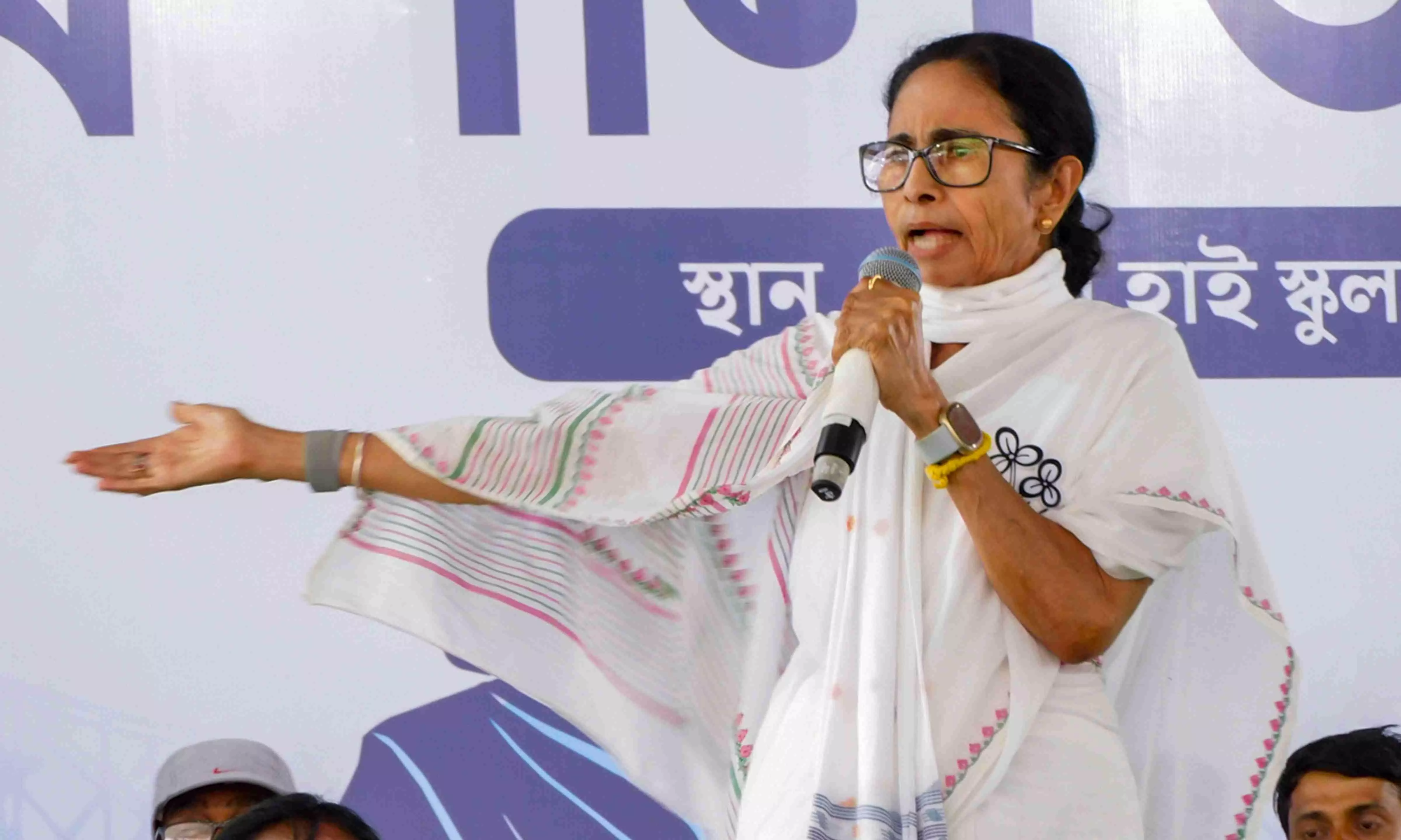
File photo of West Bengal Chief Minsiter Mamata Banerjee on the campaign trail. Beforethe popular 'Khela Hobe' catchphrase, the TMC had raised the call for 'Poriborton', or change to dislodge the CPM government in the state.
Underlying the almost playful gaming metaphor of the challenge is an intensely charged temperament. The slogan’s use in high-decibel attacks and counter-attacks at rallies, coupled with the history of political violence involving TMC and BJP cadres, lends the words a tinge of potential sinisterness.
“Bengal's history of violence stretches deep into the modern era — from the Partition riots and the ‘Great Calcutta Killings’ [of 1946], Naxal uprisings [of the 1960-70s], Left Front brutality, the Nandigram and Singur agitations [2006-07], to TMC-era violence. In such a conflict-saturated landscape, us-versus-them polarisation is almost inevitable. The gaming metaphor gives this division a familiar, almost normalised shape — team one against team two — subtly legitimising the othering and making political polarisation feel as natural as a sporting contest,” Bagchi added.
So, has ‘Khela Hobe’ trivialised politics in Bengal, considered to be one of the country’s most politically aware states?
Bagchi disagrees.
“The use of political violence and aggressive street style politics in Bengal is not about descending from the politics of ‘bhadralok’ (gentlemanly), but more of a continuation of the politics of violence as a critical component of how politics is shaped in the state. The idea of ‘bhadralok’ politics was largely a cover or a facade of cultural hegemony that the Left Front was able to create on the basis of violence and threat at the ground level,” he alleges.
‘Khela Hobe’s’ purported “message of violence” is something other experts, too, talk about.
“The slogan ‘Khela Hobe’ endorses and normalises the politics of violence,” claims Sanjay Roy, a retired professor of sociology at the University of North Bengal. He cites 20th-century German philosopher Jurgen Habermas’s theory of “open dialogue and mutual respect” being integral to a mature democracy, insisting that the language of violence hampers the achievement of such a democracy.
Roy, however, doesn’t hold TMC alone responsible for this subtle messaging, accusing both the ruling party in West Bengal and the BJP of eroding the state’s democratic values; a trend he terms “worrying”.
Roy’s concern is shared by Bengal-based political commentator Biswanath Chakraborty. “Such slogans are raised to create pressure on the opposition. It has nothing to do with people’s welfare but only shows the ploy of muscle power,” Chakraborty told The Federal.
Also read: Why ‘Kalinga Bull' Biju Patnaik came riding a donkey to an award ceremony in the ‘90s
The nuanced use of ‘khela’, or play or game, is not new to Bengali culture, however. The bard himself, Nobel laureate Rabindranath Tagore, used the word variously in his writings. In ‘Hori Khela’, the invitation of celebrating Holi, indulging in the play of colours, disguises a Rajput queen’s plan of revenge against a Pathan king. But the writer also mentions “Khela Hobe” in his immortal primer ‘Sohoj Path’, which teaches the basic tenets of the Bengali language to children. In the very first part, he says, “Tel mekhe joley dub diye ashi, tar pore khela hobe” (let’s take a dip in the water after applying oil on the body, we will play thereafter). Innocence personified for the same phrase that otherwise sounds annihilating in the political arena.
In the song “Aj Khela Bhangar Khela”, Tagore talks of a kind of spiritual transformation, by abandoning transient or frivolous activities for a more meaningful path in life.
There are many such examples of ‘khela’ in Bengali literature, films, music and everyday life.
In Satyajit Ray’s Satranj Ke Khiladi, the game of chess and its players are again a metaphor of political stagnation.
“Khela” could be about football, one of Bengal’s favourite sports, or about complex human psychology and relations, as in the books ‘Khela’ and ‘Khela Noy’ by late litterateur Sunil Gangopadhyay.
And for generations, the Bengali festival of Durga Puja has culminated with married women engaging in ‘sindoor khela’, the application of vermilion to the idol of the goddess and to each other.
Coming back to politics, why does a Bengali election slogan resonate far beyond its home state? Cultural historian and Krea University literature professor Sayandeb Chowdhury attributes this to several factors.
"Beyond its rhetorical appeal, the TMC's nationally prominent representatives — Derek O'Brien, Mahua Moitra, and Sagarika Ghose, a sophisticated lot — helped carry it across borders, despite the party remaining regional. Its two-word simplicity also made it instantly memorable,” he explains.
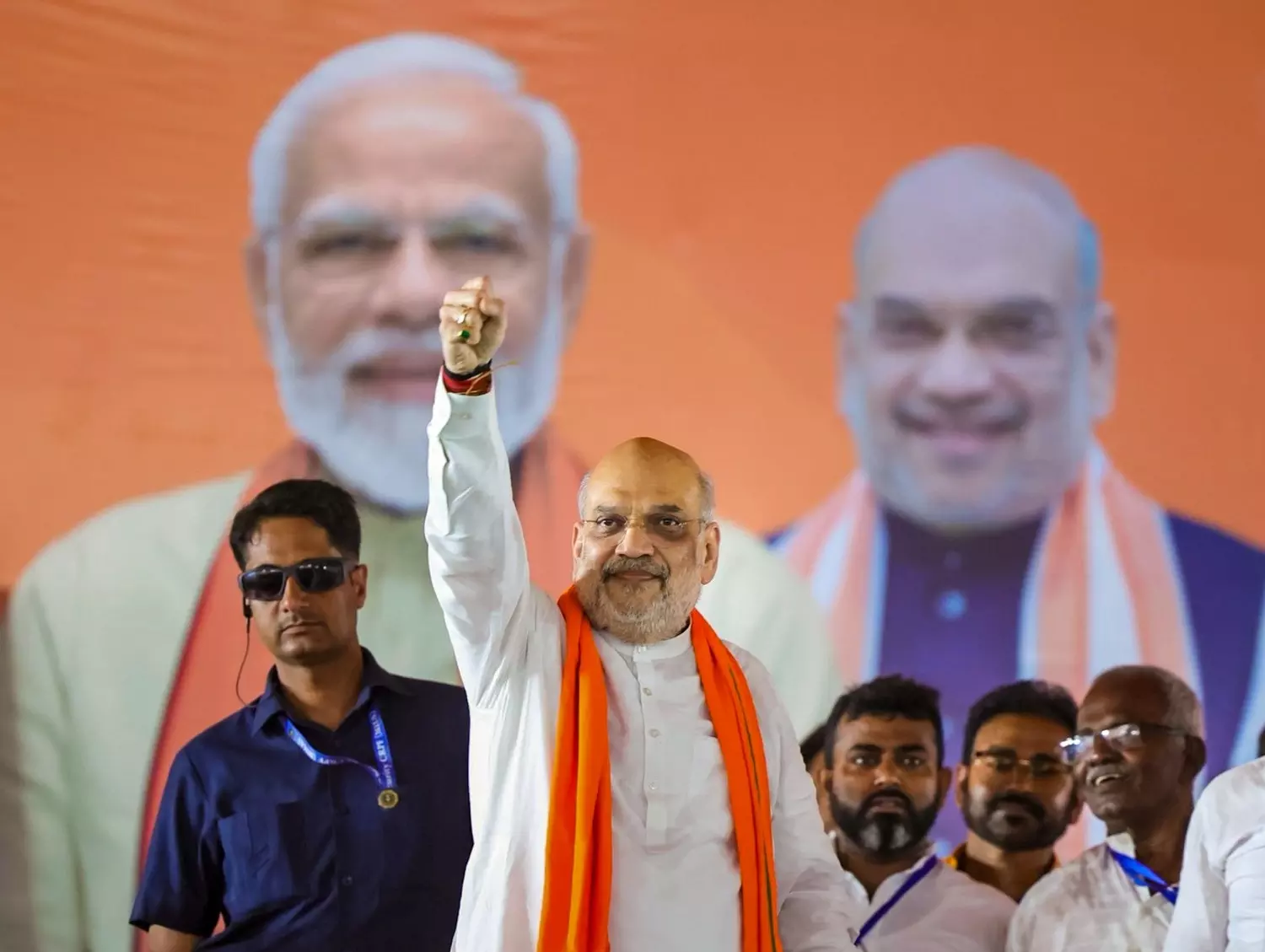
Union Home Minister Amit Shah at an election rally in West Bengal. Over the years, Shah has also countered the TMC's 'Khela Hobe' cry. File photo
Chowdhury draws a telling parallel with ‘Poriborton’ (change), another Bengali term that gained nationwide traction before and after TMC's landmark 2011 victory, ending 34 years of Left rule in West Bengal. He cites Ruchir Joshi's English book titled ‘Poriborton’ written on that election to illustrate how the word transcended its linguistic origins, embodying a broader idea of political transformation. "We heard people say Mamata didi made 'poriborton' even in regions where Bengali isn't the first language — reflecting its widespread appeal. It’s the same with ‘Khela Hobe’," Chowdhury told The Federal.
So, has the slogan come to define Bengali regional assertion?
According to Chowdhury, it does. Citing an instance of a Bollywood actor uttering “Khela Hobe” in a Hindi film, he adds that the term “sends across a raw message like ‘don’t mess with the Bengalis’ or that the ‘Bengalis are ready to play with you and even beat you. Bring it on’,”..
A veteran journalist, who has followed Bengal politics over the years, terms ‘Khela Hobe’ one of India’s most defining slogans, talking about how it strikes a chord even in north, west and parts of south India. BJP’s adoption of the phrase and coming up with the ‘Khela Sesh’ counterpoint shows that it is desperately trying to shed its ‘outsider’ tag in Bengal, the journalist added. “It is very important for top campaigners to campaign in a non-Hindi-speaking state in its local language, since translations from Hindi do not make the desired impact,” says the journalist, speaking on condition of anonymity.
Despite its two-word simplicity, extensive strategic thinking was involved in its coining.
“The slogan ‘Khela Hobe’ was deliberately crafted as a counter-narrative against the BJP's psychological blitzkrieg that portrayed the TMC as the weaker side. We said ‘the game is on, we are here, and we will fight till the last’,” says poll strategist-turned-politician Prashant Kishor of the idea behind the slogan. In 2021, Kishor had been associated with the TMC’s strategising. The strategist-turned-politician who has since launched his Jan Suraj party, adds that the TMC’s 2021 campaign song “Bangla Nijer Meyeke Chai” (Bengal wants its own daughter) complemented the ‘Khela Hobe’ strategy by repositioning Mamata from “didi” (elder sister) to “beti” (daughter), seeking broader mass mobilisation to thwart the BJP’s challenge.
A striking TMC poster captured Mamata's injured, bandaged left foot (she suffered an injury during the 2021 campaign) resting defiantly on a football beneath the words ‘Khela Hobe’.
The catchphrase has not only found its way into the political discourse of other states since, but also become a part of Bengal’s recent cultural narrative. If TMC leader Debangshu Bhattacharya's 2021 rap track of the same name captured the spirit of ‘Khela Hobe’, invoking the “Bargis” — the 18th-century Maratha raiders who plundered Bengal and were resisted by the local Nawab — as a metaphor for the BJP's political advance into the state, the West Bengal Chief Minister herself wrote a book titled ‘Khela Hobe’. And months after the TMC’s victory in the 2021 assembly elections, the slogan became the theme of Durga Puja pandals in the states.
Also read: Why Karnataka announcing revival of student union elections has reopened talks on campus democracy
“Unlike slogans like ‘Joy Bangla’, which asserts a sub-nationalism, or ‘Jai Sri Ram’, with its religious connotation, ‘Khela Hobe’ carries no ideological moorings," says Kolkata-based political scientist Maidul Islam, associated with the Centre for Studies in Social Sciences, Calcutta. “There is a kind of playfulness in it, something related to a game,” he reiterates.
According to Islam, ‘Khela Hobe’ is not the best slogan that the TMC has produced. “Since 2019, the party has come up with slogans that are from the perspective of federalism or Bengali sub-nationalism, targeting what it claims are "attacks from outside”. Slogans such as ‘Jotoi Koro Hamla, Abar Jitbe Bangla’ (attack as much as you can but Bengal will win again) and ‘Bangla nijer meyeke chai’ or ‘Je lorche sobaar daake, sei jetabe Bangla maake’ (she who is fighting for all, she will ensure that Mother Bengal wins) have become very popular.”
In 2026, ‘Khela Hobe’ might have lost some of its urgency because of the predominance of other issues, such as the controversial SIR, or coming of new catchphrases like ‘Jotoi Koro Hamla, Abar Jitbe Bangla’, but it still does its bit in energising cadre and common voters alike.
‘Khela Hobe’s’ enduring appeal is because it captures something Bengal cannot quite shake — the intoxicating thrill of political combat dressed in sporting clothes. Two words, countless meanings. As the state awaits the results of a furiously fought election, the game is indeed again afoot.