- Home
- India
- World
- Premium
- THE FEDERAL SPECIAL
- States
- Perspective
- Videos
- Sports
- Education
- Entertainment
- Elections
- Features
- Health
- Business
- Series
- In memoriam: Sheikh Mujibur Rahman
- Bishnoi's Men
- NEET TANGLE
- Economy Series
- Earth Day
- Kashmir’s Frozen Turbulence
- India@75
- The legend of Ramjanmabhoomi
- Liberalisation@30
- How to tame a dragon
- Celebrating biodiversity
- Farm Matters
- 50 days of solitude
- Bringing Migrants Home
- Budget 2020
- Jharkhand Votes
- The Federal Investigates
- The Federal Impact
- Vanishing Sand
- Gandhi @ 150
- Andhra Today
- Field report
- Operation Gulmarg
- Pandemic @1 Mn in India
- The Federal Year-End
- The Zero Year
- Science
- Brand studio
- Newsletter

Why the rise of AI-powered spiritual leaders has raised questions of trust, authority and copyright
The rise of AI-generated 'gurus' coincides with the global growth of the influencer industry into a business worth hundreds of billions of dollars. For content creators, the challenge is to keep up with AI flooding the algorithms. Meanwhile, followers are left to wonder 'what gives spiritual guidance its authority'; presence, experience, or simply the right words.

Joyeeta Nair, 29, lay awake in the dark, the dim glow from her mobile phone illuminating her face. Her eyes were focused on the screen, as she intently listened to the words of an old Tibetan monk dressed in maroon robes. Behind him, prayer flags fluttered against a bright Himalayan sky. His voice landed comfortingly in the night — low and unhurried. “The death of someone you love is not...
Joyeeta Nair, 29, lay awake in the dark, the dim glow from her mobile phone illuminating her face. Her eyes were focused on the screen, as she intently listened to the words of an old Tibetan monk dressed in maroon robes. Behind him, prayer flags fluttered against a bright Himalayan sky. His voice landed comfortingly in the night — low and unhurried. “The death of someone you love is not a wound that simply heals. It is a landscape you slowly learn to walk in,” said the monk.
The words resonated deeply with Nair, a Bengaluru-based academic counsellor, who lost her mother a few years back.
“It felt like the monk, Yang Mun, understood my daily struggle,” she says. “In a post on grief [on social media platform Instagram], he mentioned a specially curated private Inner Circle, a subscription offering daily guidance and reflections. I decided to sign up for it.” The next morning, Nair shared her experience with a friend who, she recalls, immediately pointed out that the monk is AI-generated. “I was stunned. He looked and sounded so real.”
As artificial intelligence (AI) insidiously expands its footprint in our lives, offering writing and research assistance to health and legal advice, could spiritualism long remain untouched?
On Instagram, Mun has 2.5 million followers. There are other such hyper-realistic AI spiritual leaders. Monk Shen, another AI-powered Buddhist monk bot, appears wearing a microphone clip, rendering the experience super realistic. Rabbi Menachem Goldberg, looks like an affluent banker and doles out “ancient wisdom for modern prosperity”, while Leya Love gives tips on mindfulness. All the ‘gurus’ enjoy a following running into millions.
Not much is known on the creators, but reports suggest Yang Mun was created by Israeli national Shalev Hani, while Rabbi Manichem Goldberg appears to be the product of generative systems assembled by an anonymous or uncredited operator. Leya Love has reportedly been created by Swiss media company Cosmiq Universe AG, which specialises in building virtual avatars.
When it comes to desi examples, while digital personas created with AI appear to be by-and-large unexplored as yet in India, there are plenty of AI-powered virtual companions and apps that focus on spiritual growth, mindfulness, meditation, inner reflection, emotional well-being, or motivational support. Popular examples include 'Talk with Saints', a mobile app which brings teachings and quotes from saints like Swami Vivekananda, Ramana Maharshi and Paramhansa Yogananda, plus a chatbot you can ask questions to for spiritual growth and daily reflection and 'Guru AI', an AI-powered spiritual guide app rooted in the teachings of the Bhagavad Gita. Then there is 'Krishna AI', a free AI chatbot inspired by the teachings of the Hindu deity Krishna, and 'Spiritual AI Hindi', a YouTube channel combining AI-generated visuals and audio with spiritual storytelling.
Also read: How a teacher-turned-entrepreneur is using social media to help Telangana weavers find customers
Back on Instagram, Joyeeta rewatched the videos, looking for telltale signs that might indicate the monk to be non-human. Yang Mun’s blinking seemed slightly too symmetrical. The mountains and monastery courtyard behind him never changed with the weather. She later learned that the videos are entirely AI-generated, created with Google software, according to Google’s detection tool, SynthID.
R Suguna, a 45-year-old London-based nutritionist, who logs into Facebook daily just to hear Yang Mun, experienced similar shock when told by her teenage son that she was receiving ‘gyan’ from AI. “The wisdom I get from the monk is practical and easy to follow,” she explains.
The revelation raises unsettling questions about what gives spiritual guidance its authority: presence, experience or simply the right words driven by AI.
Dr Janki Santoke, founder and managing trustee of Vedanta Wisdom Trust and a Vedanta teacher and author, takes an equanimous view. “Nothing per se is wrong with AI-generated spirituality, as it doesn’t rely on human memory,” she says. “The best way to learn the scriptures systematically is from a teacher. Failing that would, of course, be a book. And the modern version of the book is AI. When knowledge first came in a book, some would have objected then. Every technological advance makes people nervous.”
The rise of AI-generated spiritual leaders coincides with the global growth of the influencer industry into a business worth hundreds of billions of dollars. For creators who build followings around spirituality and faith, the prospect of automated competitors raises practical questions, one being the challenge of keeping up with AI flooding the algorithms.
Algorithms reward volume and consistency, both of which AI can do effortlessly, points out digital data analyst Preeti Gupta.
“You think you are just scrolling through a meditation video, but each pause, each click, and each follow becomes data. The system notices your interest and starts feeding you more quotes, short clips and more voices in the same vein,” she explains. If one AI monk is part of a wider network of automated accounts posting continuously, Gupta adds, a user’s feed can gradually tilt in that direction. “Not because it is universally popular, but because the system reinforces what you engage with.”
In the attention economy, volume becomes ‘influence’. Even as AI scales endlessly, human influencers are experimenting with ways to make their presence felt. Shweta Awal, a spiritual influencer, argues that technology is more a tool than a threat. “As a spiritual influencer, I understand that we are living in a fast-paced digital world,” she says. “If social media is already influencing minds, then why not use it consciously?” She uses AI to generate animation reels featuring her digital avatar to disseminate spiritual learnings. “I do feel that I have the best of both worlds. AI helps me with storytelling, although AI visuals are no replacement for true spiritual content.”
Behind the AI guru’s spirituality lies an elaborate architecture. AI coach and digital marketer Sorav Jain explains how AI is not trained like a spiritual teacher. “It is trained to recognise patterns in language,” he says. If someone wants AI to generate spiritual advice, they feed it structured data. That may include scriptures like the Vedas, the Bhagavad Gita, Buddhist texts, or other public domain material. Developers can also fine-tune it using selected content and add safety guardrails. Scaling, he added, does not mean letting AI randomly read the internet. It involves curating datasets carefully, setting boundaries through prompts, and continuously testing and correcting outputs. “The challenge is not making AI sound spiritual. The real challenge is making sure it does not generate incorrect or misleading interpretations.”
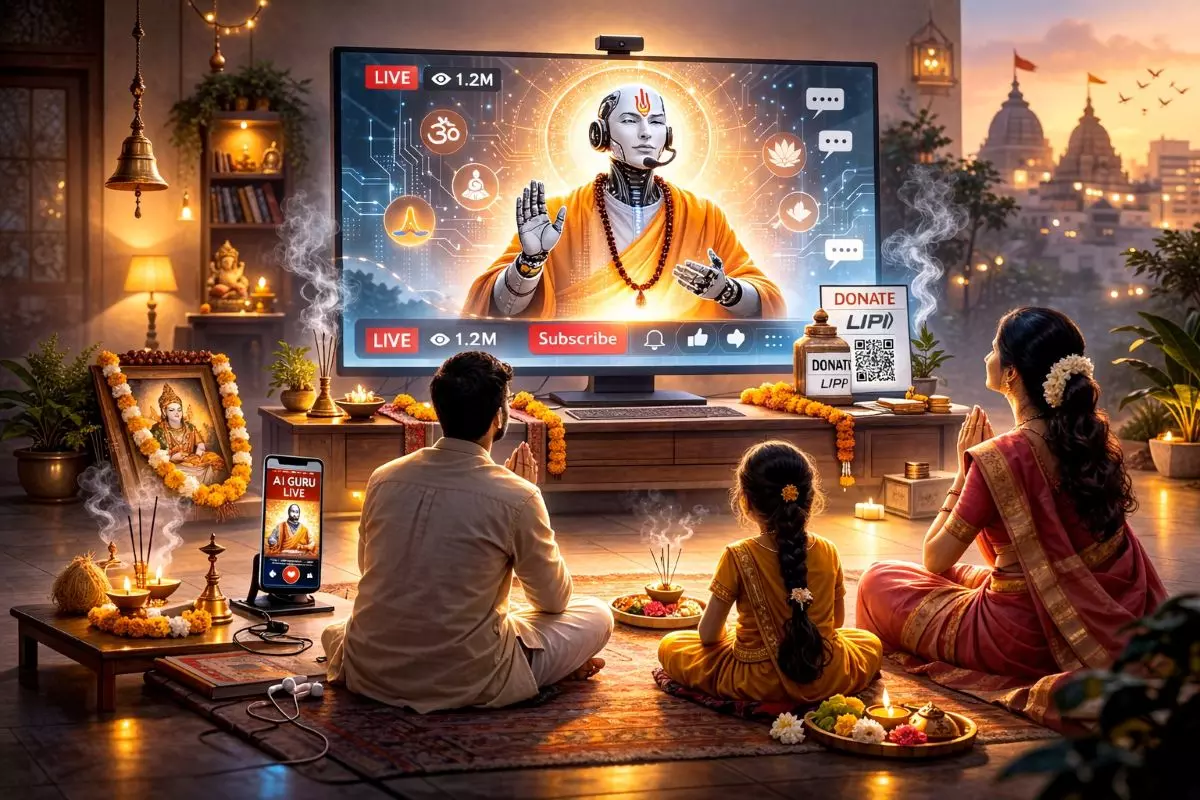
When it comes to desi examples, while digital personas created with AI appear to be by-and-large unexplored as yet in India, there are plenty of AI-powered virtual companions and apps that focus on spiritual growth and meditation.
But while careful curation and fine-tuning of AI may prevent errors, trust issues remain. “This is where things become sensitive,” Jain notes. If an AI monk looks real, dresses like a monk, speaks with emotional conviction, and appears authoritative, people may assume it has lived experience or spiritual depth. “But AI has no lived experience. It has no discipline, no personal journey, no spiritual practice. The biggest risk is misplaced trust. People may treat it as a source of ultimate truth when it is only generating responses based on patterns.”
According to Santoke, AI’s spiritual authority is ultimately accorded by the follower. “What is important is people’s judgment of what is worth following and what is not.” Transparency, Jain adds, plays a crucial role. “If something is AI-generated, it should clearly state that it is an AI system,” he says. “There should be no attempt to create a false sense of divine authority.”
Also read: In dating app era, why Indian professionals continue to fall for the charm of a workplace romance
If AI has the edge in volume and consistency, human influencers have the advantage in nuanced interpretation of texts, say those in the know.
Advocate and author Ganesh Shivaswamy cites his own expertise on the works of artist Raja Ravi Varma as an example. “AI trained on information available on Raja Ravi Varma on the internet will not be able to match someone like me who has had access to Ravi Varma’s letters in the archives of private collections. Even my books on Ravi Varma have been copyrighted for sixty years, making it impossible for AI to access them,” he says.
Then there are the unique personal stories that human influencers can share. “So even if the teachings are the same, the felt experience always is felt at a deeper level by the audience,” claims wellness influencer Kartika Nair.
And even the most sophisticated AI cannot replicate that human connection, say experts. “Let’s be clear on this,” Jain notes, “AI does not feel devotion. It does not experience suffering. It does not reflect or meditate. It predicts words based on patterns it has learned from large amounts of text. There is no consciousness, no belief, no awareness. It is a very advanced prediction system.”
Still, psychotherapist Neha Savara says she isn’t surprised that people are turning to bots and AI-generated influencers for spiritual and mental guidance. “The bots are accessible, give instant response and are created to be non-judgmental. As society adapts to an ever-evolving technological landscape, the use of such [AI-powered] bots is becoming a routine part of daily life. In a culture where mental health stigma persists, bots may feel safer than approaching a therapist.” The flip side of such dependency is the lack of accountability, a lack of co-regulation and depth which therapy or mindfulness offer. “True healing and growth extend beyond the mere receipt of advice or answers,” Savara adds. “They unfold within the context of a safe space and attuned human connection.”
Then there are the more practical issues of copyright, ownership and consent.
While AI is usually trained on scriptures and texts that are in the public domain, “if an AI [guru] copies someone’s tone, style, or teachings without permission, it becomes a consent issue. It can also become a deepfake problem,” explains Jain.
Deepfake videos have already been flagged by some religious organisations and institutions for featuring Indian gurus and leaders delivering fabricated spiritual messages through AI-generated content. Recently, the Shiromani Gurudwara Parbandhak Committee announced their intention to hold meetings with leading AI companies to prevent the creation and uploading of misleading and sacrilegious AI content on social media. Shri Siddharoodha Swamiji Math Trust Committee (SSSMTC) too has appealed to devotees not to use photographs of their spiritual leaders to produce any AI content.
In case of conflict, the judicial process to resolve the issue can be time consuming.
“It’s not easy,” admits Shivaswamy, “to put things neatly in a box.” According to him, there are two ways laws on AI could take shape. One is the traditional route: a conflict is brought to court, which hears arguments, allows deliberations, and moves through the high, higher, and highest courts before a ruling is reached. The other is through Parliament, which could pass legislation directly. “The point to stress is that even if something is technically available online, that does not automatically make it ethically acceptable to use. Clear consent and proper licensing frameworks are necessary.”
Coded spirituality may be a new realm, but the wisdom it dispenses is ancient. The Federal reached out to the creators of Yang Mun, Rabbi Manichem Goldberg and Leya Love on the influencers’ Instagram handle to know about the process of creating and maintaining these AI-powered personas, but has yet to receive a response. The article will be updated if a response is received.
Meanwhile, despite now knowing that Yang Mun doesn’t exist in real life, Joyeeta has signed up for the Inner Circle. She was conflicted initially because on Yang Mun’s website, in a blog, the question of the monk being real has been addressed by the operators of the site: …One of the most common questions online is ‘Is Yang Mun real?’ Yes. Yang Mun is a real person. The confusion often comes from the tone of his work — calm, minimal, and timeless — which feels different from modern self-help branding. There is no No AI persona, No fictional character, No hidden identity. Yang Mun writes, teaches, and guides as a human being, speaking directly to people who feel overwhelmed, disconnected, or exhausted from constantly trying to improve themselves.
“I realised that the claim is false as independent reporting and technical investigation show that Yang Mun is a constructed AI persona circulating as a virtual influencer,” Joyeeta says. “Still, every word he speaks is alive and it feels like I have a wise teacher to guide me back to balance.” Grief, she discovered, ultimately needs the right words to make sense of the devastation within.