- Home
- India
- World
- Premium
- THE FEDERAL SPECIAL
- Analysis
- States
- Perspective
- Videos
- Sports
- Education
- Entertainment
- Elections
- Features
- Health
- Business
- Series
- In memoriam: Sheikh Mujibur Rahman
- Bishnoi's Men
- NEET TANGLE
- Economy Series
- Earth Day
- Kashmir’s Frozen Turbulence
- India@75
- The legend of Ramjanmabhoomi
- Liberalisation@30
- How to tame a dragon
- Celebrating biodiversity
- Farm Matters
- 50 days of solitude
- Bringing Migrants Home
- Budget 2020
- Jharkhand Votes
- The Federal Investigates
- The Federal Impact
- Vanishing Sand
- Gandhi @ 150
- Andhra Today
- Field report
- Operation Gulmarg
- Pandemic @1 Mn in India
- The Federal Year-End
- The Zero Year
- Science
- Brand studio
- Newsletter
- Events

How the centuries-old tradition of Tamil Nadu’s Athangudi tiles is finding a place in modern homes
Step into any Chettiar mansion and perhaps the first thing to catch the eye would be the vividly coloured tiles, with intricate floral and geometric motifs. Made in brass moulds, filled with a mix of cement, local sand and dyes, each of these handmade tiles takes 8 to 18 days to complete.

In Athangudi, a village in Tamil Nadu’s Shivganga district, a centuries-old tile-making tradition is crossing the threshold of neighbourhood homes to find a place in modern residential and commercial spaces across India and abroad. Kept alive by artisans who have been making the eponymously known Athangudi tiles for generations, these handmade tiles are identified by their vivid colours...
In Athangudi, a village in Tamil Nadu’s Shivganga district, a centuries-old tile-making tradition is crossing the threshold of neighbourhood homes to find a place in modern residential and commercial spaces across India and abroad. Kept alive by artisans who have been making the eponymously known Athangudi tiles for generations, these handmade tiles are identified by their vivid colours and intricate floral and geometric motifs.
The tiles aren’t mass-produced. Instead, they are made in brass moulds, filled with a mix of cement, local sand and dyes, which are then placed under the sun to dry. According to artisans engaged in making Athangudi tiles, the high laterite content in the region’s soil ensures that the tiles do not lose their sheen.
Once a marker of grandeur, gracing the mansions of those from the Chettiar community — originally local to the state’s Chettinad region, of which Shivganga is a part — these tiles are now gaining popularity among others for their exotic designs and for being eco-friendly.
Each tile is unique, carrying the imprint of the artisan’s hands.
“The colour scheme of Chettinadu mansions is predominantly white, in both exterior and interior, owing to climatic conditions [extreme heat]. Colours, in shades of red and blue, were added as borders and along the parapet. Inside, the colourful Athangudi tiles, along with Burma teak pillars, artefacts, chandeliers, ceramic products, portraits [created a look of quiet opulence],” says architect AR Periyannnan, who leads the APDO — Architect’s Peri Design Office in Chennai, known for its expertise in vernacular architecture. Many of the tiles would be simple black and white diagonal checks, an imitation of Italian marble patterns.
Also read: What Telangana’s Mudumal Menhirs say about India’s past astronomical prowess
The origin story of the tiles is linked to the Nagarathars, also known as Nattukottai Chettiars, a flourishing merchant and banking community from Chettinad who travelled and worked extensively in Southeast Asia.
"They were inspired by the vibrant, patterned floors in these countries. To lend their mansions grandeur and richness, the community began producing these handmade cement tiles locally. For the Chettiars, these tiles symbolised prosperity, craftsmanship and an amalgamation of their Chettiar heritage with global influences,” claims 65-year-old Unnamalai Thiagarajan, a member of the Chettiar community, based in Chennai.
According to Periyannan, the tiles fulfilled all the requirements of the community; for instance, the raw material was such that their sheen improved with usage, much needed to enhance the rich ambience of the mansion. “These are also made of climate-responsive material, which kept the interiors cool,” he adds.
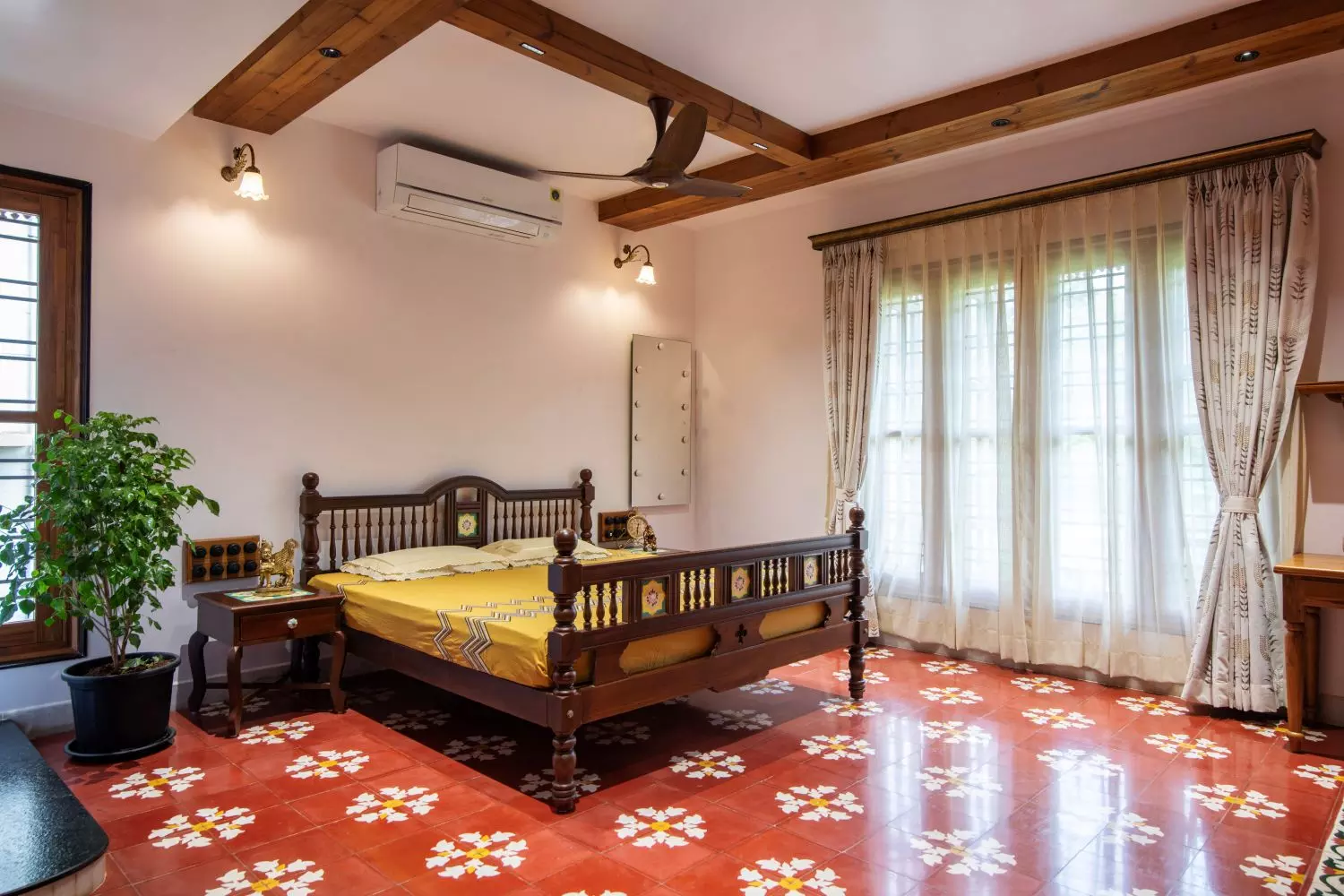
A room laid out with Athangudi tiles. Photo: By special arrangement
While Athangudi tiles have always been central to Periyannan's designs, the architect says he has noticed their growing popularity post-Covid. "Social media, especially Instagram, gave it a lot of prominence and visibility," he explains.
For Jayalakshmi Balakrishnan and Venkateswaran Ramanathan, it was the desire to recreate the warmth of their Palakkad (a district in Kerala) roots and Tamil-Brahmin upbringing that made them turn to the interior design studio, Studio Anvaya, to infuse an old-world charm into a modern Bengaluru residence. Around 600 square feet of the home is laid with garnet Athangudi tiles. “We fell in love with the vibrant and opulent architectural style of Chettinad homes during one of our visits. We hadn’t seen such aesthetic use of colours and textures in any other form of home design. A lot of colours had always meant ‘gaudiness’, but this was different,” explains Jaya.
The growing awareness of Athangudi tiles has also drawn entrepreneurs to the region.
Chettinad Tiles, an Athangudi-based tile-making facility, was established by Vignesh Yuvaraj and co-owners Srinivedhia HB and Prasanth B in December 2021.
A recent entrant in a centuries-old industry, Chettinad Tiles has been supplying to architects, designers and homeowners in Bengaluru, Mumbai and Hyderabad, among other places, in the past few years. “At least 20-30 per cent of queries we receive are from clients abroad. We are currently exporting to Malaysia, Singapore, Thailand and Dubai, but there is also demand in places like the US and Australia,” says Vignesh.
One of the reasons for the growing interest in Athangudi tiles, apart from their design and sustainability benefits, could be the competitive pricing. While standard vitrified tiles range from Rs 50 to Rs 140 per square foot, according to industry experts, with those from high-end brands touching Rs 300 per square foot and above, Athangudi tiles are typically priced between Rs 55 and 120 per square feet.
The popularity of this traditional, handmade tile has also inspired some brands that have been making vitrified tiles to venture into the manufacturing of Athangudi-inspired designs.
“In Bengaluru, one company has introduced ceramic tiles with Athangudi-style prints. Similarly, there is another one in Tamil Nadu, which has long been known for vitrified tiles, which began producing Athangudi-patterned tiles last year,” claims Vignesh.
Also read: How GI tag has brought fresh focus to ‘Kutch Ajrakh’, helped find new platforms for promotion
In Athangudi, the tiles are a cottage industry, with nearly 100 manufacturing units concentrated in the area.
One such manufacturing unit is Malar Tiles, helmed by 45-year-old Michael Raj. The business, started by his grandfather, today employs 15 artisans and makes an estimated 800 tiles a day. “Our annual business is worth Rs 80,000,000-90,000,000, with a year-by-year increase of about 20 per cent,” he says.
The making of Athangudi tiles is an interesting process that begins with a glass sheet. Artisans place a patterned brass mould on the glass to give the tile its natural shine. Iron oxide pigments are poured into the mould and carefully mixed to get deep reds, greens, yellows, blacks, and blues.
Once the pattern is filled, a layer of dry cement is sprinkled on top to hold its place and for strength. Then a wet mortar mix is applied for the remaining thickness and the tile is left to air cure for roughly 18-24 hours, after which it is placed in a water bath to be cured for more than three days. The tile is then left to dry in the sun for a few days. Each tile is made by hand, taking anywhere between eight to eighteen days to finish.
Because they are handmade, no two Athangudi tiles are exactly similar. The tiles are iconic enough to earn a mention on the state’s tourism website, under the section on Tamil Nadu’s crafts.
Forty-five-year-old Muthurani (identified by first name only), who works at Chettinad Tiles, learned the skill from his mother. “She would take me with her when I was around 12 and I would sit and watch. She said to me, ‘idhaan namma vazhakkam’ (Tamil for ‘This is our way’) and taught me the craft step by step. My father did tile laying [of the tiles', so our whole family was involved in the work and now the work feels like family,” he says.
With each unit employing an estimated four to ten artisans, the industry has an approximate strength of 500.
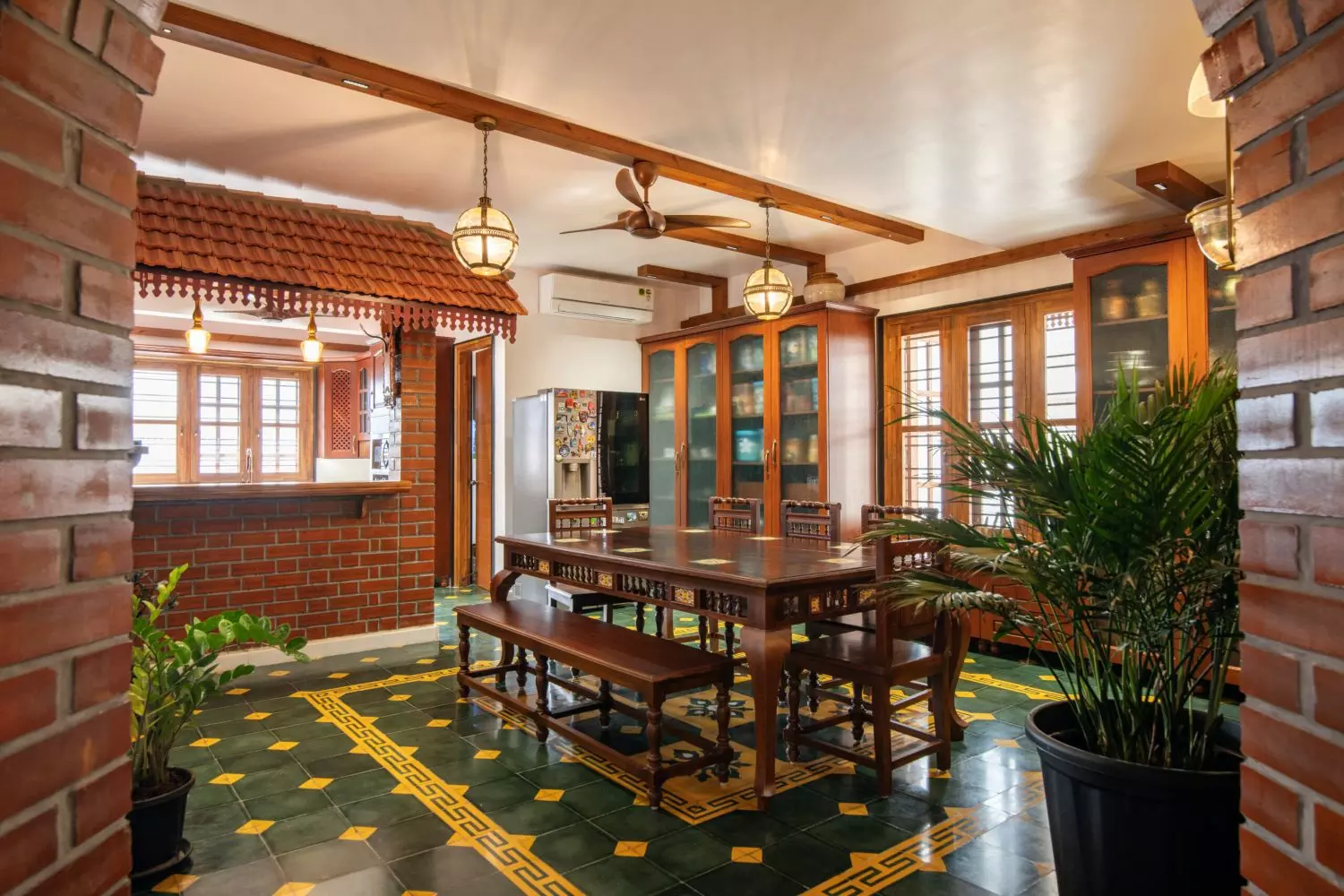
Floors covered with Athangudi tiles add a touch of colour and vibrancy. Photo: By special arrangement
Pandi (identified by first name only), a 55-year-old artisan who has been working at Malar Tiles for 37 years, is the third generation of his family to be engaged in making Athangudi tiles. "It feels great that something we make with our hands is used in homes, not just in Chettinad but in different parts of India. This work has helped me provide for my family,” he says, adding, artisans are paid Rs 10 per tile and make anywhere between 70 and 100 tiles per day.
Also read: A prized possession for generations, why Mysore silk sarees are failing to keep up with demand
The designs range from bold geometric borders to floral, star and checkerboard motifs. While traditionally people preferred chokkattan design (a geometric pattern with a mix of yellow ochre, terracotta red, black and white), geometric 3D patterns or black and white diagonal checks, today, floral patterns are more in demand, say those from the industry.
“In residences designed in traditional style, these tiles are used extensively. In contemporary residences, they are mostly used in specific areas, informal sitting areas, puja spaces, balconies, etc. They are also being used in other typologies like art centres, restaurants, entertainment hubs, buildings of vernacular style, restoration projects etc. The colours and patterns are also a reason behind their increasing popularity,” emphasises Periyannan.
But traditional artisans rue the change that has come in the craft with its growing popularity. “Some factories have started using machines. I have worked in several other factories before this and some rushed the drying and curing to finish fast, which weakened the strength of the tiles,” rues Muthurani.
While Vignesh talks of securing a geographical identification (GI) tag for Athangudi tiles to protect its originality, a bigger threat could be the eventual lack of artisans interested in carrying on with the traditional art. “The younger ones don’t want to spend so much time making one tile,” agrees Muthurani.
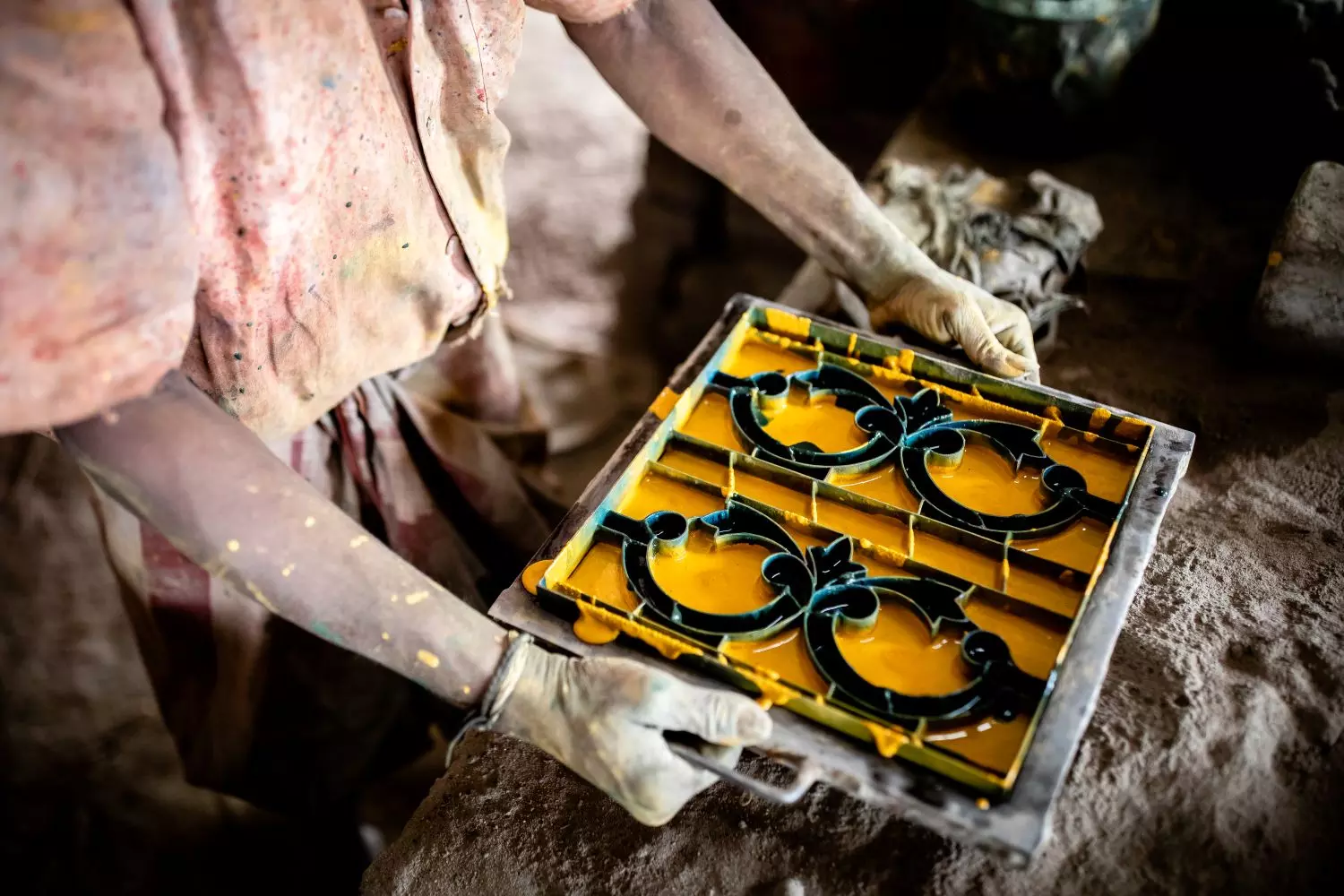
Athangudi tiles being made. Photo: By special arrangement
Meanwhile, for property owners, Athangudi tiles promise a slice of heritage in a 21st-century construction.
Vizag-based Mahalakshmi Swamithan started The Chettinad Homes, an interior design company, in 2023, after she fell in love with Chettinad architecture. As she wanted to build a house that’s traditional, sustainable and low-maintenance, she began visiting Athangudi frequently to study the architecture. Her stunning abode, Madhuram by the Bay of Bengal, incorporates some bits from Kerala, but is majorly in the Chettinad style. “Now I show Madhuram as the sample house to the clients. They come and stay here and then decide [what they want],” she says.
Swaminathan adds: “Athangudi tiles are a constant in my designs for houses in Mumbai, Pune and Vizag. The black and white checkered tiles lend a very cool and classy vibe, and I also experiment and juxtapose them with Jaisalmer stone, marble and others.”
In a world rushing toward mass-produced sameness, Athangudi tiles stand as a reminder that beauty lies in imperfection, longevity, and local wisdom. Their rising popularity isn’t just a design trend; it’s a revival of heritage, identity, and the hands that keep this century-old craft alive.