- Home
- India
- World
- Premium
- THE FEDERAL SPECIAL
- Analysis
- States
- Perspective
- Videos
- Sports
- Education
- Entertainment
- Elections
- Features
- Health
- Business
- Series
- In memoriam: Sheikh Mujibur Rahman
- Bishnoi's Men
- NEET TANGLE
- Economy Series
- Earth Day
- Kashmir’s Frozen Turbulence
- India@75
- The legend of Ramjanmabhoomi
- Liberalisation@30
- How to tame a dragon
- Celebrating biodiversity
- Farm Matters
- 50 days of solitude
- Bringing Migrants Home
- Budget 2020
- Jharkhand Votes
- The Federal Investigates
- The Federal Impact
- Vanishing Sand
- Gandhi @ 150
- Andhra Today
- Field report
- Operation Gulmarg
- Pandemic @1 Mn in India
- The Federal Year-End
- The Zero Year
- Science
- Brand studio
- Newsletter
- Elections 2024
- Events

What Telangana’s Mudumal Menhirs say about India’s past astronomical prowess
Dating back 3,500 years, the ‘upright stones’ of Mudumal, which made it to UNESCO’s tentative list of world heritage sites earlier this year, are believed to have been used to study the stars. One of the most significant features of the site is a representation of the Ursa Major constellation.

On the banks of the Krishna river, on the outskirts of Mudumal village, in Telangana’s Narayanpet district, a cluster of stones stands tall among agricultural fields, like custodians of the secrets of a bygone era. Dating back 3,500 years, the Mudumal Megalithic Menhirs, or the ‘upright stones’ of Mudumal, tell a story of ancient astronomical prowess.“The stones are spread...
On the banks of the Krishna river, on the outskirts of Mudumal village, in Telangana’s Narayanpet district, a cluster of stones stands tall among agricultural fields, like custodians of the secrets of a bygone era. Dating back 3,500 years, the Mudumal Megalithic Menhirs, or the ‘upright stones’ of Mudumal, tell a story of ancient astronomical prowess.
“The stones are spread across approximately 80 acres. Massive stones, 10 to 15 feet tall, some arranged in rows, some in straight lines and others placed over each other. A careful study reveals a significant alignment with the directions of sunrise and sunset during the spring and autumn equinoxes. Their style of arrangement resembles Stonehenge [in UK], indicating the stone’s astronomical links,” says Dr KP Rao. A retired professor of the University of Hyderabad, Rao is currently serving as the research head of the Deccan Heritage Academy Trust, an organisation involved in promoting the conservation, protection and rehabilitation of India’s tangible and intangible cultural heritage, especially those of the Deccan region.
Earlier this year, Mudumal Menhirs earned a spot on the UNESCO’s tentative list of ‘World Heritage Sites’. But securing a permanent inclusion would require extensive documentation and satisfying the UN organisation’s thorough scrutiny. It was as part of field visits to prepare for this that a team from the Deccan Heritage Academy Trust, which has been involved in restoration work at the site for the past several years, made its way to Mudumal earlier this week, on December 16. Another visit is planned on Friday (December 19) to discuss the relocation of power grid towers and transmission lines that are present on the site, Vedakumar Manikonda, the Deccan Heritage Academy Trust’s founder-chairman, told The Federal.
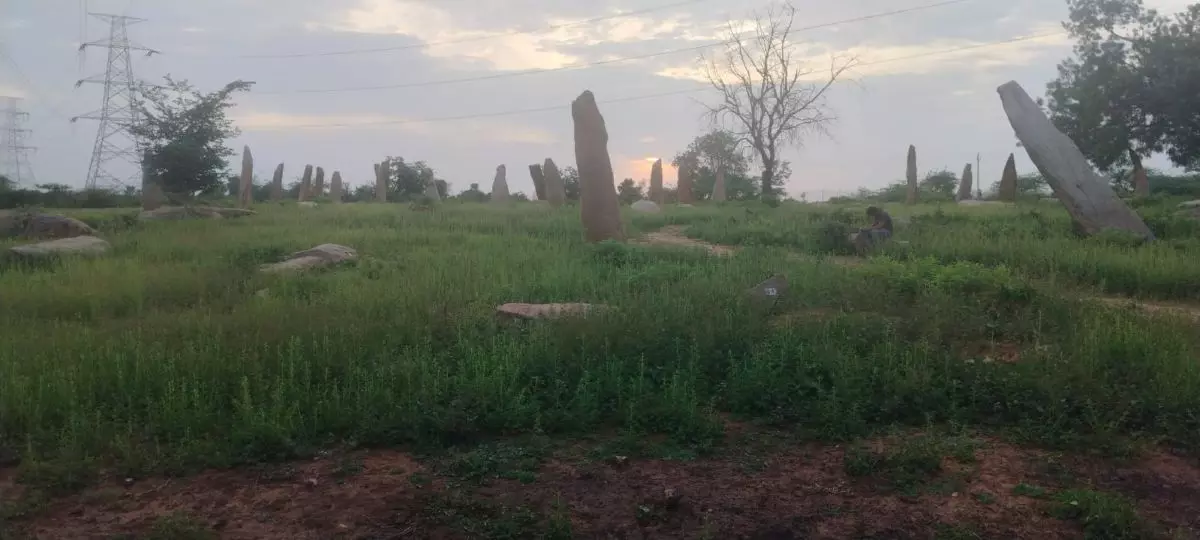
The stones are scattered across agricultural fields and over the years have come to be associated with local beliefs and folklore. Photo: Komanabelli Kiran Kumar
Vedakumar’s association with the Mudumal Menhirs dates back to 2016, when his attention was first drawn to the stones. Then later, when he learnt of encroachment on the site, he decided to take action.
“I have been working as a member of the India unit of the International Council on Monuments and Sites [a non-governmental organisation working worldwide to protect and conserve places of cultural heritage] for a long time. When I read in the newspapers that this site was being encroached upon, I started meeting with government representatives for its protection,” says Vedakumar. The Deccan Heritage Academy Trust began restoration work on the Mudumal standing stones in November 2021.
Also read: How Hyderabad’s iconic palaces and monuments narrate a story of past architectural glory
The first academic mention of the Mudumal Menhirs appears in a 1941 report by geologist LS Krishna Murthy, published in the Journal of Hyderabad Geological Survey, recalls Rao. “But as a geologist, he only mentions the standing stones, without giving any other details [about their astronomical importance],” Rao informs.
He adds: “Each stone, standing 10 to 15 feet tall, was set up as a memorial marker over the graves of important members of their community. In the past, there were hundreds of such stones, but due to agricultural activities, many were destroyed. Today, only about 80 stones remain.”
Rao’s interest in the site was triggered in 2003, while researching megalithic sites in the Deccan region, when he realised the astronomical potential of the Mudumal stones. His findings were presented in a paper, “Astronomical Relationship of South Indian Megaliths” presented at the Oxford International Conference on Archaeoastronomy held at the Northern Arizona University in July 2004.
One of the most significant features of the site is the replication of the Ursa Major constellation.
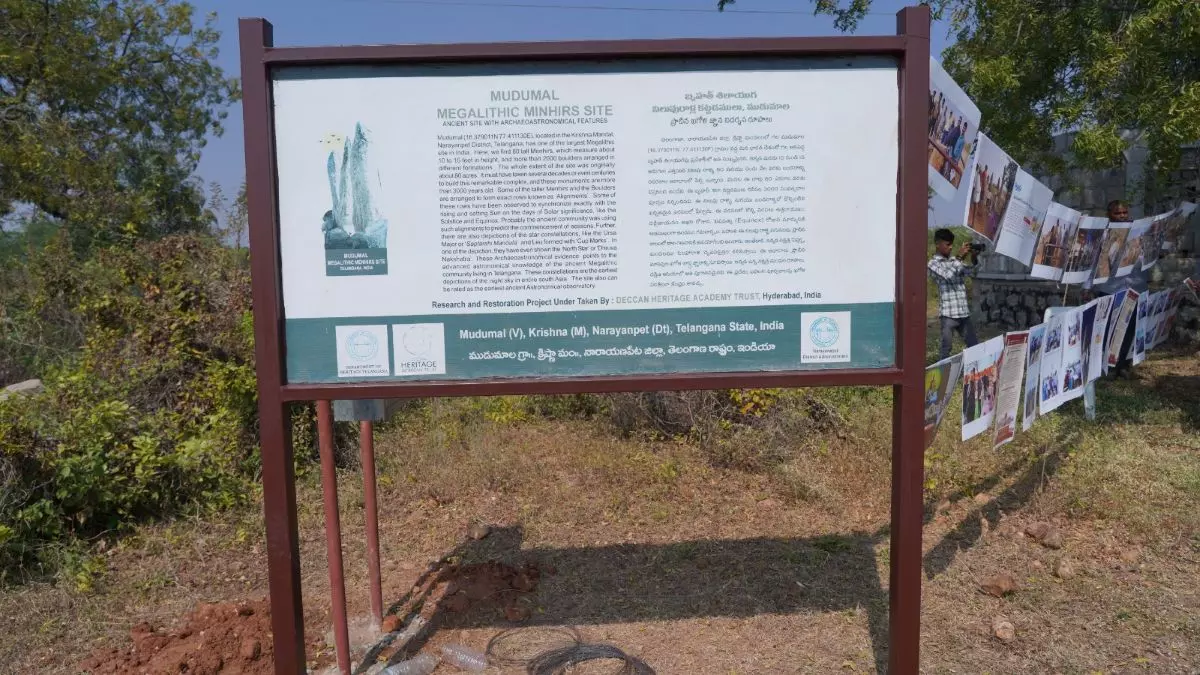
One of the most significant features of the site is a representation of the Ursa Major constellation. Earlier this year, the site found a place in UNESCO's tentative list of world heritage sites. Photo: Komanabelli Kiran Kumar
On its website, UNESCO mentions, “About 400 meters west of the menhirs, the terrain becomes more rugged, leading to a hillock where multiple stone circles, representing megalithic burials, are found. On the summit of this hillock, there is a remarkable cuboid-shaped rock bearing cup marks that replicate the constellation of Ursa Major. This careful depiction of the night sky reveals the advanced astronomical knowledge of the site's builders and points to the site's function as a place of celestial observation.”
It adds: “The Ursa Major constellation is particularly significant, as it has been revered in various cultures for its link with the North Star. In Hindu mythology, Ursa Major is known as the Saptarishi (Seven Sages). The positioning of two stars in this constellation, Merak and Dubhe, points to the North Star, a crucial navigational guide for centuries.”
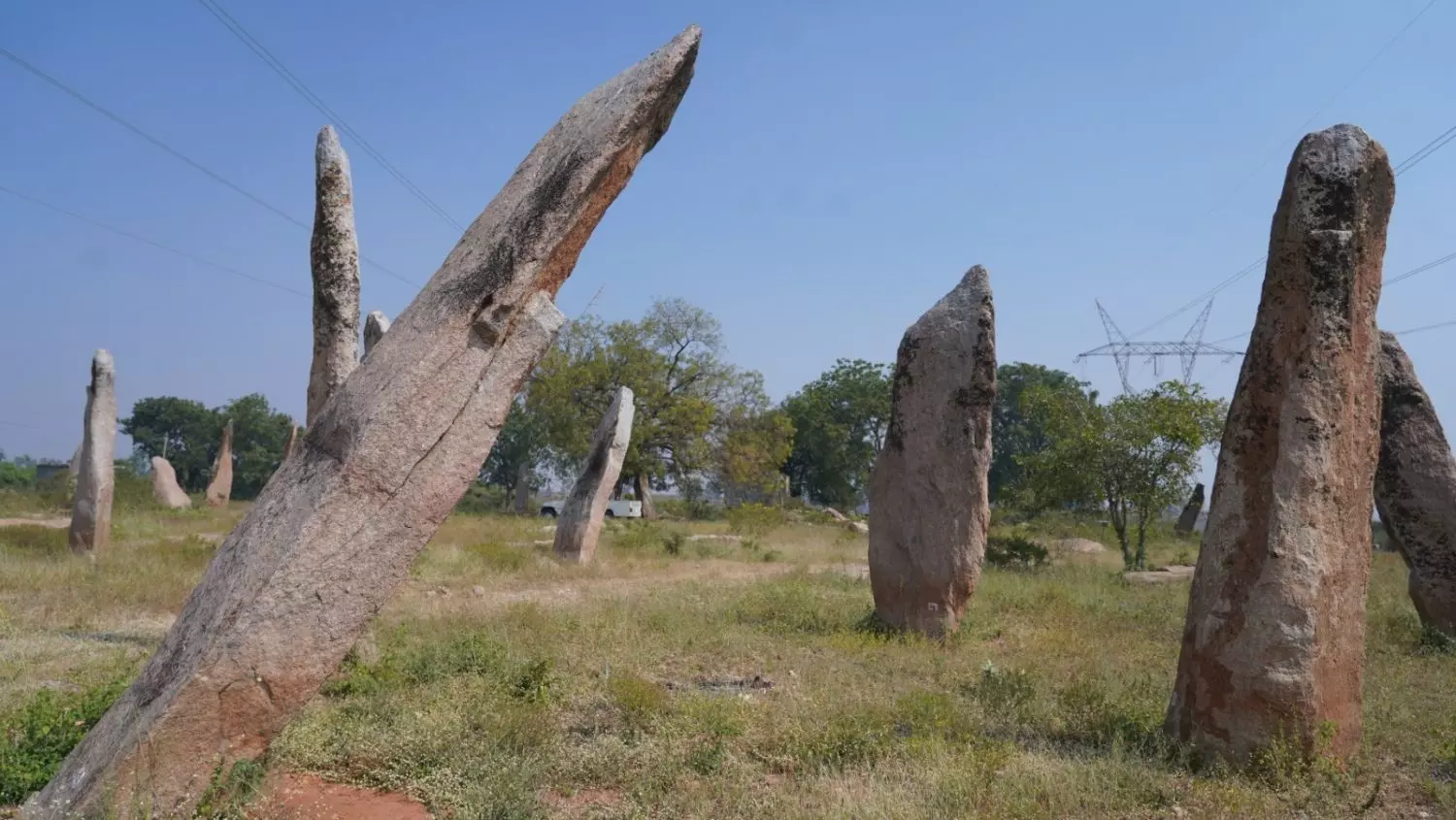
The megalithic menhirs of Mudumal have been compared to the Stonegenge in UK. Photo: Komanabelli Kiran Kumar
According to Rao, in most ancient depictions elsewhere in the world, the imaginary line connecting the Ursa Major does not precisely indicate the North Star.
“The cup marks of Ursa Major in this [Mudumal] depiction are aligned in a straight line with the Pole Star. This suggests that people used this stone as a reference to determine directions,” Rao adds.
In addition to the standing stones, there are some large stone spheres that Rao informs were likely used to estimate ancient climatic conditions, based on the shadows they cast.
Over the years, the stones have also become a part of local faith and folklore.
“The menhirs are considered sacred by the local population…with one particular menhir being worshipped as Goddess Yellamma [a Hindu deity revered as the goddess of the masses and downtrodden],” mentions the UNESCO profile of the Mudumal stones.
It adds: “The Mudumal Megalithic Menhirs are associated with local legends that deepen their cultural significance. One such legend recounts how a deity visited the village, asking for offerings, but the villagers tried to deceive her. In response, the deity cursed them to turn to stone, and thus they became the menhirs.”
Also read: Why in Bihar’s Biswak, a Kashmiri sultan’s grave remains forgotten and neglected
A permanent place in the UNESCO World Heritage list will help conserve not just the physical site, but its cultural significance, putting Mudumal on the world map and creating awareness about another chapter of India’s past astronomical knowledge.
Touching upon the significance of the Mudumal Menhirs, K Arjun Rao, director, department of heritage, Telangana, claimed the Mudumal Menhirs to be “the first place in the world where a star constellation was precisely recorded, leaving behind a priceless heritage for us”. He added that efforts are underway, with cooperation from the central and state governments and the Deccan Heritage Academy Trust, to secure UNESCO recognition for the standing stones.
While the Deccan Heritage Academy Trust hopes to submit a dossier on the relevance of the Mudumal stores to UNESCO within the next one-and-a-half years, to secure a permanent place on the World Heritage list, the recognition will be preceded by a visit by UNESCO representatives to investigate its validity.
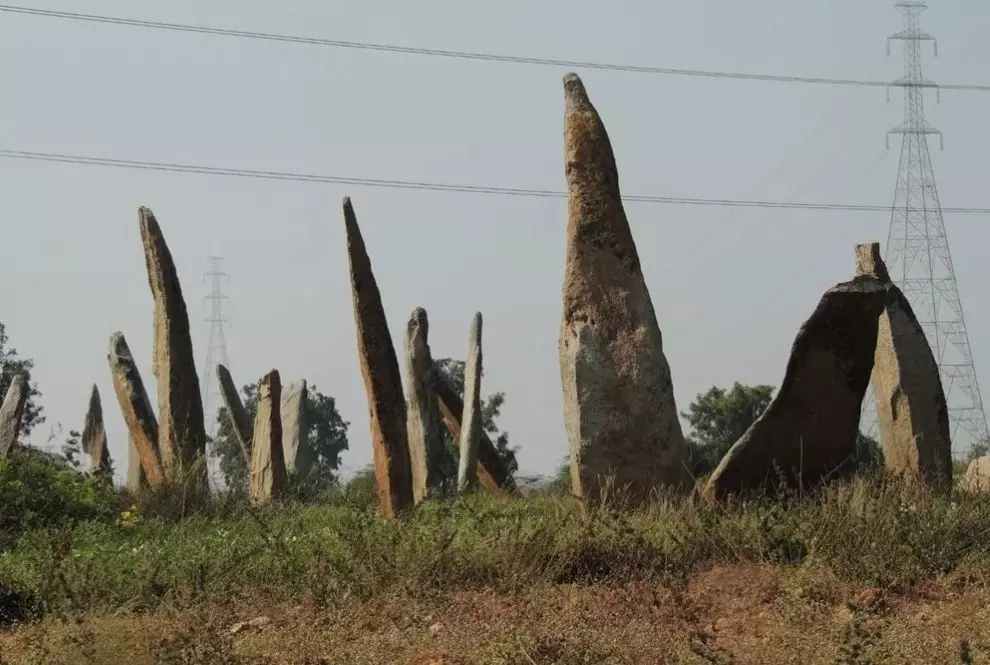
The presence of power grid towers and transmission lines on the site present a potential threat to its recognition by UNESCO. Talks are on to relocate these. Photo: Komanabelli Kiran Kumar
And one potential barrier to the hoped-for recognition is the presence of three power transmission towers at the site and the transmission cables that stretch out over the stones.
About 10 km from Mudumal, across the Krishna River, is the Raichur Power Station, from where electricity is transmitted to Gooty in Andhra Pradesh through dedicated power grid lines. The transmission towers pass directly over the Mudumal standing stone site, with three towers located right within the premises, says Arjun Rao. If the towers are found to be obstructing the view of the site at that time, the chances of recognition will be lost, adds Vedakumar.
To sort this out, a field visit of officials from the Telangana power, revenue and archaeology departments has been scheduled on December 19. Meanwhile, Vedakumar has also brought the problem to the attention of Vakati Srihari, state minister for animal husbandry, youth services, and sports, and MLA from the Makthal constituency, of which Mudumal is a part.
Responding to the issue, Srihari told The Federal, “I will speak to the power grid authorities to have the electricity lines passing over the Mudumal site removed. It is a place that will bring great recognition to our region. We will protect it, showcase it to the world and develop it as a tourist destination. The government will provide all necessary support.”
Also read: How a groundnut festival to appease a bull became a part of Bengaluru's cultural calendar
Comparing Mudumal to Stonehenge, a prehistoric, megalithic structure in England, the profile on the UNESCO site states, “Like Stonehenge, the Mudumal menhirs are deliberately aligned with the rising and setting sun during the solstices, suggesting a sophisticated understanding of celestial phenomena among ancient cultures.”
It adds: “The tangible depictions of the Ursa Major and Leo constellations, along with a presumed planetary representation marked by cup-marks, establish Mudumal as the only site in South Asia featuring representations of the night sky. This shared astronomical characteristic worldwide signifies a commonality in symbolic language across diverse regions, thereby enhancing our understanding of cross-cultural influences and connections within the context of megalithic practices globally.”