- Home
- India
- World
- Premium
- THE FEDERAL SPECIAL
- Analysis
- States
- Perspective
- Videos
- Sports
- Education
- Entertainment
- Elections
- Features
- Health
- Business
- Series
- In memoriam: Sheikh Mujibur Rahman
- Bishnoi's Men
- NEET TANGLE
- Economy Series
- Earth Day
- Kashmir’s Frozen Turbulence
- India@75
- The legend of Ramjanmabhoomi
- Liberalisation@30
- How to tame a dragon
- Celebrating biodiversity
- Farm Matters
- 50 days of solitude
- Bringing Migrants Home
- Budget 2020
- Jharkhand Votes
- The Federal Investigates
- The Federal Impact
- Vanishing Sand
- Gandhi @ 150
- Andhra Today
- Field report
- Operation Gulmarg
- Pandemic @1 Mn in India
- The Federal Year-End
- The Zero Year
- Science
- Brand studio
- Newsletter
- Elections 2024
- Events

A prized possession for generations, why Mysore silk sarees are failing to keep up with demand
Introduced by Tipu Sultan in the 1790s and further developed by Krishnaraja Wadiyar IV in 1912, today the Karnataka Silk Industries Corporation is the sole custodian of this heritage weave. But despite efforts at training, lack of skilled artisans is crippling efforts at scaling up production

Days before Diwali, the Karnataka Silk Industries Corporation (KSIC) showroom in Bengaluru’s Malleshwaram area opened for sales at eight in the morning. Within hours, by 11 am, the store found itself out of stock of its signature Mysore silk sarees. Through the day, buyers continued to crowd the showroom for the prized weave, but had to leave empty-handed.Flaunted by actor Deepika Padukone...
Days before Diwali, the Karnataka Silk Industries Corporation (KSIC) showroom in Bengaluru’s Malleshwaram area opened for sales at eight in the morning. Within hours, by 11 am, the store found itself out of stock of its signature Mysore silk sarees. Through the day, buyers continued to crowd the showroom for the prized weave, but had to leave empty-handed.
Flaunted by actor Deepika Padukone — not as a saree but a printed shirt — at the 75th Cannes Film Festival in 2022, Mysore silk has for centuries enjoyed royal patronage and public demand. Known for their smooth texture, rich sheen and use of pure mulberry silk with real zari borders, for generations of Indian women, Mysore silk sarees have been a prized possession.
“In the 1790s, Tipu Sultan, impressed by gifts of silk from foreign rulers, started silk production in Mysore. It is said he sent envoys to Bengal and China to procure silk worms and set up sericulture centres in the region. Then, in the 19th century, another ruler, Krishnaraja Wadiyar IV, took another initiative to boost Mysore’s silk industry. Inspired by the mechanised silk production he saw in Britain, he imported 32 power looms from Switzerland and established a silk factory in Mysore in 1912,” historian PV Nanjaraj Aras told The Federal.
After Independence, control of the factory passed to the Karnataka Department of Sericulture and since 1980, KSIC has managed operations there. On its website, KSIC claims credit for being the “only organisation in the country commanding the entire gamut of silk production right from reeling of cocoons to the weaving of pure silk fabric of various shades and designs, all under one roof”.
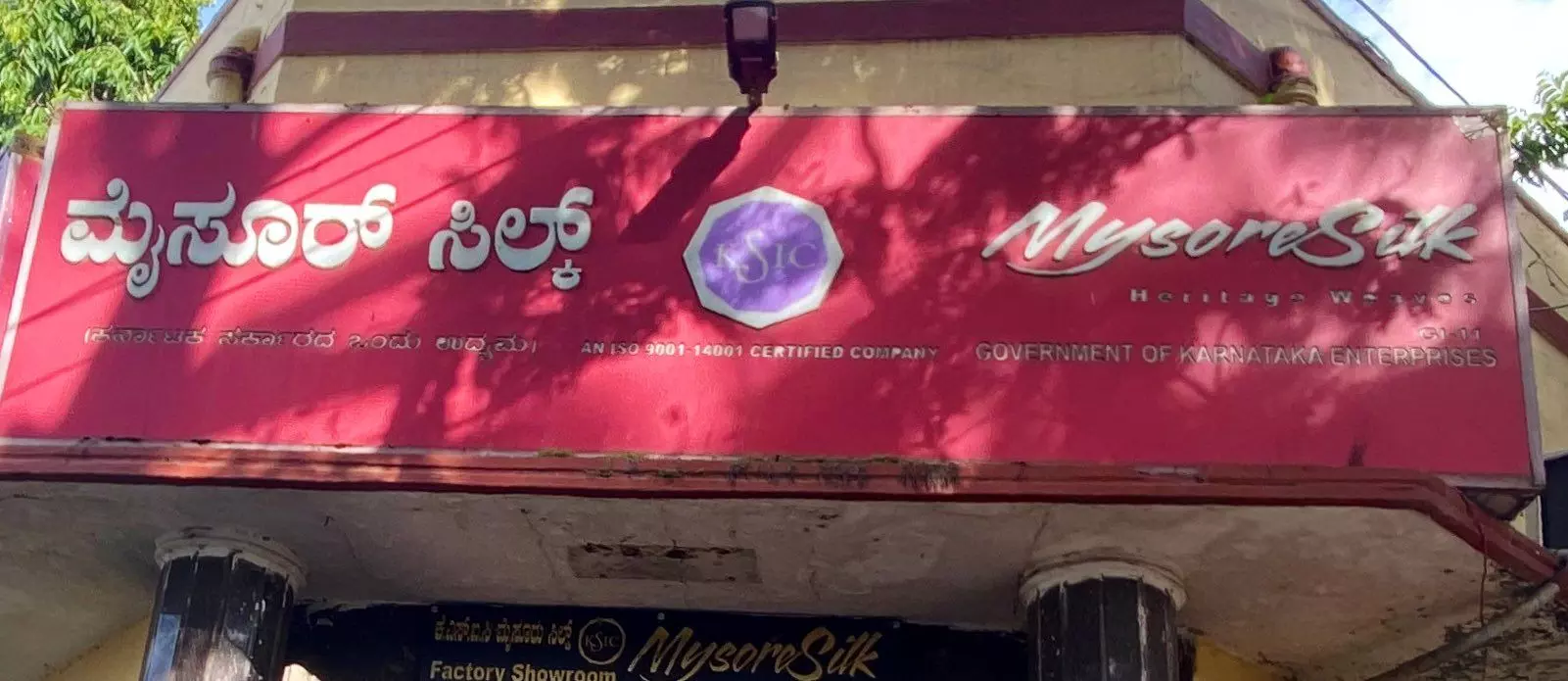
A Karnataka Silk Industries Corporation showroom. By special arrangement
KSIC is not only the custodian of Mysore silk’s royal heritage, but purportedly also the “sole proprietor for ‘Mysore Silk’,” or the “only authorised entity to produce and sell Mysore silk".
Yet, the government agency is by no means the only entity involved in weaving or selling silk sarees in the region.
Also read: Globally recognised, why Kolkata’s kathi rolls continue to rule over the city’s heart
Murudachala Moorthy, a 45-year-old weaver of silk sarees in Bengaluru, claimed, “ local weavers weave sarees of the same quality as KSIC’s. But since KSIC is a brand, people are more attracted to it. There is no difference between the silk they use and the silk we use. The difference is only in the twisting process [of the yarn].” Unlike the KSIC sarees, which are woven on powerlooms, Moorthy uses a handloom to weave the sarees. “It takes up to two days to make one saree and we earn on an average Rs 800 a day,” he added.
Explaining the difference in weaving time between an electric loom and a handloom, another weaver, Gangadhar, who only weaves cotton sarees, said, “For me, since I use an electric loom, it takes me about four hours to weave one saree. On a handloom, the same saree will take a day to finish. A silk saree will take longer to finish on a handloom.”
KSIC, arguably the largest manufacturer of Mysore silk sarees in the area, “operates weaving units at Manandavadi Road [Mysore], T. Narasipura and Channapatna [all three in Karnataka]. While 500 workers are employed at the Mysore weaving centre, 200 work at the T. Narasipura unit and 89 others at Channapatna,” said KSIC general manager Siddalinga Prasad. The company also adds 30–40 new looms each year and continues to expand training for new artisans, added KSIC managing director, Jehra Naseem.
What explains the shortage in supply, then?
Also read: Osmania biscuit: How Hyderabad’s popular tea-time snack got the Nizam’s name
KSIC manages 16 showrooms across Karnataka and Hyderabad. Despite online sales and exhibitions, supply continues to fall short of demand, more so during the festival season spanning Varalakshmi Puja (worship of Goddess Lakshmi in the Hindu calendar month of Shravan, corresponding to the months of July-August in the Gregorian calendar) to Deepavali. “New saree collections arrive twice a week, on Wednesdays and Fridays. However, the stock is usually sold out within hours, leaving many customers disappointed,” admitted KSIC marketing manager Naveen (identified by first name only).
One reason for the limited supply, according to Siddalinga, is that production capacity has not increased in proportion to demand. “KSIC sarees are woven only by trained in-house artisans, limiting the scope to scale up production,” he explained.
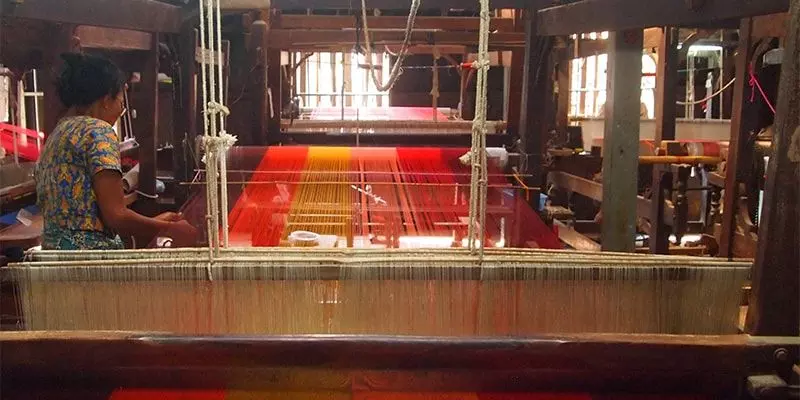
Weaving underway at a silk factory. By special arrangement
Agreed Naseem: “Training new weavers is a long process — it takes three years for new artisans to master complex weaving patterns. Skilled artisans are retiring faster than replacements can be trained. It takes six-seven months to train artists enough for them to be able to weave a small-border saree properly. This shortage of skilled labour has directly reduced production.”
Also read: Kolhapuri Saaj: How this handcrafted gold necklace keeps a city’s heritage alive
Karnataka’s Mysore, Ramanagara, and Bengaluru areas are known for their silk production, said S. Gangadhar, chairman of the Karnataka Silk Board. “Ramanagara is Asia’s largest silk cocoon market, supplying high-quality raw material. The climate and soil here are ideal for mulberry cultivation, which supports sericulture,” he added. The mulberry silk thus produced gives Mysore silk sarees their characteristic sheen and lightness.
According to silk farmer Basavaraju Kalladevanahalli, “maintaining the right temperature is crucial for silkworms as they’re sensitive to rain and cold. Once the cocoons are ready, they are sold at an auction in Ramanagara”.
Kalladevanahalli added: “I grow about 18,000 kg of silk annually. A kilogram fetches about Rs 700.”
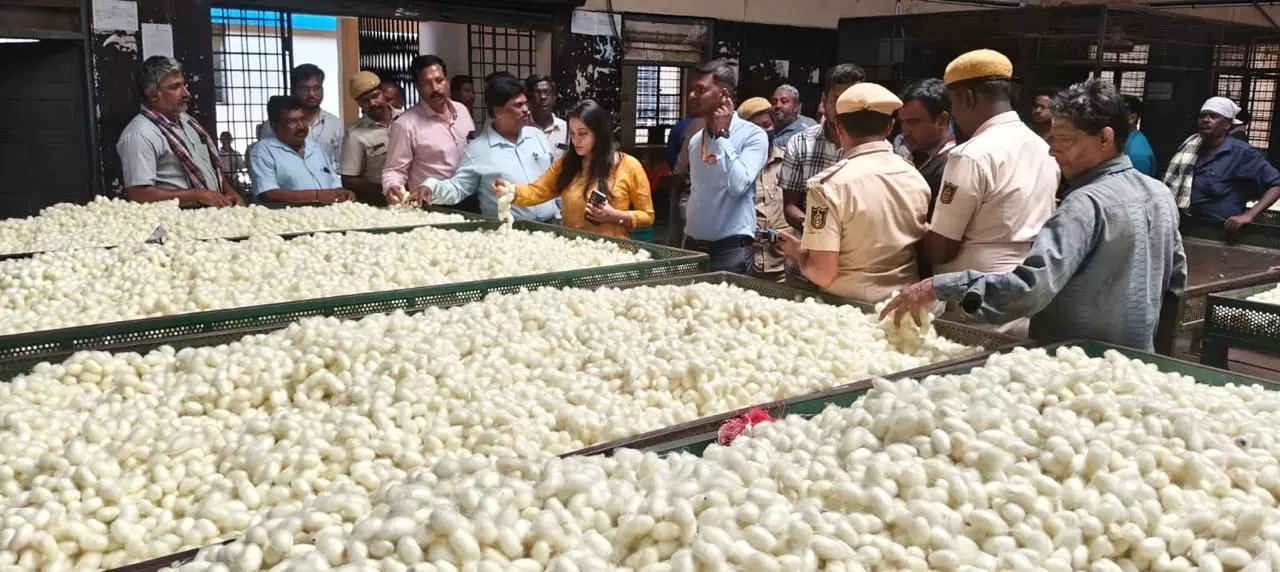
Silkwork cocoons being sold. By special arrangement
In 2005, Mysore silk received Geographical Indication (GI) certification. KSIC has also earned an Integrated Management System (IMS) certification in 2009, confirming compliance with international standards, thus giving its sarees an elevated status in the region.
“High-quality cocoons are procured from Ramanagara and Sidlaghatta markets. These are processed at the T. Narasipura factory to produce silk yarn, which is then sent to the Mysore plant. Skilled artisans use Dobby and Jacquard power looms to weave intricate designs. Each saree is finally embroidered with the KSIC trademark to prevent counterfeiting,” said Siddalinga.
Obviously, the quality assurance comes at a price.
KSIC’s Mysore silk sarees are priced between Rs 16,000 to ₹3,00,000, with printed sarees available for Rs 10,000. The agency sold an estimated 1,03,347 Mysore silk sarees in the 2024-25 financial year, recording a turnover of Rs 332 crore.
In comparison, Shastha Vastra Bhandar, a local saree shop in Bengaluru, offering a wide range of pure silk, crepe silk and semi crepe silk sarees, has pure silk weaves in the range of Rs 5,000 to Rs 50,000, said owner Darshan (identified by first name only). “The saris are sourced from Mysore and Bengaluru. All pure silk sarees come with ‘Silk Mark’ certification,” he added.
Also read: In Tamil Nadu, Swamimalai artisans keep alive Cholas’ lost-wax casting technique
For a lover of authentic Indian sarees, however, an authentic Mysore silk saree would be as much of a wardrobe essential as a Benarasi, a Kanjeevaram or a Bengal dhakai.
“Mysore silk has consistent demand because of quality assurance and softness. Today, most women are employed and have higher purchasing power. Many now own multiple Mysore silk sarees instead of just a prized possession,” summed up Naseem.
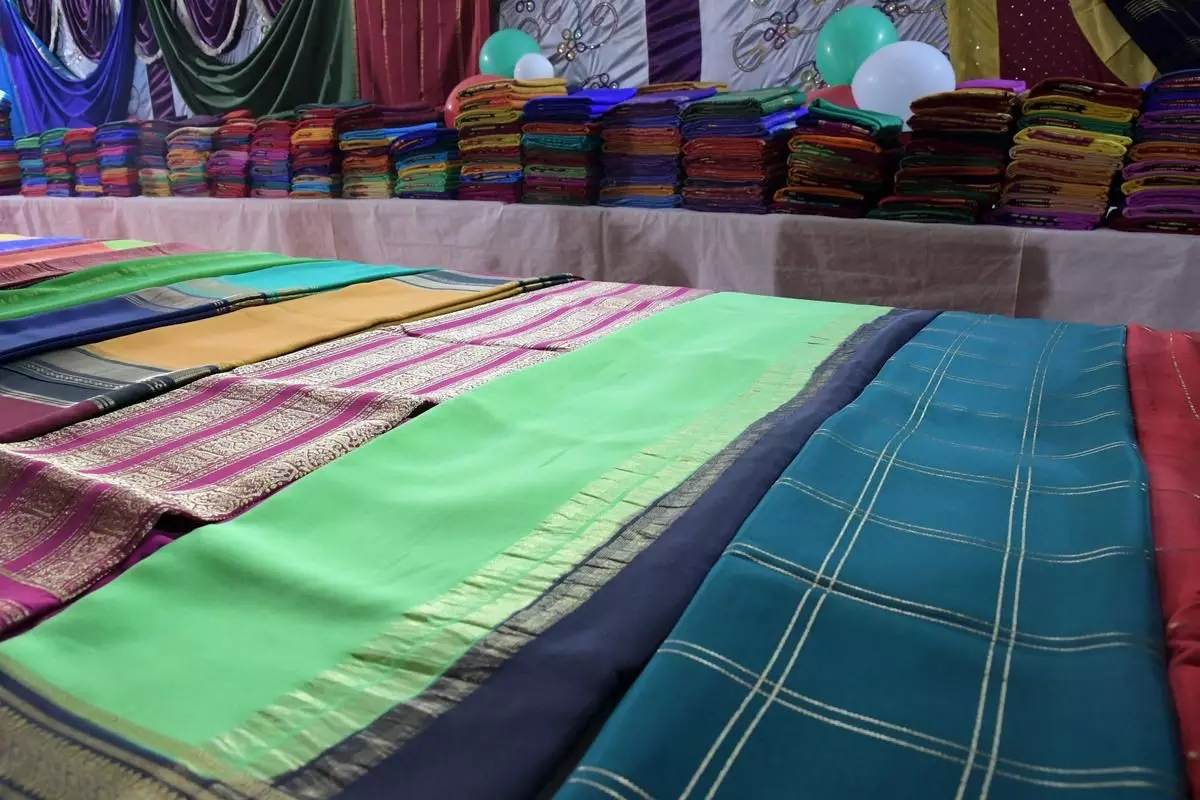
Mysore silk sarees being sold at an exhibition. By special arrangement
Like 46-year-old teacher at a government primary school, Pratibha V, who bought her most recent Mysore silk saree earlier this year, for Rs 23,000. “They’re so light to wear yet look incredibly grand. I usually buy them from the KSIC showroom in Mysore. Every woman should own at least one Mysore silk saree,” she gushed. Her one complaint? “A few times, the design I wanted has been out of stock, especially during the festival season.”