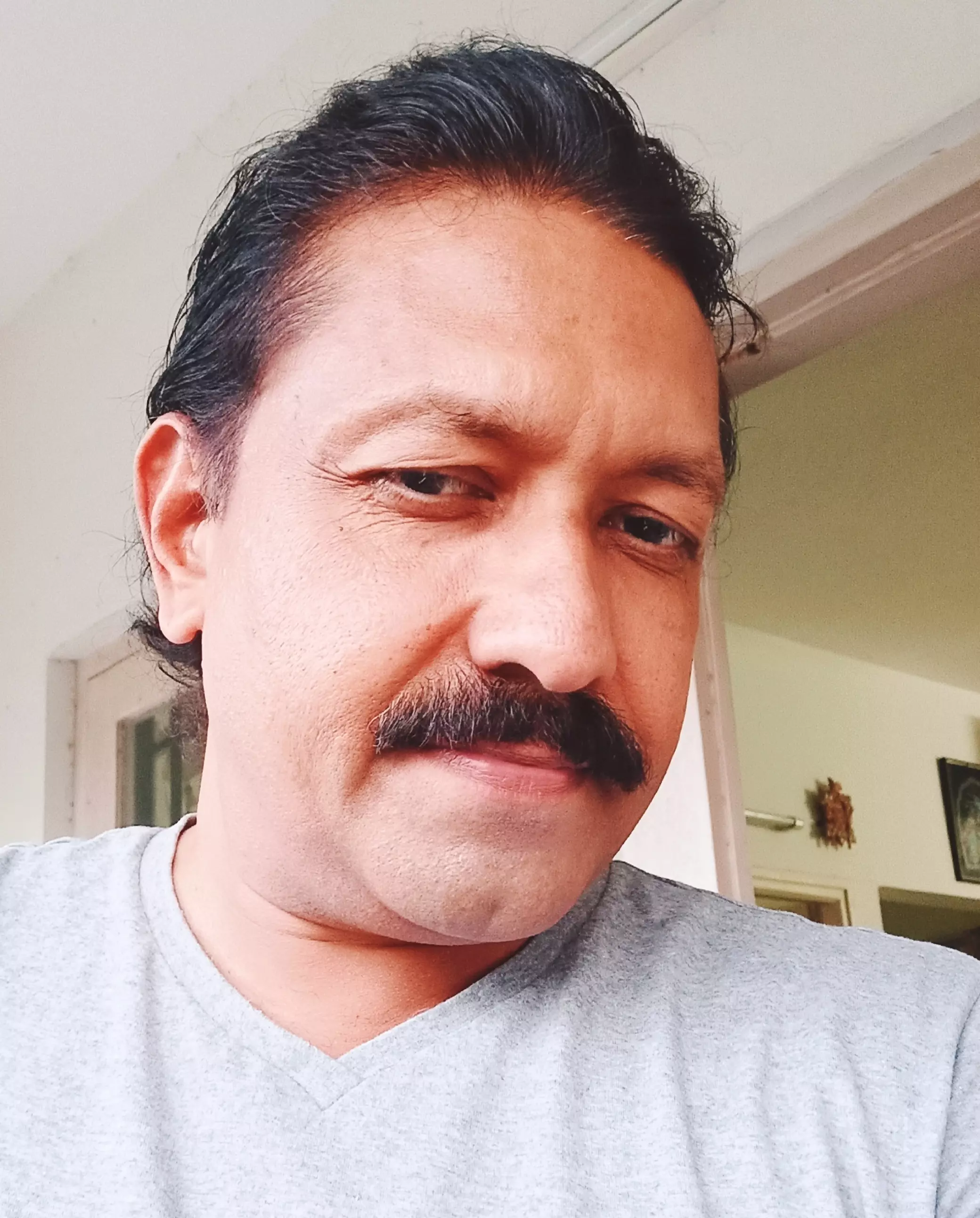
A Jahir Husain (left) with actor M Nassar at the launch of the music video. Photo: By special arrangement
When A Jahir Husain of the University of Madras was looking for someone to sing his Arabic translation of a lullaby by renowned poet Bharathidasan, he was told by his Palestinian students of the talent back home. Husain eventually roped in Reem Ahmed of Gaza for the project. But the singer has since gone missing.

A year back, when A Jahir Husain, head of the Department of Arabic, Persian, and Urdu at the University of Madras, was looking for someone to sing his Arabic translation of a lullaby by the renowned 20th-century Tamil poet Bharathidasan, some of his Palestinian students told him about the presence of talent back home. Inspired, Husain says, he got in touch with a music studio in Gaza, Traneem.
The initial response was far from encouraging. “They told me they were in a mess, moving from one location to another owing to the ongoing war. ‘No food, no shelter. Our lives have been devastated’, they said,” recalls Husain.
Gaza, a territory in Palestine, has been in crisis ever since Hamas — an armed Palestinian group in the Gaza Strip, designated a terror outfit by many countries — attacked Israel in 2023, killing a reported 1200 people and taking 251 hostages. An Israeli offensive in Gaza has since reportedly killed tens of thousands of Palestinians.
Husain persisted in his communications with the Traneem music studio, however, and a second exchange a couple of months later proved more fruitful. The studio put him in touch with singer Reem Ahmed.
Husain’s challenges were, however, far from over. Amidst the ongoing war in Gaza, Ahmed too declined the singing offer. With her, too, a second attempt at persuasion proved to be more successful.
The song — ‘Nam Ya Azizi, the Arabic translation of the well-known Tamil lullaby, ‘Kararum Vaanatthil Kaanum Muzhu Nilave’ — was composed and sent to Ahmed through the music studio. Ahmed sang and returned it, infusing the tracks with love and emotion. Despite her struggles with displacement and destruction in the war-torn region, her voice was fresh and vibrant.
Also read: Why Iran's strike on Israel’s Haifa has reminded some in Mysore of a battle over 100 years old
Then came the twist. Ahmed went missing.
“Even though she sang with a great sense of emotion, we wanted a retake on some words that she pronounced. But by then she was found missing from Gaza,” says Husain, also the director of ‘Nam Ya Azizi’.
An inquiry through the music studio yielded no results. “They said that it was for the first time that Ahmed had sung for them. All they knew was that her family had been relocated, and no one knew where they were,” he added.
The song was eventually released last month by renowned Tamil actor M Nassar and has received a tremendous response since.
“Bringing ancient and modern Tamil literature to the Arabic language is a great work. We need more such translations from Tamil to Arabic. Initiatives like ‘Nam Ya Azizi’ inspire a deeper cultural awareness within us,” Nassar said after the launch.
The cover of ‘Nam Ya Azizi, the Arabic translation of 20th-century Tamil poet Bharathidasan's lullaby ‘Kararum Vaanatthil Kaanum Muzhu Nilave’. Photo: By special arrangement
According to experts, the timing of the video song is significant, coming as it does amidst ongoing conflicts in Palestine. In the past month, the ongoing Iran-US war, which has drawn Israel to the support of the US, has further intensified the international geopolitical crisis.
“Translating Bharathidasan’s poems into Arabic is just one dimension of the matter. There are tales of displacement, conflict, and disappearance associated with this project. The woman who sang the lullaby is nowhere to be found in Gaza. What is her current situation? May this song be a tribute to her,” says SK Menon, a cultural commentator based in Coimbatore.
The song has meanwhile evoked tremendous response in the Tamil and Arab literary circles, receiving more than five lakh visitors in the first week following its release. This prompted Husain to again try and reach out to Ahmed to share the good news with her. “A few days ago, a person who worked in the studio told me that she (Ahmed) and her family relocated to some unknown location after her brother was badly injured in the war. This is what I heard last about her,” he says.
Produced by Glady Gerard under the banner Drums Jerry Entertainment, the music for the song was composed by Ubaid Kunnakkavu, a composer and keyboard-harmonium player. “The work was completed in Sharjah. I composed the tune and transmitted the track to a studio in Gaza. I am unaware of the singer’s identity, but she sang the lullaby with a great feel. This is the first time that I composed a song without knowing the singer,” says Ubaid, who also plays the harmonium for ghazal and qawwali concerts.
According to Ubaid, the music was created by mixing the traditions of both Arab and Tamil cultures. “When you examine the music alongside the visuals, it becomes evident that it represents a fusion of both traditions, encompassing both Tamils and Arabs. The voice was outstanding owing to its refreshing quality. I am pleased that the song garnered lakhs of viewers within just a week of its release; however, I feel a sense of sadness that we have lost contact with the singer because of the ongoing conflict in the region,” he adds.
Also read: Why life today is a struggle of a different kind for former Sri Lankan LTTE fighters
Husain had originally planned to cast an Arab woman for the video. However, he was unable to locate one. “So, I opted to use AI. Reem’s voice was remarkable, possessing a profound quality in traditional Arabic music. The song attracted viewers from around the globe, and I believe this is primarily owing to Reem’s singing style,” he says.
Human emotions do not recognise geographical distance. Whether born in the poetic imagination of Bharathidasan or rearticulated through the vision of Jahir Husain, they travel freely across languages, cultures, and histories.
And so, the lullaby — which speaks of a mother’s emotions for her child, who is her dream come true — speaks equally to people across cultures. The video juxtaposes images of a woman in a robe and headscarf with her baby, with those of one in a saree and flowers in her hair, linking the song’s Tamil roots with its Arab rendition.
"This work is not merely a translation or adaptation — it is a bridge. A lullaby once rooted in Tamil literary tradition becomes, in Arabic form, a universal whisper of compassion. The tenderness embedded in the original poem survives the journey, proving that art and literature are among the most powerful vehicles of shared human experience. They do not require passports; they move through the heart," says Ashraf Aboul-Yazid, an Egyptian poet and journalist, serving as the secretary general of the Congress of African Journalists, Egypt.
He adds: "What makes this project especially meaningful is its sincerity. The song reaches beyond aesthetic appreciation into the realm of humanitarian connection. It speaks to those who suffer, those who hope, and those who seek comfort — regardless of where they are [located geographically]. In this sense, ‘Nam Ya Azizi’ becomes more than a song. It is a reminder that shared sorrow can unite humanity more deeply than any border can divide. Through poetry, music, and performance, the poet and the performers extend a gentle hand to all who endure hardship, proving that artistic expression remains a global language of empathy.”
Ubaid Kunnakkavu, who composed the music for the song. Photo: By special arrangement
For Husain, this is not the first cultural project of its kind. The academic has previously, in 2013, translated the Tamil epic Thirukkural into Arabic — the first one to attempt the Tamil to Arabic translation of this text. Armed with a copy of the translated Thirukkural, he travelled to all Arab nations as part of his cultural exchange initiative.
In 2015, he translated 12th-century Tamil poet Avvaiyar’s Aathichoodi into Arabic. The epic comprises a collection of 109 insightful single-line quotations arranged in alphabetical order aimed at promoting good deeds. He has also introduced the works of poets such as Subramania Bharati and Bharathidasan to the Arab literary community. In 2022, he translated 30 poems by Bharati, and in 2024, he translated 50 poems by Bharathidasan into Arabic. All four books were published with the assistance of the Tamil Nadu government. ‘Nam Ya Azizi’ is his third video song, following the first two, which focused on Aathichoodi and the works of Subramania Bharati.
“Today, videos disseminate information rapidly and generate great response. My initial two albums received an overwhelming response. ‘Nam Ya Azizi’ has taken it a step further. There exists a cultural bond between the Tamils and the Arabs, which is why the Tamil works I translated have been well-received in the Arab world,” says Husain, who has received several accolades for his translations, including the Tamil Nadu government’s ‘Best Translator’ award in 2016.
Also read: Why restoring Kannada classic Samskara would help preserve a landmark in Indian cinema
Students and research scholars feel that cultural exchange through literature is essential at a time when conflict has engulfed much of the Middle-East and West Asia. “Arab literature is as rich as Tamil literature. The Arabs have maintained maritime trade links with the Tamils for centuries. A cultural exchange through literature is indeed necessary at this moment,” says Bajeel P, a post-graduate student in Arabic at the University of Madras.
For Husain, however, ‘Nam Ya Azizi’ has become inseparable from the mystery of its missing singer. While he is aware it is impossible for him to travel to Gaza at this time, he insists he will continue his search for Ahmed, hoping that “the lullaby she sang will lead me to her one day”.