- Home
- India
- World
- Premium
- THE FEDERAL SPECIAL
- Analysis
- States
- Perspective
- Videos
- Sports
- Education
- Entertainment
- Elections
- Features
- Health
- Business
- Series
- In memoriam: Sheikh Mujibur Rahman
- Bishnoi's Men
- NEET TANGLE
- Economy Series
- Earth Day
- Kashmir’s Frozen Turbulence
- India@75
- The legend of Ramjanmabhoomi
- Liberalisation@30
- How to tame a dragon
- Celebrating biodiversity
- Farm Matters
- 50 days of solitude
- Bringing Migrants Home
- Budget 2020
- Jharkhand Votes
- The Federal Investigates
- The Federal Impact
- Vanishing Sand
- Gandhi @ 150
- Andhra Today
- Field report
- Operation Gulmarg
- Pandemic @1 Mn in India
- The Federal Year-End
- The Zero Year
- Science
- Brand studio
- Newsletter
- Elections 2024
- Events

Why Iran's strike on Israel’s Haifa has reminded some in Mysore of a battle over 100 years old
On September 23, 1918, troops of the Mysore Lancers — a cavalry regiment raised by the erstwhile princely state of Mysore — working with a similar battalion from the erstwhile state of Jodhpur, the Jodhpur Lancers, had liberated Haifa from nearly 400 years of Ottoman rule.

Earlier this month, as reports of an Iranian missile strike on the Israeli port city of Haifa started doing the rounds, some in Karnataka’s Mysore were thinking of a different battle — one fought more than a century ago that had forever established a link between the two cities, but that few in Mysore remember the details of today.On September 23, 1918, troops of the Mysore Lancers —...
Earlier this month, as reports of an Iranian missile strike on the Israeli port city of Haifa started doing the rounds, some in Karnataka’s Mysore were thinking of a different battle — one fought more than a century ago that had forever established a link between the two cities, but that few in Mysore remember the details of today.
On September 23, 1918, troops of the Mysore Lancers — a cavalry regiment raised by the erstwhile princely state of Mysore, which got its name from the lances (a steel-tipped spear) they used to fight — working with a similar battalion from the erstwhile state of Jodhpur, the Jodhpur Lancers, had liberated Haifa from nearly 400 years of Ottoman rule.
Both troops, the Mysore Lancers and the Jodhpur Lancers, were part of the 15 (Imperial Service) Cavalry Brigade, which also included soldiers from the two other princely state regiments known as the Hyderabad Lancers and the Patiala Lancers. The 15 (Imperial Service) Cavalry Brigade had served in Palestine alongside the British forces during the First World War (WWI).
The Suez Canal was a crucial maritime route for the British, linking Europe, Asia, and Africa for the British Empire. It was vital for maintaining connections with colonies across South and Southeast Asia, including India. Recognising its strategic importance, Germany and its ally, the Ottoman Empire, attempted to seize control of the canal to disrupt British supply lines. The imperial forces retaliated.
Before the Haifa battle, the Mysore Lancers had successfully defeated Bedouin tribes that had seized control of sections of the canal, restoring British authority there. It is said impressed by the prowess of the lancers, the British entrusted them with the task of liberating the port city of Haifa.
According to historians, the Mysore Lancers deployed 29 officers, 444 cavalry soldiers and 526 horses for the battle.
“The Mysore Lancers earned immense global recognition and respect for the extraordinary bravery and sacrifice they displayed during World War I. Their capture of the Suez Canal and the liberation of Haifa are considered major turning points in the war,” says Pampa Urs, a professor of history at the Seshadripuram College in Bengaluru, whose great-grandfather, Captain Chamaraj Urs, had led the Mysore Lancers during the Haifa battle, along with Captain A. Nanjudiah Urs. Another of her great-grandfathers, Lingaraj Urs, had also participated in the battle. “These victories not only significantly aided the advance of the British Empire and allied nations, but also ensured that the Mysore Lancers were not remembered merely as a regional cavalry unit. Instead, their participation in the war secured them a permanent place in history as one of the most distinguished cavalry forces on the global stage.”
Also read: Why Karnataka’s Lakkundi village has become the state’s latest history hotspot
According to historical accounts, the Ottoman and German forces had positioned artillery and machine guns on the slopes of Mount Carmel, a coastal range in what is now northern Israel, creating formidable defences. Yet the Mysore and Jodhpur Lancers advanced on horseback, armed mainly with swords and lances, charging directly toward the enemy. Forcing the German troops to retreat, they captured Haifa.
Accounts of the battle have been detailed by historian Rao Bahadur M Shama Rao in his book Modern Mysore, published in 1936.
According to Rao, the Mysore soldiers possessed exceptional physical strength. “In distant and unfamiliar lands, even amid harsh climates and extreme physical exhaustion, they were especially known for their endurance and hard work,” he writes.
The horses were given excellent training under the leadership of Colonel Deshraj Urs. After witnessing the soldiers’ drills and the training of the cavalry horses, the then Viceroy of India openly praised the discipline of the regiment, Rao adds.
“The victory [at Haifa] was one of the greatest achievements in the history of the Mysore Lancers,” claims the historian in his book.
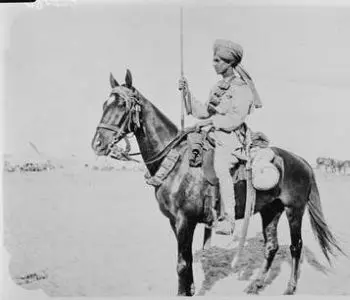
A soldier of the Mysore Lancers. Photo: Wikimedia Commons
The Lancers’ success was also praised by the British commander, Edmund Allenby.
In The Story of the Jodhpur Lancers (1885–1952), retired Indian Army officer Mahendra Singh Jodha refers to General Allenby’s wartime reports.
According to it, while the soldiers of the Mysore Lancers were clearing the rocky slopes of Mount Carmel, the Jodhpur Lancers advanced through narrow routes. Riding directly toward enemy machine-gun positions, they entered the city and fought street by street, striking down Turkish soldiers with their lances.
The book adds that Allenby described the battle as a rare event in military history, noting that during the entire war campaign, no other cavalry action of such magnitude had taken place.
Jodha writes that according to the strategy devised by Allenby, the enemy forces were positioned at a highly advantageous location. The only route into Haifa was a narrow passage between Mount Carmel and the Kishon River. From their position on the hill, enemy forces could easily fire upon anyone advancing below.
The Mysore Lancers were tasked with climbing the rocky slopes of the mountain and neutralising the enemy artillery. Once the Mysore troops eliminated the danger from the hilltop, the Jodhpur Lancers launched a direct charge against the enemy machine guns, capturing the city.
Allenby regarded this episode — where a fortified city was captured within a few hours using only swords and lances — as a unique and extraordinary achievement in military history, adds the book.
“Liberating a war-torn region and protecting its people is an important responsibility. The contribution of the Mysore Maharaja to the world [for sending the Mysore Lancers to the war] at that time is worth remembering,” says Urs.
Another descendant of a Lancer soldier, TV Nagaprasanna Raje Urs, grandson of Risaldar A. Lingaraje Urs, among the frontline leaders of the Mysore Lancers, also recalls his grandfather’s achievements with pride.
“During the war to safeguard the control of the Suez Canal, my grandfather had seized a sword from Rizkalla Salim, a Bedouin tribal leader. The sword is still preserved with the family,” he says.
N. Gopichand Pawar's residence in Malleshwaram, Bengaluru, too, one can find the lance and sword of a Mysore Lancer, preserved with utmost care. The weapons belonged to his grandfatherLimbaji Pawar. "The stories my father used to tell me [of his grandfather's heroism] still echo in my ears," says Gopichand, adding that the memories are a source of immense pride and joy for the family.
Agrees Panduranga Rao, whose grandfather, Chandar Rao Shinde, was a Mysore Lancer soldier and fought in the battle of Haifa. "My grandfather took his younger brothers, Govind Rao Shinde and Krishna Rao Shinde, along with him to the battlefield. He also had his son-in-law, Mahadev Rao Bhonsle, by his side. We still remember them fondly in our family. It is an immense honor that our family members were part of the historic and heroic missions at Haifa and the Suez Canal," says Panduranga.
Also read: What Telangana’s Mudumal Menhirs say about India’s past astronomical prowess
At the very beginning of WWI, the then Maharaja of Mysore, Krishnaraja Wadiyar IV, is said to have donated a huge sum of Rs 50 lakh to the British government from his personal funds.
Horses, transport vehicles and medical supplies were also sent to the war front by the erstwhile princely state. In addition, under the leadership of the then Mysore Dewan HM Kantharaj Urs, a special fund called the 'Mysore War Fund' was established.
Through this effort, a total of Rs 65,08,400 was contributed by the Mysore government and Rs 42,75,455 by the public. Altogether, more than one crore rupees were collected at that time for war relief efforts, records of which are found in the book India's Services in the War, as well as in the Mysore Administration Reports.
Following the end of the war, the achievements of the Lancers were recorded in government publications of the time. The book Mysore's Part in the War: 1914–1918, published by the Mysore Government Press in 1919, references official dispatches sent by Allenby during the Battle of Haifa, and mentions the capture of 1,350 prisoners of war and 17 artillery guns by the soldiers.
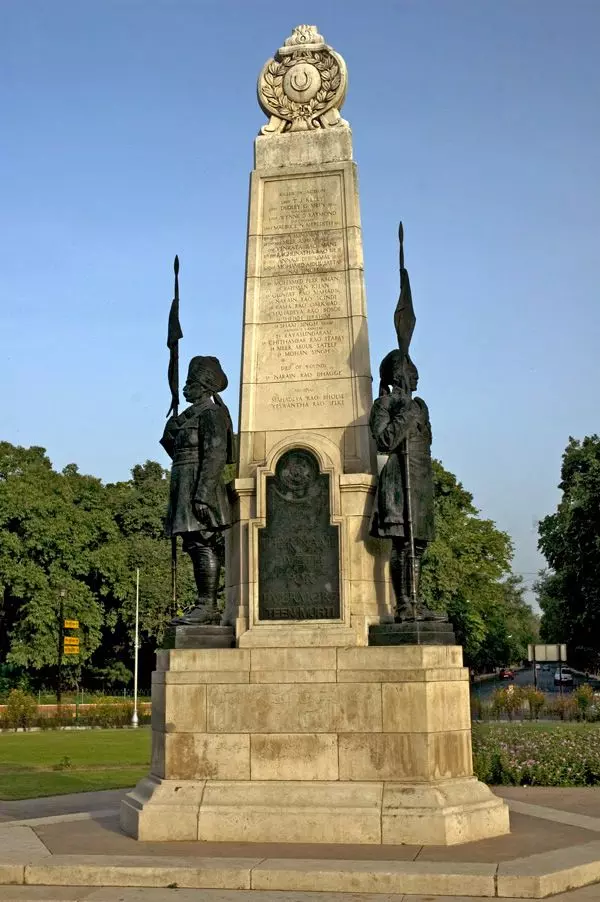
A memorial to the Imperial Service Cavalry Brigade in New Delhi. Photo: Wikimedia Commons
Yet, the achievements were not without losses.
After the war, the Mysore government provided pensions, compensation, and housing to returning soldiers and the families of those who died.
According to records in the Karnataka State Archives, compensation of ₹1,170 was paid to families of soldiers who died, while ₹6,020 was distributed as special allowances to those who fought in the war. Land belonging to fallen soldiers was protected, and their children were provided with education and housing.
Also read: Why in Bihar’s Biswak, a Kashmiri sultan’s grave remains forgotten and neglected
Today, traces of the lancers’ legacy survive amidst everyday life in Mysore.
Like a 250-kg bronze bell bearing French inscriptions at the Muneshwara Swamy Temple in Bengaluru, donated by grateful soldiers who had made the journey back from the war.
“Family members of soldiers who served in the Mysore Lancers visit the temple every year on Haifa Day (September 23) to offer prayers,” says Ravindra Singh, a Bengaluru resident, one of whose family members had served in the Mysore Lancers and had also fought on the British side during World War II. Another inscription, dating back to 1923, near the Sri Pattaladamma Temple in Karnataka, also commemorates soldiers who fought in that war and later donated to the construction of certain temple structures.
In 1923, the Mysore Lancers Memorial was built near Hebbal, Bengaluru, to honour soldiers who died in the war. A memorial to the Imperial Service Cavalry Brigade also exists in Teen Murti Haifa Chowk in New Delhi. When Israel's Prime Minister Benjamin Netanyahu visited India in 2018 he paid tribute there along with Prime Minister Narendra Modi. There is also an Indian war memorial in Haifa, where Modi paid homage during his historic visit to Israel in 2017.
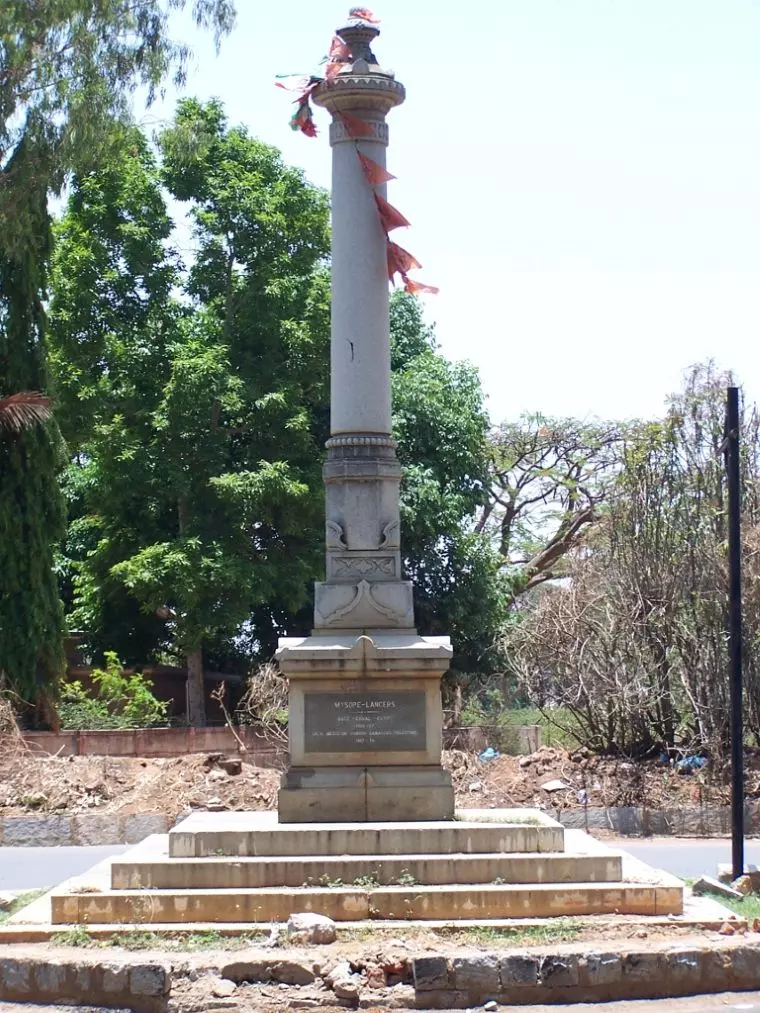
A memorial to the Mysore Lancers. Photo: Wikimedia Commons
Yet, sadly, the average Mysoreans have little recall of the Lancers today.
When The Federal approached the priests of the Sri Gundu Muneshwara Temple for comments on the historic bell, they instead spoke of the religious significance of the temple.
Sanitation workers of the Greater Bengaluru Authority Municipal regularly clean the area around the Hebbal memorial. But there was little information about the structure forthcoming from officers of the Authority The Federal reached out to. The memorial truly comes alive on Haifa Day, when army personnel and families of Lancers gather there to pay their respects.
Speaking on one such occasion, former Bengaluru police commissioner Bhaskar Rao had urged for the story of the Mysore Lancers to be passed on to future generations.
“There is a misconception that people from Mysore live comfortable lives and do not engage in difficult tasks. But the victory of the Mysore Lancers proves that idea wrong,” he said.
For now, as Urs says, it is the present turmoil in Haifa that has brought back memories of the brave Lancers.