- Home
- India
- World
- Premium
- THE FEDERAL SPECIAL
- Analysis
- States
- Perspective
- Videos
- Sports
- Education
- Entertainment
- Elections
- Features
- Health
- Business
- Series
- In memoriam: Sheikh Mujibur Rahman
- Bishnoi's Men
- NEET TANGLE
- Economy Series
- Earth Day
- Kashmir’s Frozen Turbulence
- India@75
- The legend of Ramjanmabhoomi
- Liberalisation@30
- How to tame a dragon
- Celebrating biodiversity
- Farm Matters
- 50 days of solitude
- Bringing Migrants Home
- Budget 2020
- Jharkhand Votes
- The Federal Investigates
- The Federal Impact
- Vanishing Sand
- Gandhi @ 150
- Andhra Today
- Field report
- Operation Gulmarg
- Pandemic @1 Mn in India
- The Federal Year-End
- The Zero Year
- Science
- Brand studio
- Newsletter
- Events

Why ISRO’s handling of post-failure transparency after PSLV-C62 mission loss will be closely watched
One concern following the failure of India's PSLV-C62 mission on January 12 is the fate of the lost hardware. Filmmaker OP Srivastava, whose ‘The Dirty Sky' addressed the crisis of uncontrolled accumulation of space debris, analyses whether the missing satellites could add to this trash load.

India’s first space launch of 2026, the PSLV-C62 mission, ended in failure on January 12 when the Polar Satellite Launch Vehicle — long regarded as the most dependable pillar of India’s space programme — encountered a technical anomaly during the third stage of flight. The failure resulted in the loss of 15 satellites from India and abroad, including a crucial defence-linked...
India’s first space launch of 2026, the PSLV-C62 mission, ended in failure on January 12 when the Polar Satellite Launch Vehicle — long regarded as the most dependable pillar of India’s space programme — encountered a technical anomaly during the third stage of flight. The failure resulted in the loss of 15 satellites from India and abroad, including a crucial defence-linked Earth observation satellite, marking the second consecutive failure of the PSLV after a similar setback in May 2025.
Yet amid the disappointment, one payload unexpectedly survived. A Spanish re-entry capsule called KID (Kestrel Initial Demonstrator) reportedly managed to separate from the launch vehicle and transmit data — an outcome described by its makers as “against all odds” and one that adds an unusual footnote to an otherwise grim mission.
The PSLV-C62 failure is significant not merely because a launch went wrong — spaceflight failures are not uncommon — but because of what this particular mission carried, who it affected and what it means for India’s ambitions as a commercial launch provider.
The PSLV-C62 mission lifted off from the Satish Dhawan Space Centre, Sriharikota, at 10.18 am, carrying 16 “passengers”: 15 satellites and one re-entry capsule.
The primary payload was EOS-N1, also referred to as Anvesha, a hyperspectral Earth-observation satellite developed for the Defence Research and Development Organisation (DRDO). The satellite was designed to support strategic surveillance and monitoring, with applications ranging from terrain analysis to tracking military movement. Its loss represents a setback to India’s national security and reconnaissance capabilities.
Alongside EOS-N1 were satellites representing a cross-section of India’s emerging private space ecosystem and foreign customers. One of these was AyulSat, built by Bengaluru-based startup OrbitAID, intended to demonstrate in-orbit satellite refuelling, a capability that could dramatically extend satellite lifespans. There were six more satellites from Indian startups, including payloads developed by Dhruva Space, Eon Space Labs, and TakeMe2Space, many of them experimental CubeSats (small, nanosatellites that are of a standard size) and aimed at testing next-generation Earth-observation and in-orbit data processing technologies. Then there were foreign satellites from Nepal, Brazil, Thailand and the UK and Spain, including academic and research spacecraft and small commercial payloads.
The sole bright spot came from KID, the re-entry capsule developed by Spanish startup Orbital Paradigm. The company confirmed that the capsule successfully separated from the launch vehicle, powered on, and transmitted telemetry data — achieving its core objective of validating atmospheric re-entry technologies, even though the parent mission failed.
Also read: Why damage to China’s Shenzhou-20 spacecraft has lesson on debris threat for space-faring nations
ISRO has confirmed that the first two stages of the PSLV performed normally, and that the anomaly occurred during the third stage (PS3), when the rocket was being propelled toward its intended orbit.
According to ISRO Chairman V. Narayanan, disturbances and deviation from the flight path were observed during the third stage, when strap-on motors were still contributing thrust. The anomaly prevented the vehicle from achieving the velocity and attitude required for successful orbital insertion.
The third stage of PSLV is a solid rocket motor, responsible for providing the final major velocity push before the fourth stage takes over for precision orbit placement. Failures at this stage are particularly unforgiving; once control or thrust is lost near burnout, recovery is virtually impossible.
ISRO has initiated a detailed analysis of telemetry and flight data. At present, the agency has not indicated any external interference and the failure profile is consistent with known engineering issues associated with propulsion, guidance, or control transitions.
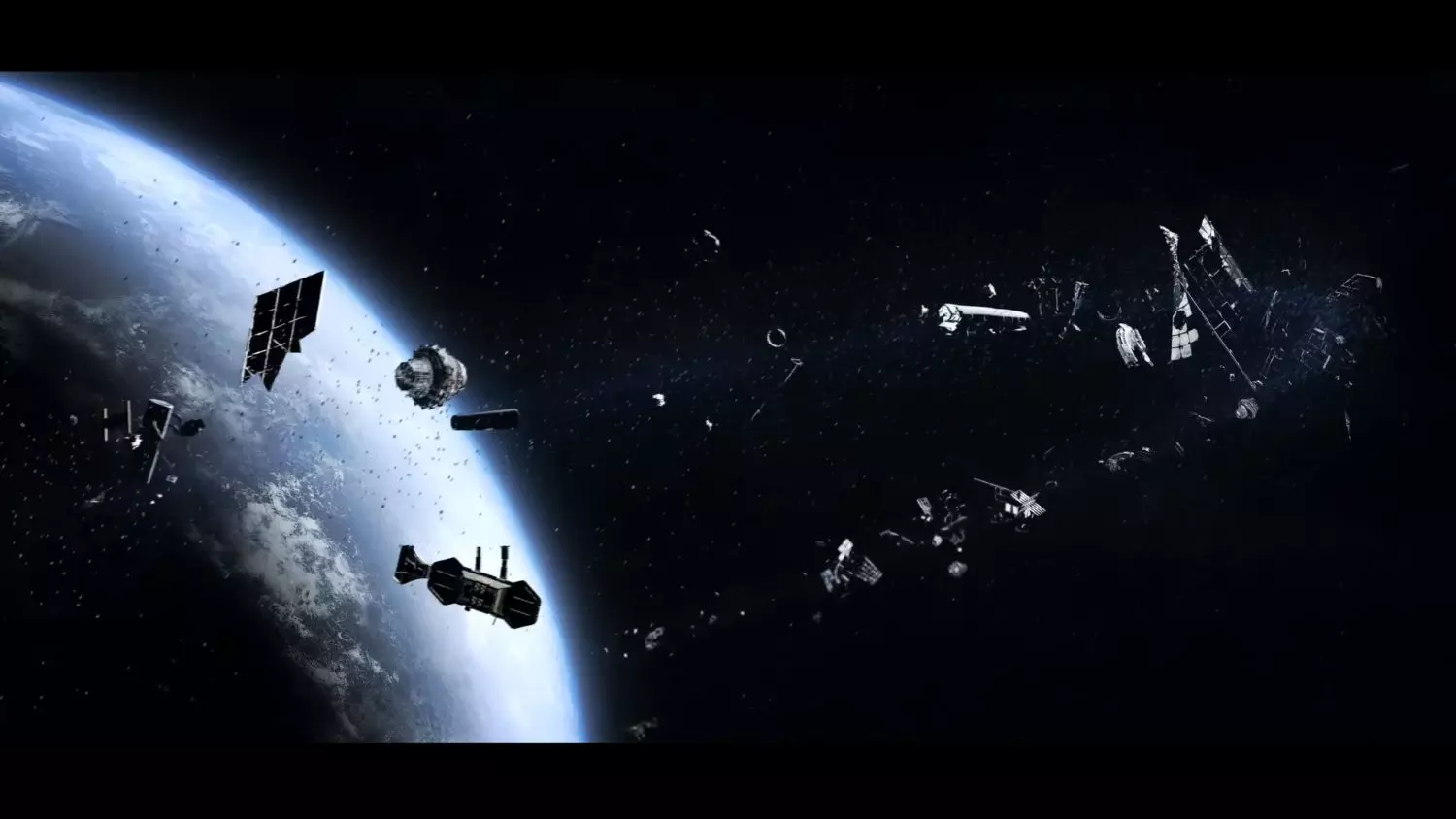
A screenshot of space debris from OP Srivastava's 'The Dirty Sky'.
One of the immediate public concerns following any launch failure is the fate of the lost hardware — and whether it adds to the growing problem of space debris.
The outcome depends on whether the rocket reached orbital velocity.
Based on the timing of the anomaly during PS3, experts say two scenarios are most likely. The first is a sub-orbital trajectory and atmospheric re-entry, in which case most hardware would burn up, with any surviving fragments falling into remote ocean areas. The second, a short-lived, unintended orbit, followed by rapid decay owing to atmospheric drag.
ISRO has not yet released definitive tracking data, and until international space-situational-awareness catalogues are updated, the precise fate of the debris remains unconfirmed.
Historically, India has experienced both outcomes. While most PSLV stages safely re-enter, there have been exceptions. The PSLV-C3 mission in 2001, for instance, saw the upper stage fragment in orbit, creating hundreds of debris pieces — some of which remained in space for years. More recently, in 2023, debris later identified as originating from a PSLV mission washed up on an Australian beach, highlighting that rocket remnants can occasionally survive re-entry.
Also read: Why astronomers are racing to observe the violent death of a supergiant star
There are no binding penalties for pollution, no mandatory debris-mitigation protocols and few incentives for cleanup. Voluntary guidelines are often ignored amid geopolitical competition and commercial ambition. The primary governing document, the 1967 Outer Space Treaty, is visionary but outdated and lacks enforcement mechanisms.
Active debris removal remains experimental and expensive. Innovative companies are piloting capture, deorbit, and removal technologies, but the business model is fragile and underfunded. No nation or consortium has yet established a ‘Global Orbital Maintenance Fund’ or mandatory cleanup fees for satellite operators.
In such a scenario, ISRO’s handling of post-failure transparency — particularly a clear statement on whether the PSLV-C62 debris re-entered or remains temporarily in orbit — will be closely watched.
Beyond national prestige and defence capability, the PSLV-C62 failure has hit India’s fledgling private space sector particularly hard.
According to reports, six satellites belonging to Indian startups were lost in the mission, raising difficult questions about risk, insurance, and sustainability in a capital-intensive industry where failure tolerance is low.
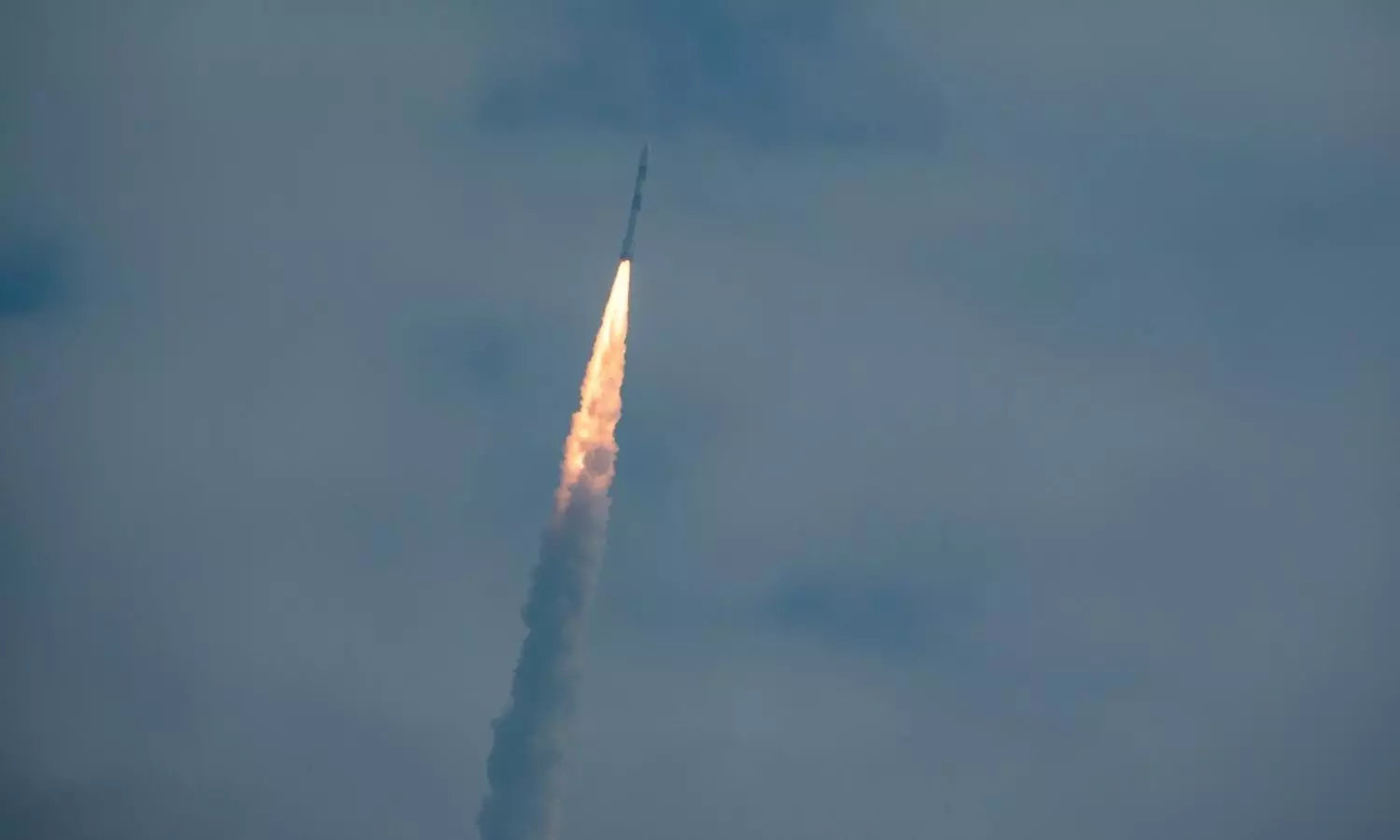
The PSLV-C62 as it had lifted off from the Satish Dhawan Space Centre, Sriharikota, on January 12. Photo: PTI
Unlike ISRO, which does not insure its own rockets or domestically launched satellites, startups often struggle to secure insurance — especially for first-of-its-kind experimental missions. OrbitAID’s CEO, Sakthikumar, has been quoted in the media as saying that despite multiple attempts, insurers were unwilling to cover AyulSat because of the mission’s novelty and risk profile. Crucially, the possibility of failure was not a central concern during planning, given PSLV’s long record of success.
For companies like Eon Space Labs and TakeMe2Space, the lost satellites were intended to demonstrate AI-enabled, in-orbit Earth-observation processing, a capability that could reduce data transmission costs and redefine satellite design. Rebuilding such missions takes time, money, and fresh launch opportunities — none of which are guaranteed.
The PSLV has launched over 350 satellites for Indian and foreign customers since the late 1990s and has been a key reason India carved out a niche as a cost-effective, reliable launch provider.
That reputation is now under strain.
While PSLV has failed on four occasions over three decades (1993, 2017, 2025 and 2026), the 2026 failure is the first to result in the loss of foreign customer satellites. This distinction matters in a competitive global market where customers can choose from multiple launch providers.
In the short term, analysts expect higher insurance premiums for PSLV missions, greater caution among foreign customers, pressure on New Space India Limited (NSIL), ISRO’s commercial arm, to reassure clients and explain corrective actions.
The long-term impact will depend on how quickly ISRO identifies the root cause and demonstrates a successful return to flight.
Also read: How rare interstellar comet 3I/ATLAS is whizzing through our solar system
As with many high-profile failures, speculation and rumours have circulated — some even suggesting sabotage. There is no evidence to support such claims.
Launch failures across the world overwhelmingly result from engineering, manufacturing, or integration issues. From SpaceX’s Falcon 9 failure in 2015 to Europe’s Ariane 5 software error in 1996, history shows that even mature space programmes stumble. What defines credibility is not the absence of failure, but the quality of response.
ISRO’s investigation — based on telemetry analysis, hardware inspection, and supply-chain traceability — is designed precisely to identify technical causes and rule out non-technical ones.
The PSLV-C62 failure is a serious setback, but not an existential one.
It comes at a time when India is actively opening its space sector to private players, pitching itself as a competitive launch hub, and seeking a larger share of the global space economy. The episode underscores both the risks of spaceflight and the fragility of trust in commercial space services.
Handled with transparency, technical rigour, and sensitivity to affected startups and customers, the failure can still become a learning moment — one that strengthens systems, improves oversight, and ultimately restores confidence.
India’s space programme, like all others, will be judged not by whether rockets ever fail, but by how quickly, openly, and competently it learns from failure and flies again.
The failure of PSLV-C62, though being read as a setback for India’s space programme, is in reality, a pause —one that forces us to look beyond mission success and ask harder questions.
The real crisis in space is no longer technological capability but 'orbital congestion'. Every failed launch, every uncontrolled fragment, adds to a growing, invisible cloud of debris circling Earth. Low Earth Orbit is fast becoming a dumping ground, where collisions are no longer hypothetical but inevitable.
The PSLV-C62 incident should therefore be seen as a global wake-up call. In an era of frequent launches and mega-constellations, reliability alone is insufficient. Sustainability must become the new measure of progress — through transparent debris reporting, enforceable end-of-life protocols, and international accountability.
India has the credibility to lead this conversation. The question is whether the world is ready to listen — before the sky becomes unusable.