Why scientists’ nearly-100-year-journey towards creating ‘artificial Sun’ continues to face hurdles
For decades, physicists have been trying to recreate on Earth the nuclear process that makes the Sun shine, building machines that heat hydrogen nuclei to blazing temperatures and confine them long enough for fusion reactions for energy generation. In India that work happens at the Institute for Plasma Research in Gujarat. And earlier this week, researchers there took another step towards that goal.

It was a late evening in March 1929. Twenty-six-year-old Fritz Houtermans was out for a walk with Charlotte Riefenstahl, a fellow young physicist. Both had received their doctorates in theoretical physics from Göttingen University two years earlier and were still associated with the university.The Sun had set. Dusk gradually gave way to darkness and the first stars appeared in the sky....
It was a late evening in March 1929. Twenty-six-year-old Fritz Houtermans was out for a walk with Charlotte Riefenstahl, a fellow young physicist. Both had received their doctorates in theoretical physics from Göttingen University two years earlier and were still associated with the university.
The Sun had set. Dusk gradually gave way to darkness and the first stars appeared in the sky. They walked close together, their conversation occasionally giving way to silence, their hands brushing as they strolled through the evening. It was a pleasant, romantic moment.
“Look how pretty the stars shine!” Charlotte exclaimed in a husky voice.
Houtermans, apparently unable to resist the opportunity to impress his girlfriend, replied with some pride: “I’ve known since yesterday why it is that they shine.”
It was not quite the romantic response Charlotte might have expected. But Houtermans had reason to boast. Just the previous day, he and the British physicist Robert d’Escourt Atkinson had solved the puzzle of how stars generate enormous energy and intense light. Their work, titled Zur Frage der Aufbaumöglichkeit der Elemente in Sternen (On the Question of the Possibility of the Synthesis of the Elements in Stars), was published a few months later in the physics journal Zeitschrift für Physik.
The paper showed that thermonuclear fusion deep inside the star's dense core produces the energy and radiation. Under the immense temperature and pressure in stellar cores, light hydrogen nuclei can combine to form heavier nuclei, releasing energy in the process. This is thermonuclear fusion.
We do not know what Charlotte thought of Houtermans’ rather unromantic answer. But the stellar pickup line evidently worked. The two married in August 1930, only to be separated in 1943 as a result of Nazi racial laws that prohibited Germans from marrying Jews.
Nearly a century later, physicists are still pursuing the question that Houtermans and Atkinson helped unravel. If stars can produce energy through nuclear fusion, can we reproduce the same process here on Earth? Can we have a mini-Sun shine in our hands?
That question has sparked one of the most challenging scientific and engineering efforts of the modern era. Around the world, researchers are building machines that heat hydrogen nuclei to blazing temperatures and confine them long enough for fusion reactions to occur.
Also read: Buying a plot of land on the Moon? Here’s why it’s not really real estate investment
One of the most ambitious efforts is ITER, an international fusion project being built in southern France. Seven members, China, the European Union, India, Japan, South Korea, Russia and the United States, are pooling their scientific, technological and financial resources to build the world's largest tokamak fusion reactor. The tokamak is a device used to harness the energy from fusion reactions.
These experiments are often described as attempts to make an “artificial Sun”. The phrase is useful as a metaphor, but a fusion reactor does not reproduce the Sun. It seeks to reproduce one of the physical processes by which the Sun produces its energy.
The scale of this effort is considerable. The International Atomic Energy Agency’s (IAE) global survey has identified more than 130 experimental fusion devices around the world, either operating, under construction or being planned.
Around the world, researchers are building machines that heat hydrogen nuclei to blazing temperatures and confine them long enough for fusion reactions to occur. The tokamak is the most widely pursued approach. Photo: iStock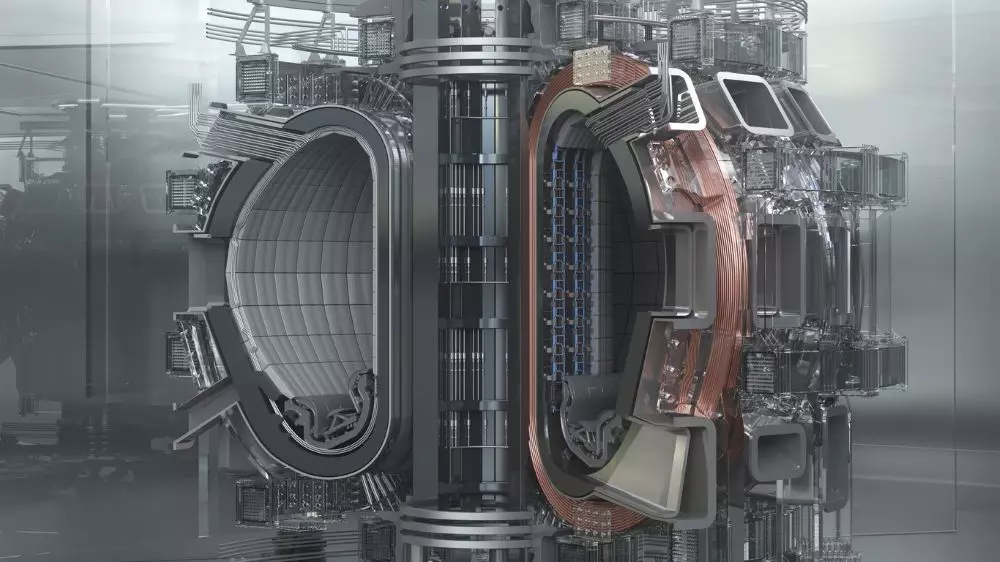
India is part of this international effort. At the Institute for Plasma Research (IPR) in Gandhinagar, Gujarat, researchers operate ADITYA-U, an upgraded version of India’s first indigenous tokamak. They are also experimenting with SST-1 (steady-state superconducting Tokamak), India’s first superconducting tokamak. In December 2025, IPR also produced the first plasma (ionised gas used as the medium for nuclear fusion) in its indigenously designed Small-Scale Spherical Tokamak (SS_ST). And earlier this week, it installed and commissioned a new gyrotron (vacuum tubes that generate high-frequency electromagnetic waves) as part of SST-1.
India is therefore experimenting with both conventional and spherical tokamak designs. Indian scientists are also contributing major components and technologies to the international ITER project in France.
India’s fusion programme goes beyond the tokamak. At the Raja Ramanna Centre for Advanced Technology (RRCAT) in Indore, scientists work on high-power lasers and laser–plasma interactions, including research relevant to laser-driven inertial-confinement fusion.
Researchers have pursued the idea of controlled nuclear fusion for energy generation in different ways for decades. Some experiments use powerful magnetic fields to confine an extremely hot plasma inside a Medu vada-shaped chamber. Others compress tiny fuel pellets with powerful lasers. Other approaches use different magnetic configurations and alternative confinement methods.
The tokamak is the most widely pursued approach, numbering around 70 in recent global inventories.
Imagine a large, Medu vada -shaped chamber. Inside it, hydrogen fuel is heated until it becomes plasma, a very hot gas in which the atoms have been stripped of their electrons, leaving electrically charged nuclei and electrons moving freely. This part is easy.
Now comes the key challenge. To make fusion possible, the plasma must be heated to more than 100 million degrees Celsius. The obvious problem is that no material can withstand direct contact with something this hot.
The solution is to keep the plasma floating midair, away from the walls, using magnetic fields. Charged particles are attracted or repelled by magnetic fields. This is done by creating an appropriate magnetic field around the doughnut — or vada-shaped chamber — away from the walls. Think of it as an invisible cage: unlike an ordinary cage, its bars are not made of metal but of magnetic fields. The plasma is held within this magnetic cage without, ideally, touching the walls.
Developed by the Soviets, tokamaks have been the main focus of fusion research for decades. The international ITER project in France is the largest tokamak experiment under construction. India has also pursued this route, with tokamak experiments including ADITYA-U and the superconducting SST-1 at the Institute for Plasma Research in Gandhinagar.
But the tokamak has a close relative, called a stellarator, another device for controlled nuclear fusion, which takes a different approach to the magnetic cage. A stellarator also confines plasma using magnetic fields, but its magnetic cage is three-dimensional and much more complicated. If a tokamak resembles a smooth vada, a stellarator is more like a twisted hollow jalebi or imarti.
Why make the shape so complicated? One reason is that a tokamak relies partly on an electric current flowing through the plasma to create its magnetic field. Controlling this current can be difficult and can contribute to plasma turbulence.
A stellarator instead tries to produce the necessary twisted magnetic field mainly through the shape and arrangement of external magnets. In simple terms, the machine is designed so that the magnetic cage itself does more of the work.
The approach has its own engineering challenges, particularly the complexity of designing and manufacturing the magnets. But stellarators offer a different way of tackling the confinement problem. One of the best-known examples is Wendelstein 7-X in Germany.
Tokamaks and stellarators try to hold hot plasma in place. Inertial-confinement fusion takes a different approach: instead of holding a relatively large amount of plasma for a longer period, it compresses a tiny amount of fuel extremely rapidly. The fuel is placed inside a tiny spherical capsule. Powerful lasers hit the capsule from different directions almost simultaneously. The outer layer is blasted outward, driving the fuel inside inward and compressing it to enormous density and temperature for a fraction of a second. It is like squeezing a balloon equally from every direction, except that the object is microscopic and the entire process happens in an instant.
The National Ignition Facility (NIF) in the United States uses this approach. Its enormous laser system focuses energy on tiny fuel targets to create the extreme conditions required for fusion.
For fusion, hydrogen fuel is heated until it becomes plasma, a very hot gas in which the atoms have been stripped of their electrons, leaving electrically charged nuclei and electrons moving freely. Photo: iStock
The machines may look very different, but they are all trying to solve the same problem: how to persuade tiny charged atomic nuclei, which normally repel one another, to come close enough to fuse.
Whatever the design of the machine, the basic physics is the same. The fuel is usually hydrogen isotopes, particularly deuterium and tritium. If the positively charged nuclei are brought close enough for an instant, the strong nuclear force can overcome this electrical repulsion and make them fuse to become a helium nucleus. In this process, they release neutrons along with a large amount of energy. In a thermonuclear power plant, the hope is to capture that energy as heat and ultimately use it to generate electricity.
The principle may look simple, but keeping the extreme conditions required for fusion is extremely challenging. The plasma must stay extremely hot and sufficiently dense, and it must remain confined long enough for fusion reactions to occur. At the same time, the machine must cope with the severe heat and energetic particles produced by the reactions.
The difficulty becomes clear when we look at how long fusion plasmas can actually be kept under control. In February 2025, the WEST tokamak at the CEA’s Cadarache centre in France sustained a hydrogen plasma for 1,337 seconds, more than 22 minutes. This is currently the record for tokamak plasma duration. Just weeks earlier, China’s EAST tokamak had set the previous record, maintaining a plasma for 1,066 seconds, or nearly 18 minutes. Imagine the power generator going off every twenty minutes and having to start priming the machine from scratch.
Generating plasma requires huge amounts of energy: heating it enough for fusion, creating a powerful magnetic field and powering high-powered lasers. Ultimately, the key challenge is that the input energy must be much less than the output electricity. This is another key challenge for fusion reactors.
In 1997, JET produced a record of 16 megawatts of fusion power from 24 megawatts of heating power, a ratio, or Q, of 0.67. The ITER experiment strives to reach a Q of 10, producing 500 megawatts of fusion power from 50 megawatts of heating power. It still has a long way to go.
ITER is still under construction in southern France. The world’s largest tokamak will weigh about 23,000 tonnes and contain more than one million components and 10 million individual parts, making it one of the largest and most complex machines ever built by humans. It is expected to begin research operations in 2034, with deuterium–tritium fusion experiments planned for around 2039. ITER is an experimental facility intended to demonstrate the feasibility of burning-plasma fusion, not to generate electricity for the grid.
Alongside ITER, countries such as India and China are operating their own experimental fusion machines, gaining experience in fusion technology and plasma physics; therefore, they will be able to replicate ITER. If the scientific and engineering challenges can be overcome, commercial fusion power could begin to emerge sometime around the middle of the century, perhaps in the 2045–50 period.
Also read: What NASA invitation to India to join work on planned Moon Base could mean for both
Notwithstanding challenges, fusion continues to attract scientific and engineering interest because of its possibilities. Fusion reactors often use deuterium and tritium, two isotopes of hydrogen, as fuel. Deuterium is naturally present in seawater, while tritium can potentially be produced from lithium within the reactor.
Fusion itself does not produce global-warming gases and, unlike fission, is not a major cause of concern for radioactivity. If the conditions needed for fusion are disrupted, the reaction stops. The process can also release a large amount of energy from a relatively small quantity of fuel.
None of this makes fusion automatically safe, economical or commercially viable. The scientific and engineering challenges remain formidable. But these possibilities explain why, nearly a century after Houtermans looked up at the stars, scientists are still trying to bring a little piece of their energy down to Earth.