- Home
- India
- World
- Premium
- THE FEDERAL SPECIAL
- Analysis
- States
- Perspective
- Videos
- Sports
- Education
- Entertainment
- Elections
- Features
- Health
- Business
- Series
- In memoriam: Sheikh Mujibur Rahman
- Bishnoi's Men
- NEET TANGLE
- Economy Series
- Earth Day
- Kashmir’s Frozen Turbulence
- India@75
- The legend of Ramjanmabhoomi
- Liberalisation@30
- How to tame a dragon
- Celebrating biodiversity
- Farm Matters
- 50 days of solitude
- Bringing Migrants Home
- Budget 2020
- Jharkhand Votes
- The Federal Investigates
- The Federal Impact
- Vanishing Sand
- Gandhi @ 150
- Andhra Today
- Field report
- Operation Gulmarg
- Pandemic @1 Mn in India
- The Federal Year-End
- The Zero Year
- Science
- Brand studio
- Newsletter
- Elections 2024
- Events

Politically vocal but electorally outfoxed — what 2025 has been like for India's Opposition parties
The challenges it must confront as it enters 2026 are complex, layered and existential. The BJP would, of course, want to go beyond its avowed dream of making India Congress-mukt to a country that is Opposition-mukt, where anything the Opposition says or does has little national consequence.

As 2025 draws to a close, Opposition parties, which had banded together under the banner of the INDIA bloc in 2023 and clocked some critical successes the following year, find themselves sliding back into a familiar paradox.Politically vocal but electorally outfoxed almost each time it has gone up against the BJP, the Opposition may not have been consigned to total irrelevance but the...
As 2025 draws to a close, Opposition parties, which had banded together under the banner of the INDIA bloc in 2023 and clocked some critical successes the following year, find themselves sliding back into a familiar paradox.
Politically vocal but electorally outfoxed almost each time it has gone up against the BJP, the Opposition may not have been consigned to total irrelevance but the challenges it must confront as it enters 2026 are complex, layered and existential. Yet, almost nothing that the Opposition found itself ranged against through its travails of 2025 was an entirely new addition to the BJP’s playbook.
The uneven poll pitch prepared by a visibly complicit Election Commission had existed through the past 11 years of Prime Minister Narendra Modi’s regime and was only being tweaked further now with an opaque and hugely controversial Special Intensive Revision (SIR) of electoral rolls. The conversion of a political system that once thrived on its inherent conflicts – between the Treasury and Opposition in Parliament, between the Centre and States, between the Executive and Legislature or the Legislature and Judiciary – to one that is increasingly centralised, has been an ongoing project since 2014 and remained so in 2025.
As such, if the Opposition finds itself flummoxed by Modi mastering the mechanics of power and the optics of dominance, the fault lies in its own inability to reshape itself and navigate better the labyrinth of institutional pressure, asymmetrical power and legislative and parliamentary red herrings that the ruling dispensation has made into an enduring feature and not an episodic obstacle in India’s democratic journey.
Also read: GDP growth rebounds, but average Indian’s living standard dips — How Indian economy fared in 2025
The Opposition needn’t look too far off to assess how it is constantly outmanoeuvred by its shrewd nemesis. A senior Lok Sabha MP of the Congress party, which is still the de jure pivot of the INDIA bloc despite its repeated routs against the BJP in direct electoral combats, cited the example of the winter session of Parliament, which concluded on December 19.
“The Opposition may have made a lot of noise all through the winter session, but what did we achieve at the end of it,” the multiple-term MP asked, while claiming that the BJP “took us all for a ride”.
The Congress MP added: “This was a session where all INDIA bloc parties, despite our many internal problems, came united on the issue of the SIR. All it took the BJP to derail that unity was to throw in a debate on Vande Mataram as a pre-requisite for agreeing to a discussion and not on the limited issue of SIR, but on the more nebulous electoral reforms and we fell for it. They used Vande Mataram as a red-herring and our people were happy that we did well in that debate but what happened to the debate on electoral reforms? Without giving any answers, the government earned boasting rights to claim that the issue has now been discussed even in Parliament.
If the discussion on electoral reforms ended as a damp squib with the BJP conveniently glossing over the ‘vote chori’ allegations made by Lok Sabha’s Leader of Opposition Rahul Gandhi and showcasing the NDA’s unexpected electoral triumph in Bihar a month earlier as the public’s validation of the SIR, what should have hurt the Congress and its allies much more was the bulldozing of the VB G-RAM-G Bill through Parliament in the concluding days of the winter session.
The Viksit Bharat Guarantee for Rozgar and Ajeevika Mission (Gramin) Bill, or VB G-RAM-G Bill, was not part of the legislative agenda of the government when the schedule for the winter session was first announced. The bill, which has now replaced the UPA-era Mahatma Gandhi National Rural Employment Guarantee Act (MGNREGA), was introduced in Lok Sabha towards the fag end of the winter session with MPs given no prior intimation of the Centre’s intent to repeal the historic MGNREGA, a demand-driven and rights-based central legislation, and replace it with a law that, in reality, is little more than a centrally sponsored scheme to be rolled out as per the Centre’s whims.
Also read: How fresh finds, research progress made 2025 a significant year for science and technology
As with the SIR, the Opposition came to Parliament breathing fire against G-RAM-G too, but in the nearly 16 hours that Lok Sabha and Rajya Sabha spent discussing the bill, the INDIA bloc’s protests remained disproportionately concentrated on the Centre’s decision to replace the name of the Father of the Nation with the Modi-era leitmotif of Viksit Bharat, as the employment law transitioned from its old to new avatar. The grave challenges that the new law would now create for common folk, the drivers of electoral triumphs and debacles, were sadly consigned to background noise while the Centre succeeded in getting the bill enacted with a mere voice vote, reducing Parliament, yet again, to a ratifying body rather than a deliberative forum.
What followed was a typical absurdity that has repeatedly haunted the disjointed INDIA bloc. From the Opposition’s standpoint, the debate on G-RAM-G was the single most robust endorsement of a Congress policy that has come from a united Opposition since even before Modi became Prime Minister.
Speaker after speaker from Opposition benches, including from parties like the Trinamool Congress and the Aam Aadmi Party (AAP) that no longer see eye to eye with the Congress on any issue, hailed the late Manmohan Singh and Sonia Gandhi for making MGNREGA a legislative reality and slammed the BJP for undoing it. When the session concluded, the Trinamool MPs sat on a 12-hour protest inside the Parliament complex against the MGNREGA repeal, flanked occasionally by MPs from other Opposition parties. Missing in the frame throughout, though, were MPs from the Congress – the party that should have led the sit-in as the author of the original law.
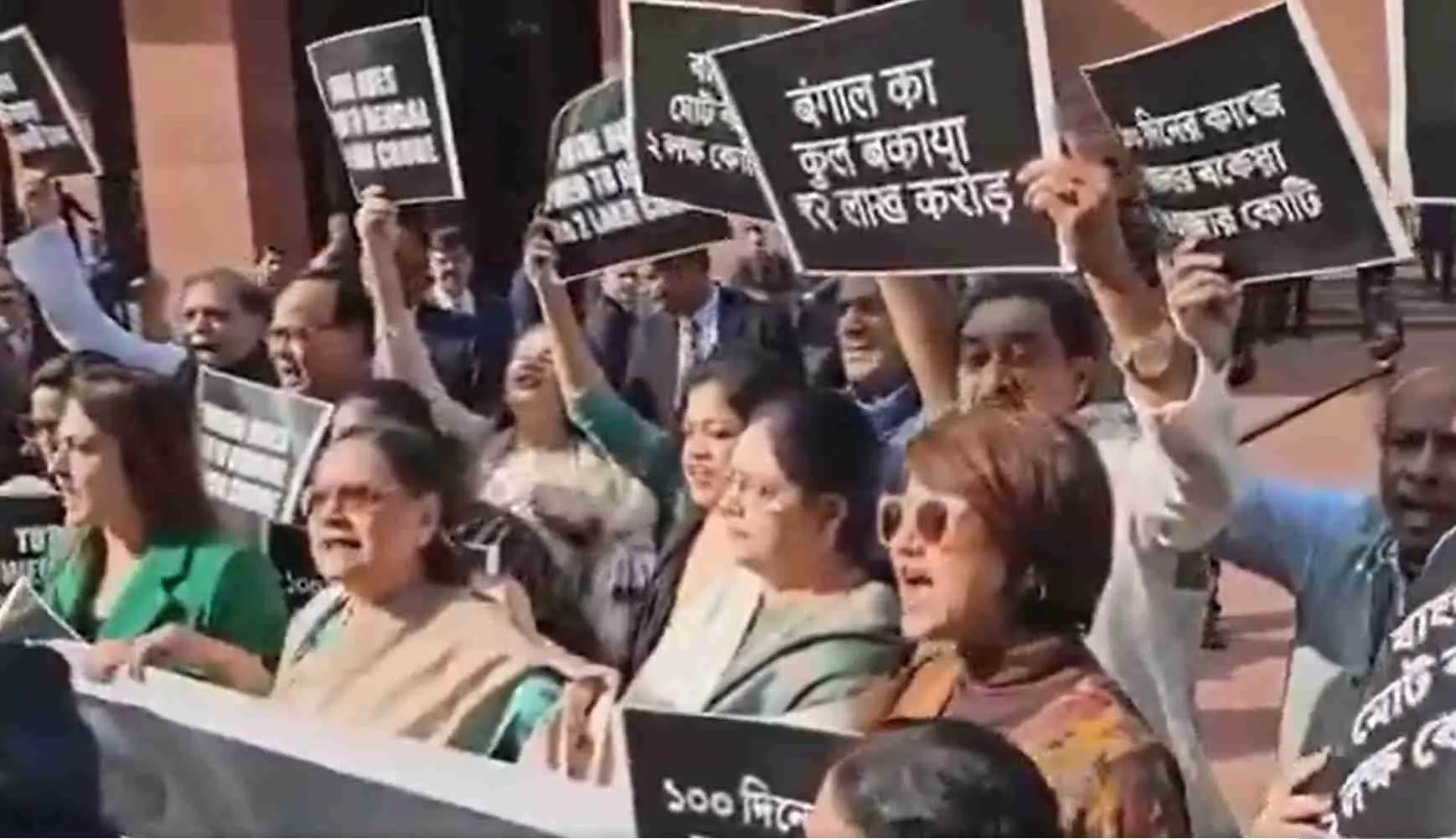
Trinamool Congress MPs protest against the alleged withholding of MGREGA dues. Photo: PTI
“This (MGNREGA repeal) was an issue that should have united the Opposition and driven us to instantly launch joint street protests across the country. The damage from the G-RAM-G Bill will be much more than the three farm laws (of 2020 and since repealed) because NREGA had become the backbone of India’s rural economy and employment. The Congress should have taken the lead in reaching out to all INDIA allies and formulating a nationwide joint protest strategy. They should have owned this fight because NREGA was made possible only because of Sonia Gandhi’s persistence, but a week has passed since Parliament concluded and not one call has been made from the Congress to its allies to discuss how it wants to proceed,” a Rajya Sabha MP from the Trinamool Congress told The Federal.
That any appraisal of the Opposition’s performance begins and ends with brickbats for the Congress, the largest constituent of the INDIA bloc, is not surprising. The year, as the 11 years preceding it, has been one of uneasy continuity for the Grand Old Party – continuity of electoral debacles, internal disarray, convoluted and confused narratives and patchy leadership.
If the 2024 Lok Sabha elections had restored the Congress’s numerical relevance, the party’s humiliating routs in Haryana and Maharashtra, in late 2024, and Delhi and Bihar this year have dented yet again its political centrality. While Rahul Gandhi’s aggressive critique of democratic backsliding may have sharpened his party’s ideological edge but its electoral dividends are hard to find. Though the Congress high command had declared 2025 to be its year of sanghathan srijan (organisation building) and launched a state-wise programme to revive the party’s district units, it continues to oscillate between moments of mobilisation and prolonged spells of organisational inertia, particularly in the Hindi heartland, where the BJP’s social coalitions remain largely intact.
Congress veteran Digvijaya Singh concedes that the party needs a complete overhaul, not just of its organisational structure but of the way it functions as a political outfit. The former two-term Madhya Pradesh chief minister has been repeatedly urging his colleagues and leadership to “step out of press conferences and seminars” and “take our issues directly to the people through door-to-door campaigns, public meetings, padyatras and grassroots mobilisation” but has often found his views brushed aside as rants of a has-been warhorse.
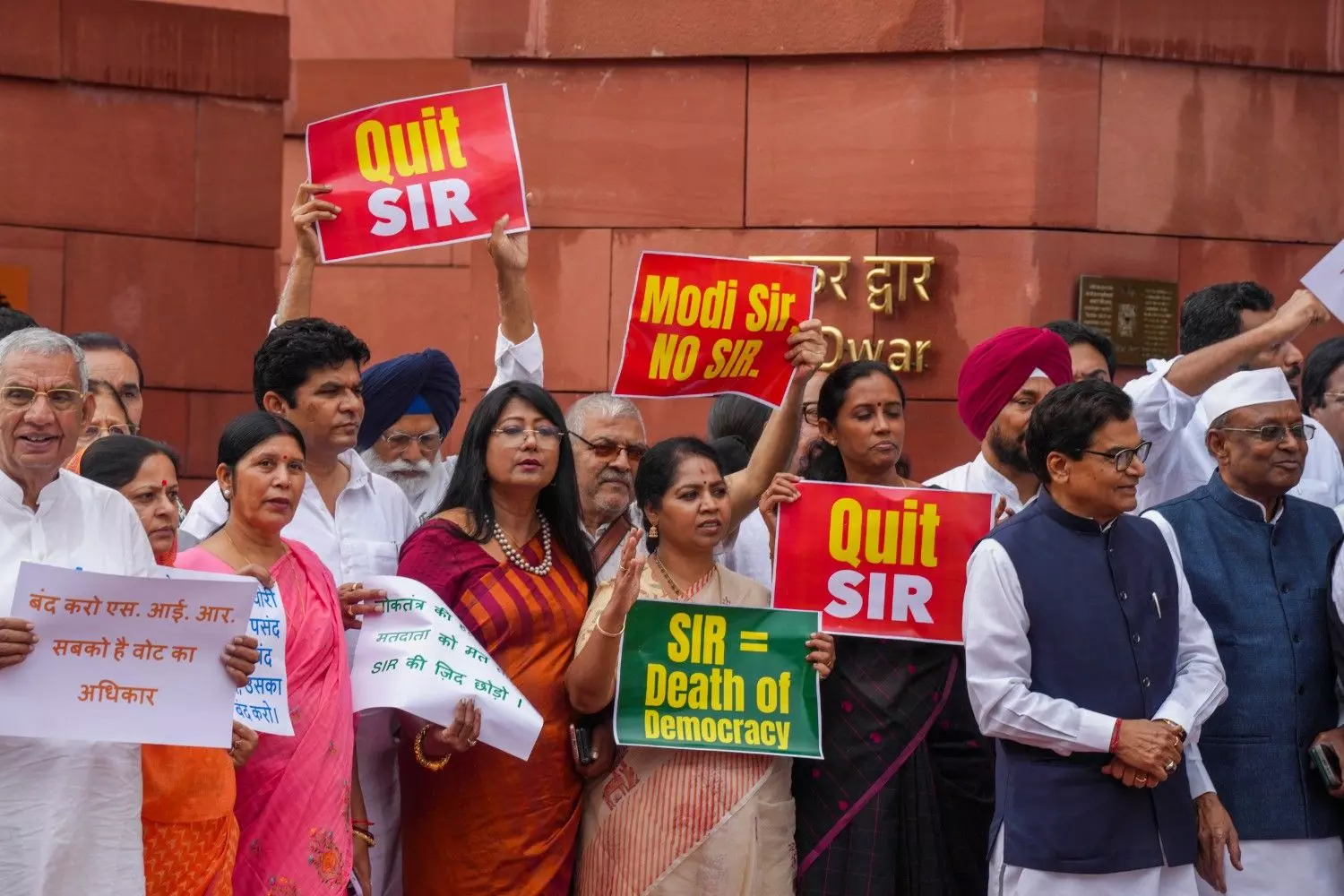
Opposition protest against the special intensive revision of electoral rolls. Photo: PTI
Compounding these weaknesses is the broader institutional terrain in which the Congress and other Opposition parties operate. The SIR, for instance, has been among the most contentious issues to agitate the Opposition parties nationally this year. Politically, Opposition leaders like Rahul at the national level or Rashtriya Janata Dal’s (RJD’s) Tejashwi Yadav in Patna, Dravida Munnetra Kazhagam’s (DMK’s) MK Stalin in Chennai, Trinamool Congress’s Mamata Banerjee in Kolkata and Samajwadi Party’s (SP’s) Akhilesh Yadav in Lucknow, may be right in asserting that the electoral process itself is no longer neutral ground. Their campaign against “vote chori” and disenfranchisement may even reflect a shift from conventional anti-incumbency politics to a more existential anxiety about democratic participation, but as Singh points out, such campaigns work only as long as electoral results reflect a convergence of such anxieties between the Opposition and the public at large.
This sense of institutional unease is amplified by the continued and visible use of central investigative agencies against Opposition leaders. The Enforcement Directorate and Income Tax Department have become permanent fixtures in the political narrative, particularly for parties like the Aam Aadmi Party. Arvind Kejriwal’s arrest and prolonged legal battles have effectively frozen AAP’s national ambitions and forced the party into a defensive crouch even in its core territories. The fall of the AAP government in Delhi in February 2025 was not merely an electoral defeat; it exposed the party’s vulnerability once its governance narrative was disrupted and its leadership consumed by legal and political firefighting.
Also read: 10 years of Constitution Day: Why it risks becoming a masking ritual for a backsliding democracy
For other regional parties, 2025 has been a year of uneven experiences. The DMK in Tamil Nadu continues to operate at least seemingly from a position of relative strength, insulated by a robust regional identity and a political culture that has historically resisted the BJP’s ideological project. Its success, however, underscores a larger Opposition dilemma: victories are increasingly regional, while defeats are national. For the Congress, the DMK’s junior but national ally, Stalin’s strength in Chennai gives way to complications in Delhi as seen repeatedly in the way DMK leaders, including Stalin’s son Udhayanidhi Stalin, fearlessly counter the BJP’s Hindi, Hindutva and Sanatan imposition to keep their Dravidian followers intact while leaving the Congress haplessly fending off BJP’s “anti-Hindu” jibes in the rest of the country.
Besides, the DMK’s dominance in Tamil Nadu, the Left’s rule in Kerala, the Congress’s governments in Karnataka, Telangana or even the northern hill state of Himachal Pradesh or Mamata Banerjee’s vice-like grip over Bengal does little to alter the overall balance of power in New Delhi, even if it highlights the BJP’s limits in certain linguistic and cultural spaces.
The Left parties, meanwhile, remain caught between relevance and nostalgia, much like the Congress. Their ideological critique of neoliberalism and majoritarian politics retains intellectual resonance, but their shrinking organisational footprint limits electoral impact beyond Kerala and shrinking pockets in Bengal, Bihar or Tripura. A Rajya Sabha MP from the Communist Party of India (Marxist), or CPI (M), says the Left’s biggest challenge today is “not from its rivals; definitely not from the BJP”, because of the political landscape of the provinces where Left parties are now limited, but “our struggle is against our own stagnation in terms of organisation, ideology and demography”.
“Not just the CPM but the Left as a whole has been unable to formulate its ideology in a way that appeals to the younger voters. For most, the Left is a monolith – they can’t differentiate between CPI [Communist Party of India], CPM or CPI-ML (L) [Communist Party of India (Marxist–Leninist) Liberation]; our existing cadre aside which is also thinning because it belongs to a certain advanced age bracket, everyone seems to think we are against any kind of progress and we are stuck in the India of 1950s or 1960s; we have done little to formulate our ideology in a way that appeals to the young and we hardly have any young leadership taking centrestage… these are all issues for which we can’t blame the BJP or any other party; only we are to blame for them,” the Rajya Sabha MP added.
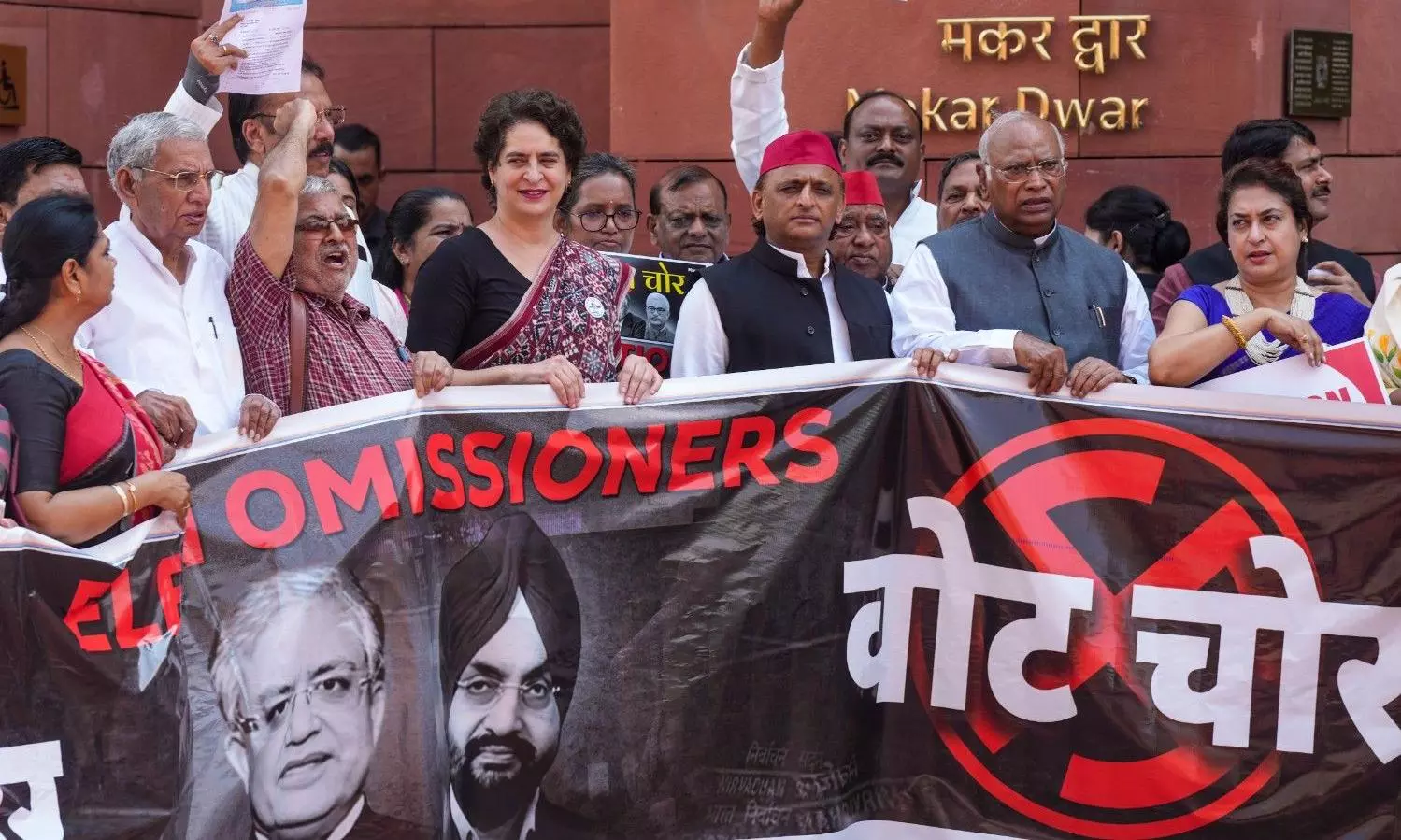
Opposition parties protest against alleged vote chori. Photo: PTI
Individual outfits aside, the Opposition’s coalition, the INDIA bloc, too continues to struggle to evolve from an electoral arrangement into a coherent political force. Seat-sharing disputes, leadership ambiguities, and divergent regional priorities have repeatedly exposed its fragility. Parties like the Trinamool and the AAP have oscillated between cooperation, distance and outright exit, wary of being subsumed under a Congress-led framework that offers limited electoral upside in certain states.
The BJP, for its part, has exploited these fractures with Machiavellian cunning. By presenting itself as the nationalistic and unapologetically majoritarian party that also promises stable governance; the means it uses to this end glossed over by its leaders and the media alike, it has turned Opposition disunity into a narrative in itself. The Opposition’s frequent appeals to constitutional morality and institutional fairness, while normatively significant, often struggle to compete with the BJP’s emphasis on majoritarian imposition, jingoistic nationalism and leadership clarity.
What emerges in 2025 is not an Opposition defeated into irrelevance, but one that is persistently outmanoeuvred. The BJP, of course, would want to push the envelope further in 2026 – going beyond its avowed dream of making India Congress-mukt to a country that is Opposition-mukt; if not in absolute terms, then at least in the sense where anything the Opposition may say or do will have little or no national consequence.
The question facing India’s Opposition is no longer whether it can defeat the BJP in a single election cycle, but whether it can reconstruct itself as a credible, durable alternative capable of navigating — and reshaping — a political system that increasingly favours centralisation and permanence. The challenge is not episodic or election-specific but structural, marked by institutional distrust, procedural marginalisation in Parliament, and an Opposition unity that remains fragile – all in all, a slow-burning crisis rather than a dramatic rupture.