Why December 4 supermoon will be 7% bigger in diameter, 16% brighter than average full moon
Supermoon is not an official astronomical term. It is used to denote a full moon that occurs when the moon is closer to Earth, making it appear bigger and brighter. Every year we get three to four consecutive supermoons.

The last full moon of the year, on December 4, 2025, is a 'supermoon'. When the Sun, Earth and moon align into a single plane on December 5, 04:45am, the moon will be only 357,219 km away. At that point, the full moon will be almost seven per cent bigger in diameter and 16 per cent brighter than the average full moon. However, the best viewing occurs shortly after moonrise on December 4, when...
The last full moon of the year, on December 4, 2025, is a 'supermoon'. When the Sun, Earth and moon align into a single plane on December 5, 04:45am, the moon will be only 357,219 km away. At that point, the full moon will be almost seven per cent bigger in diameter and 16 per cent brighter than the average full moon. However, the best viewing occurs shortly after moonrise on December 4, when the moon is low on the eastern horizon.
This is because the 'moon illusion' makes the celestial body appear considerably larger when viewed adjacent to trees or buildings, at low angles.
The moon orbits the Earth, not in a perfect circle, but in an elliptical orbit. As a result, the distance between the moon and the Earth varies based on its position and the distance from the centre of the Earth to the centre of the moon ranges between 356,500 km at perigee (closest point) and 406,700 km at apogee (farthest). In Indian astronomy, the closest point in a Moon's orbit is termed śīghrōcca, while the farthest point is called mandōcca.
Objects that are near to us naturally appear larger than those that are farther away. As a result, the moon's apparent size changes as it goes around its elliptical orbit. It will be larger at perigee and smaller at apogee — just as a luminous body appears brighter when it is near and dims as it moves away.
A supermoon is a full moon that occurs at perigee, which is when the moon is closest to Earth. A new moon at perigee is also technically a supermoon, but it doesn’t draw similar attention since the moon's disc is not visible at new moon.
A full moon is the lunar phase in which the moon appears fully illuminated from Earth, occurring when the Earth lies between the Sun and the Moon. Because of this alignment, the Sun illuminates the entire visible face of the Moon, giving it the appearance of a bright, circular disc in the sky. Typically, the full moon rises at sunset and sets during the next sunrise.
Also read: Why Hurricane Melissa is a wake-up call on how a warming climate can intensify natural disasters
We say full moon for the entire duration of the night. However, astronomers consider the moon to be full at a particular point when it is precisely 180 degrees opposite the Sun. Because the moon and Earth are constantly in motion in their orbits, the Sun, Earth, and moon will only line up in a plane for a brief moment; thus, a full moon can only last an instant. For example, on December 4 at 23:15 UTC (Coordinated Universal Time, December 5, 2025, at 04:45 Indian Standard Time), the three bodies will line up and the astronomical full moon will occur.
The moon will be at its perigee for only an instant, just as the astronomical full moon. Therefore, the full moon and perigee almost never coincide perfectly. A supermoon at the closest point to Earth will be up to 14 per cent larger in diameter and 30 per cent brighter at perigee than at apogee.
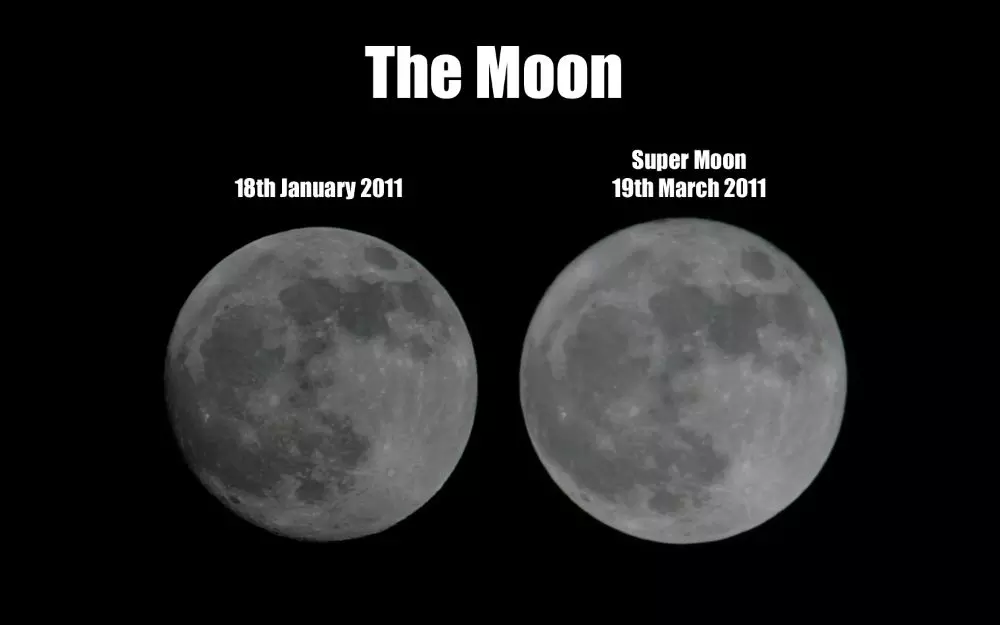
Comparative images of how a normal moon and a supermoon ocurrence looked like in 2011. Photo: Wikimedia Commons
As the full moon does not completely coincide with perigee on December 4-5, it is only seven per cent bigger in diameter and 16 per cent brighter. In fact, in the 21st century, a full moon never coincides exactly with perigee.
The closest co-occurrence of the full moon and perigee in the 21st century will take place on November 26, 2034, at 04:02 IST, when the moon will be only 356,448 km away. The perigee happens about 26 minutes after the full moon that day at 03:36 IST. Another close coincidence between the full moon and perigee had occurred on November 14, 2016, when the time lag was less than two hours and 29 minutes. This was a very close supermoon.
Also read: How astronomers spotted birth of a new solar system around baby star HOPS-315
However, for practical purposes, the '90 per cent rule' is applied. That is, when the full moon phase occurs near perigee — within 90 per cent of its closest approach to Earth in a given orbit. This correlates to the Moon's distance being less than 367,607 km at the time of the full moon. In other words, the moon traversing the perigee point within one day of the astronomical full moon is categorised as a supermoon.
For example, during this year's first astronomical full moon, which occurred on January 14 at 03:58 IST, the moon was 378,038 km away. The moon reached its perigee point on January 8 at 05:06 IST, approximately 141 hours and eight minutes before the full moon. Therefore, it was not a supermoon.
In contrast, the full moon that occurred on November 5 at 18:50 IST, was 356,852 km away and crossed the perigee point on November 6 at 04:00 IST, approximately nine hours and 10 minutes after the full moon moment, thus making it a supermoon.

Perigee is the point in the Moons elliptical orbit where it is closest to Earth and apogee is when it is farthest away. A supermoon happens when a full moon is at perigee, making it appear larger and brighter. Graphic: The Federal
Every year, we get three to four consecutive supermoons. The supermoon's periodicity is determined by two lunar movements. The moon takes approximately 29.5306 days to complete two successive astronomical full moons. However, one revolution around the Earth takes 27.5545 days, measured from perigee to perigee. The supermoon occurs when these two phases coincide.
The tiny difference between these two periods shifts the timing, resulting in a trio of supermoons in 2025: October 7, November 5, and December 4. The following one, on January 3, 2026, is also a supermoon. The next set will take place on November 24, 2026 and December 24, 2026. In 2027, the supermoon will occur on January 22 and February 20.
While it has generated considerable public enthusiasm and media attention, the term supermoon is not a formal astronomical concept like an eclipse or transit. It originated in a 1979 issue of Dell Horoscope magazine, where the American astrologer Richard Nolle defined it as "a new or full moon which occurs with the moon at or near (within 90 per cent of) its closest approach to Earth in a given orbit". Nolle, however, offered no justification for the specific "within 90 per cent of" criterion.
Also read: How rare interstellar comet 3I/ATLAS is whizzing through our solar system
Nonetheless, the mechanism behind the supermoon has been understood since ancient times.
While the lunar cycle and the recurring reappearance of the full moon after about 29.5 days have been known since ancient times, careful observers have also noticed a strange motion of the moon. The moon's daily motion in the background of stars appeared to alter, at times speeding up and slowing down.
The moon's elliptical orbit makes it move faster than average when it is closest to Earth at perigee and slower than usual when it is farthest from Earth at apogee. Astronomers refer to this difference in speed as an 'anomaly' and the period it takes the moon to make one rotation from perigee to perigee is known as the anomalistic month.
Both ancient Babylonian and Indian astronomers recognised the variation in the speed anomaly. In Siddhantic astronomy, a mathematical astronomical system developed by Aryabhata, the slower motion of the moon was called 'manda' and the faster motion 'śīghra'. The Vasishtha-siddhanta, an astronomical text dated to the early centuries of the millennium, provides two different durations for the anomalistic month. The first is slightly simpler: 248 / 9 days, or around 27.5556 days, which is off by about 0.00104 days from the modern value of an anomalistic month. However, in another part, it returns a more accurate estimate of 3031/110 days, which equals approximately 27.5545 days and is off by only 0.00000579 days from modern values.