- Home
- India
- World
- Premium
- THE FEDERAL SPECIAL
- Analysis
- States
- Perspective
- Videos
- Sports
- Education
- Entertainment
- Elections
- Features
- Health
- Business
- Series
- In memoriam: Sheikh Mujibur Rahman
- Bishnoi's Men
- NEET TANGLE
- Economy Series
- Earth Day
- Kashmir’s Frozen Turbulence
- India@75
- The legend of Ramjanmabhoomi
- Liberalisation@30
- How to tame a dragon
- Celebrating biodiversity
- Farm Matters
- 50 days of solitude
- Bringing Migrants Home
- Budget 2020
- Jharkhand Votes
- The Federal Investigates
- The Federal Impact
- Vanishing Sand
- Gandhi @ 150
- Andhra Today
- Field report
- Operation Gulmarg
- Pandemic @1 Mn in India
- The Federal Year-End
- The Zero Year
- Science
- Brand studio
- Newsletter
- Events

What attempt to cover Mohenjo-daro Dancing Girl’s bare torso exposes about our own discomforts
NCERT digitally covered the image of the sculpture in school textbooks. According to reports, following criticism, the modified image will be replaced with that of the original. But is the issue here nudity, or is the debate about who gets to look, who gets looked at and who controls the image?

This young woman from Mohenjo-daro has had an astonishingly long career.For four-and-a-half millennia, she has stood with one hand planted firmly on her hip, chin tilted upward, bangles stacked almost to her shoulder, radiating a confidence that feels less archaeological than contemporary. Empires have risen and fallen around her. Entire faiths have emerged, flourished and fragmented. She...
This young woman from Mohenjo-daro has had an astonishingly long career.
For four-and-a-half millennia, she has stood with one hand planted firmly on her hip, chin tilted upward, bangles stacked almost to her shoulder, radiating a confidence that feels less archaeological than contemporary. Empires have risen and fallen around her. Entire faiths have emerged, flourished and fragmented. She has survived burial beneath the earth, colonial excavation, museum vitrines and generations of schoolchildren gawking at her.
What she apparently could not survive was 21st-century modesty.
The National Council of Educational Research and Training (NCERT) digitally covered the bare torso of the Indus Valley Civilisation’s iconic ‘Dancing Girl’ — a 10.5 centimetres tall bronze statue dating back to the 2300-1750 BC — in an image in a school textbook. According to reports, following criticism, the NCERT will replace the modified image with the original.
But not before the move had reignited a familiar national argument. The issue appears to be nudity. Except that it almost never is.
Because what is really being debated here, according to cultural historians and psychiatrists, among others, is power. Who gets to look? Who gets looked at? Who controls the image? And why, after thousands of years, a woman's body continues to provoke anxieties that entire civilisations have failed to outgrow?
Also read: How neighbourhood dance collectives are changing lives for women in Kerala’s Thrissur
“The fact that nudity is forbidden in most cultures makes it that much more alluring,” says Pune-based socio-cultural historian Dr Vrinda Balsara. “It also feeds into a primeval desire to uncover and unclothe. History shows us how this often manifests in attempts to disempower and subjugate.”
While the decades change, the outrage merely updates its wardrobe. Every generation believes it is having a new conversation about nudity. More often than not, it is recycling an older argument about control. Ironically, societies that consider themselves more advanced frequently bring an exploitative dimension to the act of looking.”
The act of looking is central to this story, say those The Federal spoke to.
Human beings have always looked. They have looked with curiosity, reverence, desire, envy, judgement and fear. What changes is not the gaze itself but the systems of power that shape it.
“From childhood, we're taught that being nangu-pangu [naked] is unacceptable. Even before sexuality enters the picture, there is an awareness that certain parts of the body must be hidden. During adolescence, this collides with sexual curiosity, creating a lifelong tension between attraction and prohibition,” says psychiatrist Dr Rajendra Barve.
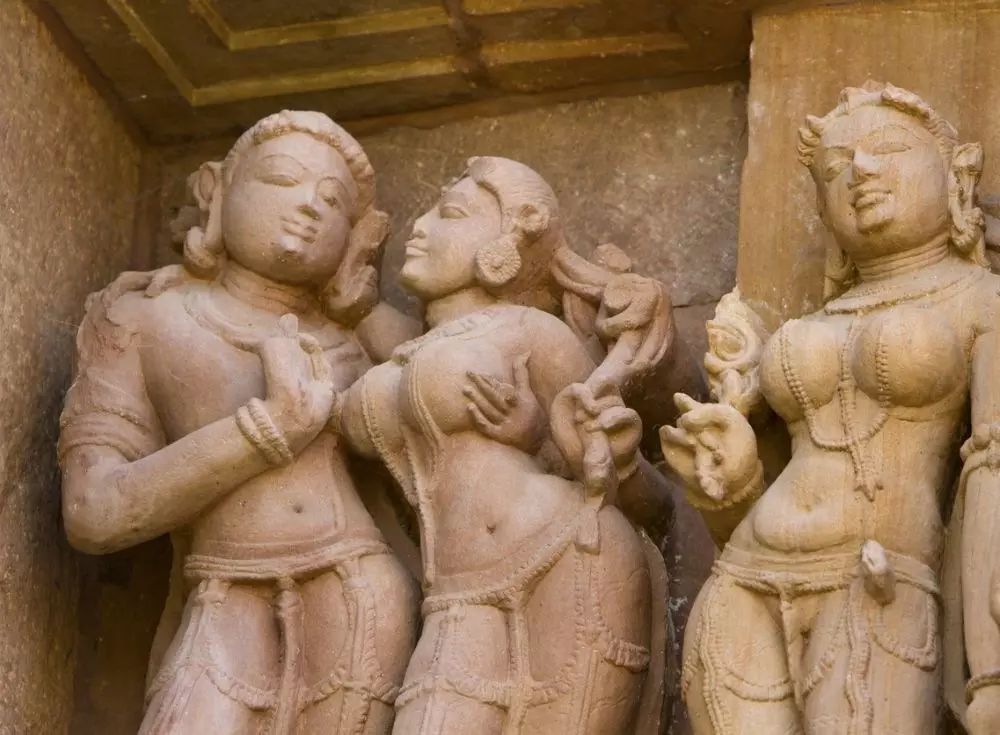
Ancient India was hardly a civilisation unfamiliar with nudity. The sculptures of Khajuraho, Konark and Belur and Halebidu, for example, depict desire, intimacy and corporeality with a confidence that often feels startlingly modern. Photo: iStock
Few forces are as potent as the forbidden. The paradox is familiar. The more vigorously a culture attempts to conceal something, the more obsessively it becomes preoccupied with it. The history of censorship is, in many ways, the history of fascination disguised as morality.
Modern societies are particularly adept at this performance. They market desire relentlessly. They use bodies to sell everything from shoes to smartphones. They transform beauty into industry and sexuality into commerce. Yet they continue to react with alarm when the body itself appears outside approved contexts.
As Barve puts it, “Look at who is being looked at, who is doing the looking and most importantly, who controls the image. Everything becomes clear.”
This is where the concept of the male gaze remains remarkably useful, say experts. Women are not simply observed. They are conditioned to anticipate observation. “Women are conditioned to see themselves through the eyes of others,” says Balsara. “Their bodies become sites of constant surveillance. Every inch is evaluated, regulated and judged. Too covered and they are [perceived to be] oppressed. Too visible and they are accused of inviting attention.”
She finds it darkly amusing that even a 4,500-year-old artefact has not escaped this scrutiny. The covering of the Dancing Girl's torso, she argues, belongs to a much longer history. “It is part of a long history of disciplining women's bodies. Across cultures and centuries, institutions ranging from religious authorities and governments to schools and families have sought to regulate how women present themselves. The language may vary between modesty, culture, decency and tradition, but the impulse remains remarkably consistent. It was, is and will always be about control.”
Also read: Why new BJP government in Bengal has brought both hope, apprehension to Bengali film industry
This is the point at which debates about nudity intersect with patriarchy. The anxiety is rarely about the naked body itself.
Ancient India was hardly a civilisation unfamiliar with nudity. The sculptures of Khajuraho (Madhya Pradesh), Konark (Odisha) and Belur and Halebidu (Karnataka) depict desire, intimacy and corporeality with a confidence that often feels startlingly modern. The creators of the Dancing Girl seem to have felt no need to drape her in retrospective respectability.
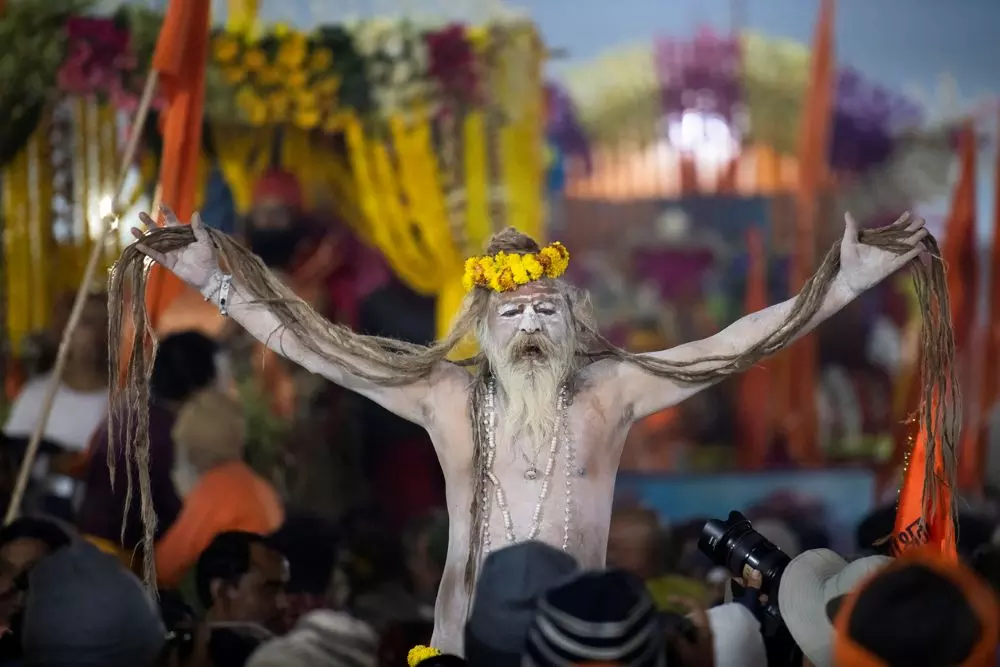
If nudity were inherently obscene, societies would respond similarly to every unclothed body. The ascetic, the archaeological artefact, the classical sculpture and the fashion photograph all occupy different cultural categories. Photo; iStock
The problem then arises not when a body is visible but when it appears to belong to the person inhabiting it.
Photographer Andrea Fernandes, whose work frequently explores female nudity, believes agency is the crucial distinction. “I feel it is important to create images that challenge stereotypes about women,” she says. “The issue isn’t nudity itself. The issue is whether women have agency in how they're represented.”
Her work repeatedly returns to this question of ownership. Who decides how a woman is seen? Who frames the image? Who holds authority over the narrative?
Fernandes recalls photographing a woman who arrived carrying all the familiar props of conventional desirability: fishnet stockings, high heels, lingerie and bright lipstick. She expected a performance of sexiness because she had spent years learning that attractiveness required performance.
As the shoot progressed, however, something shifted. The props disappeared. So did the script. Later, Fernandes recalls the woman telling her she had decided to keep the photographs for herself rather than gift them to her boyfriend as originally intended. For the first time, she told the photographer, she felt attractive without performing attractiveness for someone else's approval.
It is a small story that illuminates a larger truth.
Patriarchy is not merely a system that looks at women. It is a system that teaches women to look at themselves from the outside.
National Award-winning filmmaker Ravi Jadhav confronted this contradiction in Nude (2018), his film about a woman who secretly works as a nude model for an art school. The contradiction, he believes, lies at the heart of how patriarchal societies view women. “Women are expected to be attractive but not too attractive. Sexual but not overtly so. Desirable but never fully in control of their desirability. The same society that profits from sexualised images of women often condemns women who choose to deploy their sexuality on their own terms.”
The contradiction is impossible to miss.
Women's bodies generate billion-dollar industries. Fashion, beauty, advertising, cinema and social media all depend upon their visibility. Yet the moment women appear to exercise ownership over that visibility, alarm bells begin ringing. The body is celebrated. The autonomy is not.
Also read: Why movement for Bhojshala ‘reclamation’ discounts layering of history, has political context
The dynamics become even more revealing when one turns to male nudity.
London-based photographer Dylan Rosser has spent more than a decade photographing nude men around the world. He finds society's discomfort with the naked body somewhat bewildering. “The subject is only difficult because it is harder to find models and locations to shoot nudes,” he says. “I don’t even think photographs of the erect penis constitute pornography. There is nothing provocative or shocking in the male body by itself unless you show an explicit sexual act. I’m trying to make a beautiful image with good composition and lighting.”
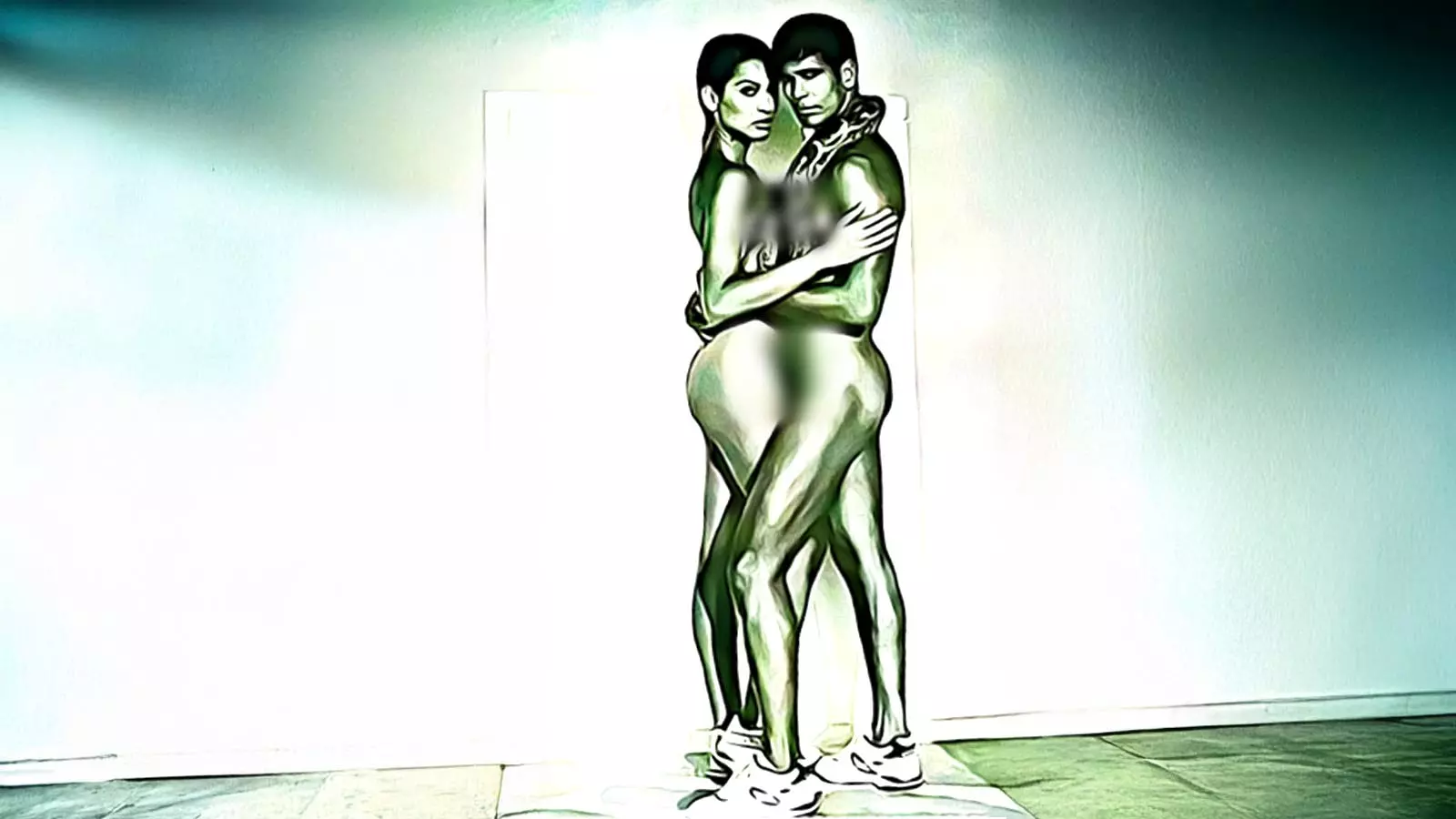
Madhu Sapre and Milind Soman in the controversial '90s Tuff shoes adverstisement. Public censure was directed disproportionately towards Sapre.
Rosser’s argument is refreshingly straightforward. The body is not inherently obscene. Meaning is assigned to it. Yet he also acknowledges the role of attraction. “Human beings are naturally drawn to certain physical attributes. Nudity offers us all of that. The sculpted male physique is often seen as the epitome of masculinity and viewers could certainly respond to that sexually.”
His observation points to a distinction that public discourse frequently ignores. Nudity can be sexual without being pornographic. It can evoke desire without existing solely to provoke desire.
Dr Barve agrees. “Unless someone is specifically looking for sexual stimulation, many forms of nudity may not be perceived as sexual at all. A Naga sadhu, for instance, may evoke reverence, discomfort, fear, indifference or even disgust rather than desire. Context changes everything.”
Pooja Bhatt offered a similar insight while reflecting on her controversial ‘90s Movie magazine cover — in which she posed covered in body paint — during a recent podcast appearance with film journalist Vickey Lalwani. “If your intent is honest, the people get it and if it’s prurient, they’ll get that too.” She also clarified that she had been wearing innerwear under the paint.
If nudity were inherently obscene, societies would respond similarly to every unclothed body. They do not. The breastfeeding mother, the ascetic, the archaeological artefact, the classical sculpture and the fashion photograph all occupy different cultural categories. What changes is not the body. What changes is the story being told about the body. And those stories are rarely gender-neutral.
Milind Soman learnt this first-hand. Although both he and Madhu Sapre appeared in the same controversial 1995 Tuff Shoes advertisement — which saw them pose naked, with a python around Soman’s neck — public outrage fell disproportionately on her. “Public anger overwhelmingly focused on Madhu despite both of us appearing in the same image. Women continue to pay a higher social price for visibility,” Soman was quoted as saying later.
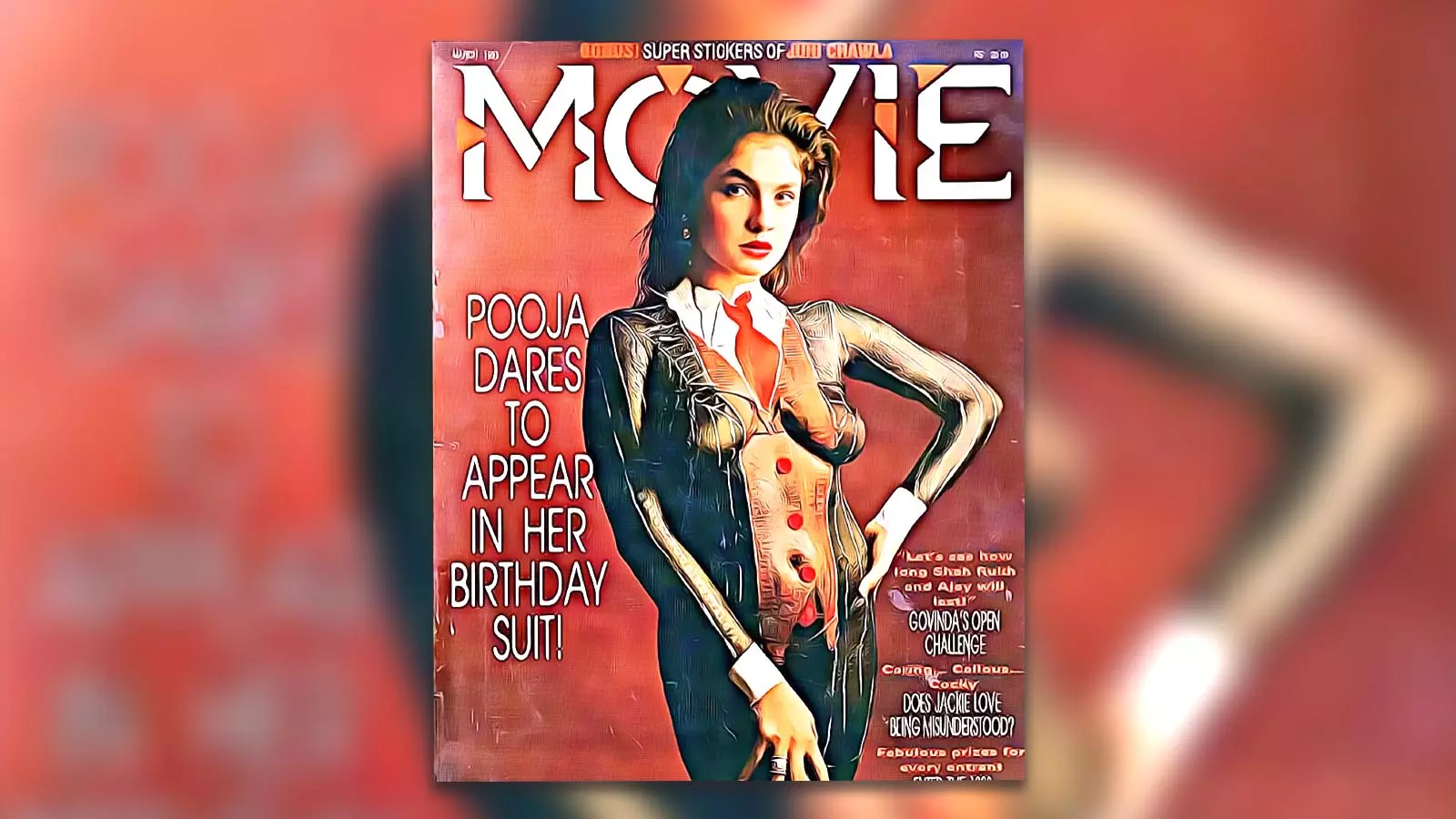
Pooja Bhatt's controversial '90s magazine cover. “If your intent is honest, the people get it and if it’s prurient, they’ll get that too," she has said recently.
Visibility, for women, has always carried a surcharge.
Photographers who work with nude subjects encounter this repeatedly. Fernandes notes that many women arrive carrying years of self-surveillance. They worry about imperfections, angles and flaws because they have spent a lifetime being scrutinised.
Patriarchy’s most elegant trick has never been censorship. It has been outsourcing censorship.
Long before institutions intervene, women have already learnt to monitor themselves. To adjust the neckline. To pull down the hem. To anticipate judgement. The gaze becomes internal. Surveillance acquires a permanent address.
Also read: How late director Shankar Nag and his team brought alive RK Narayan’s Malgudi on screen
Which brings us back to the Dancing Girl.
The digital covering of her torso reveals far more about contemporary anxieties than it does about an ancient civilisation. It assumes that a female body cannot simply exist as part of an archaeological artefact. It anticipates a gaze that might sexualise her and then attempts to solve the problem by regulating her rather than interrogating the gaze.
Censorship rarely resolves discomfort. It merely exposes it.
Somewhere in a museum, the Dancing Girl remains exactly as she has always been: unapologetic, unembarrassed and entirely indifferent to our moral panics.
The discomfort belongs to us.
Four-and-a-half thousand years after she was cast, a civilisation that proudly invokes feminine power still appears remarkably unsettled by the sight of a woman occupying her own body. Perhaps that is why we keep trying to dress her. Not because she needs covering. Because she keeps exposing us.