


- Home
- India
- World
- Premium
- THE FEDERAL SPECIAL
- Analysis
- States
- Perspective
- Videos
- Sports
- Education
- Entertainment
- Elections
- Features
- Health
- Business
- Series
- In memoriam: Sheikh Mujibur Rahman
- Bishnoi's Men
- NEET TANGLE
- Economy Series
- Earth Day
- Kashmir’s Frozen Turbulence
- India@75
- The legend of Ramjanmabhoomi
- Liberalisation@30
- How to tame a dragon
- Celebrating biodiversity
- Farm Matters
- 50 days of solitude
- Bringing Migrants Home
- Budget 2020
- Jharkhand Votes
- The Federal Investigates
- The Federal Impact
- Vanishing Sand
- Gandhi @ 150
- Andhra Today
- Field report
- Operation Gulmarg
- Pandemic @1 Mn in India
- The Federal Year-End
- The Zero Year
- Science
- Brand studio
- Newsletter
- Elections 2024
- Events

What life is like at India’s ‘first international school’, founded for children of US missionaries
The Kodaikanal International School, which celebrates 125 years this year, follows a no-uniforms policy, includes American-style proms on its calendar and has an annual fee that rivals the price of a compact SUV.

American-style proms, no uniforms and an annual fee that rivals the price of a compact SUV. Could such a school exist in India? The answer, for many, might be, “Sure! On a Karan Johar film set”. Think Kuchh Kuchh Hota Hai, Kabhi Khushi Kabhi Gham and the Student of the Year films.But the truth is that long before Johar had made his debut in Bollywood, making Ms Braganza (a character in...
American-style proms, no uniforms and an annual fee that rivals the price of a compact SUV. Could such a school exist in India? The answer, for many, might be, “Sure! On a Karan Johar film set”. Think Kuchh Kuchh Hota Hai, Kabhi Khushi Kabhi Gham and the Student of the Year films.
But the truth is that long before Johar had made his debut in Bollywood, making Ms Braganza (a character in the 1998 film Kuch Kuch Hota Hai, played by Archana Puran Singh) the benchmark of the fun-friendly-gorgeous teacher, a co-educational, residential school in Kodaikanal, a hill station set high above the plains of Tamil Nadu had already created this elite campus, elusive for most school-going children in India.
Founded in 1901, The Kodaikanal International School (KIS) celebrates 125 years this year. It’s a milestone year, made even more special by the fact that 2026 also marks 50 years since KIS adopted the International Baccalaureate (IB) program in 1976, becoming, as the school website says, the “first international school in India (and the third in Asia)”. The IB is an internationally-accepted qualification, recognised by universities worldwide for admission to higher education and was developed by educators in Geneva, Switzerland.
“I would call Kodaikanal International School truly international. Not defined by one country, but by many perspectives…It is global, diverse, and evolving,” says KIS principal Bradford Barnhardt.
The school traces its history to Margaret Eddy, an American, whose son was a missionary in India. On a visit to her son, it is said, Eddy realised the need for an English school for the children of foreign missionaries, especially those from the US, serving in South India. At the time, children of American missionaries working here would often be sent back to the United States for education.
Eddy, it is said, chose the hill station of Kodaikanal as the location of the school not for its beauty, but to shield children from malaria and cholera that were rampant in the plains at the time.
Also read: Why Karnataka’s planned discontinuation of 'Nali-Kali' education programme has some concerned
Walking through the campus, one hears bits and pieces of anecdotes about the school’s past. For example, during World War II, it is said, KIS sheltered children of interned German and Italian families. Following India’s Independence, as missionary presence in India declined, KIS opened its doors to Indian children. Today, the campus hosts students from India, Europe, Asia, the United States and beyond. And while the faculty is mostly Indian, there are among them members from across the world.
It would be understandable for most Indians who have spent their growing up years in the average public school in India to be curious about life on such a campus. So was The Federal. And so, spent some time at the institute, understanding what a day and year in the life of a KIS student is like.
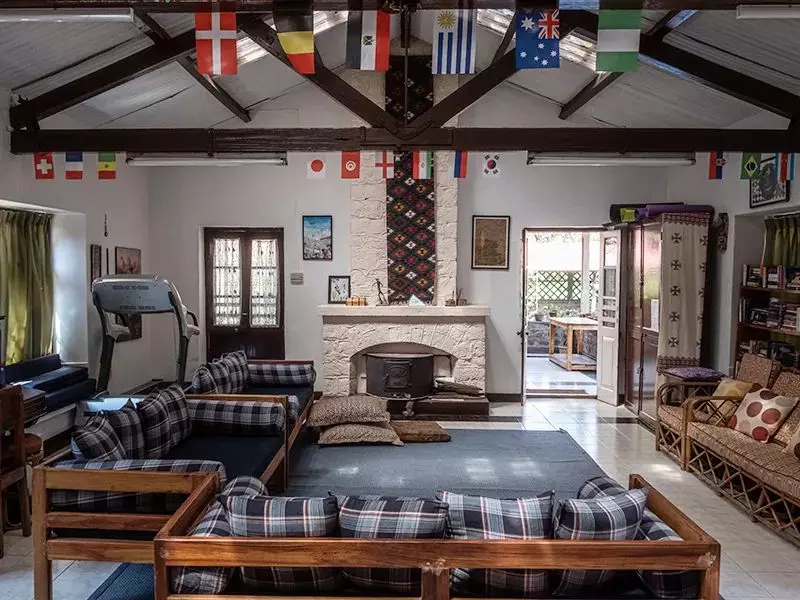
One of the common areas for students at the Kodaikanal International School. Photo: Courtesy KIS
A typical day at Kodaikanal International School begins early. Arwa Moiz Lokhandwala, a Grade 12 student and captain of the volleyball team, whose family is from Pune, wakes up between 5:45 and 6:00 am for gym or sports, training from 6:15 to 7:30 am. “Breakfast is from 8:10 to 8:40 in the cafeteria,” she says.
After that it's time for classes. Conversations here feel less hierarchical than in most Indian schools. Studies also involve discussions and debates. There is visible ease in how the students occupy space.
“You can’t just sit quietly and memorise,” says vice principal Cindy Beals. “You have to engage.”
Agrees principal Barhardt. “At Kodaikanal International School, we don’t just impart knowledge. We teach how to engage with it. Here, learning is not memorisation; it’s interaction, inquiry, and real-world thinking. If you only care about marks, KIS is not the right fit.”
By afternoon, the activities spread out. Some students head to the sports fields. Others disappear into music rooms. With 55 pianos and eleven music teachers on the campus, the arts are not peripheral at KIS.
“Music here isn’t an ‘extra’,” says Pratap Chettri, head of the music department at KIS. “It’s part of how students express themselves.” According to the school authorities, about 50 students clear ABRSM examinations every year, a board based in the UK.
In another corner, students gather on lawns in small clusters lost in discussion; English is the primary language of communication at KIS, but it’s not uncommon to hear snatches of Hindi, Korean, German or French on campus.
Diversity fuels deep conversations. “Burmese kids have a lot to share about the political situation in Myanmar,” Lokhandwala observes. “You learn a lot just by knowing a person’s story… it gives a worldly perspective.” The student adds that they learn far more about Korean culture, for example, from their fellow students than from watching the K-dramas, which have found increasing popularity among many Indians.
The school kitchen serves up an expansive spread, a mix of continental and Indian dishes at each meal, to cater to this diversity. “They try to include all major cuisines, but we still miss home food,” says Leonid Kolobov, a Grade 12 student from Russia.
The students have a packed schedule daily, but it is not restricted to book learning.
“After school, we have clubs like music, tennis, baking or community service projects,” says Lokhandwala.
Phones are surrendered at 7:00 p.m. for study hall and returned only after 8:45 p.m. “We get them back for a couple of hours in the dorm to talk to family,” adds the student. The phone timings change from grade to grade.
There are 16 dormitories, each housing 20-25 students — KIS currently has a student strength of 500, from across 24 countries, according to its website.
Ivy Roshan, a dorm parent of 16 years, says, “Every generation is different”. “The way students think, question and express themselves keeps changing. They need their space… sometimes they don’t even come to me with their problems because they don’t want the mother figure to know. But I still do,” she says with a smile.
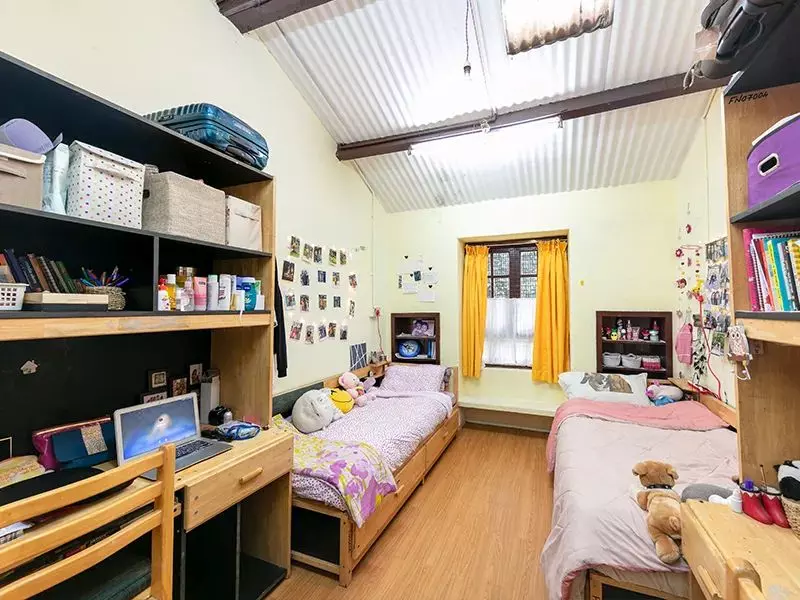
One of the dormitory rooms. Photo: Courtesy KIS
If weekdays are structured, weekends are kinetic.
“There’s the ‘Amazing Race,’” says Lokhandwala. “It’s like a treasure hunt across campus.” “There are high-energy dances, hiking, and a lot more,” she adds.
The students may also get to enjoy international bands playing in the auditorium.
Then comes prom. Fairy lights. Corsages. Suits. Carefully planned “promposals”.
“After one unforgettable horse incident, animals are officially banned,” says Harish Pillai, dean of residential life, with a smile. This followed an incident where a male student rented a horse to ride in and ask his date to prom.
There are also Christmas Banquets, carnivals and more.
Kodaikanal International School is a Christian school that was started for the children of American missionaries. So, parents do sometimes have “reservations about Christian influences on their children”.
Raja Krishnamoorthy, dean of religious life at KIS, says, “Still, conservative Christian parents think this school is not ‘Christian’ enough, given the school’s liberal American-style campus.”
"Religion is treated with flexibility. Chapel is not compulsory even for Christians,” he says. Students can sign up to visit temples or mosques. During Ramadan, special meals are arranged for those fasting. They use senior staff members’ rooms to offer prayers, adds Krishnamoorthy.
The school does have a five-minute devotional period at the dormitories, which uses the Bible as guidance. But, the authorities insist, such sessions focus on character building and not religion, per se.
Resham George, who studied at the school between 1992 and 2005, recalls how they were “always taught not to compare ourselves with other students. We were taught we all have our individual journeys".
Also read: What alleged deaths by suicide of school kids say of our awareness of mental health issues in young
Having spent their formative years in a world so far removed from even the average Indian urban, upper-middle-class milieu, how easily do the KIS alumni settle into society once they pass out of its hallowed halls?
Roughly 70 per cent of graduates eventually head abroad for higher education, say the school authorities. “Until two years ago, about 55 per cent of our students went to the US. Because of geopolitical changes, we’re seeing more students explore Europe and the Asia-Pacific now,” says vice principal Beals.
The trajectory outward is almost assumed. As is the fact that ex-KIS students will send their children to the school once they become parents. Legacy runs deep, with some families having three generations of KIS students.
Entry to this world comes at a premium — the annual school fees hover around Rs 15–25 lakh a year, which could be a stumbling block for many Indian families. Of course, KIS does offer scholarships based on merit, need and diversity (the school claims 35 per cent of students are on some sort of financial assistance) and staff children study free. This, the school authorities insist, helps bring balance, diversity and inclusivity on campus.
Still, for the vast majority of Indian students, it is a world that is both exclusive and aspirational. And for those outside its gilded walls, KIS is an experience as real and as elusive as the campuses in a Karan Johar film.
(The writer was in Kodaikanal at the invitation of Kodaikanal International School.)


