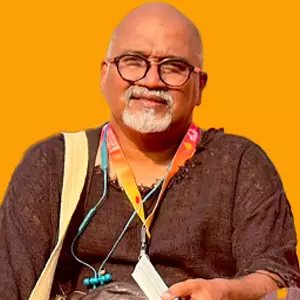
Names in Kerala often did not sit neatly within religious or caste boundaries; travelling rather across worlds, shaped by poetry, politics and popular culture as much as by tradition.
Historically, naming practices in the South, particularly in Kerala, have often attempted to move beyond rigid social boundaries. The early challenges to feudalism and caste oppression, led by reformers and grassroots mobilisations, began to loosen the tight link between name and caste, religious identities. Today, however, that landscape has changed.

“Your husband must be a Hindu?”
It is a question Aisha Potty has heard often; at times the assumption is casual, at times accompanied with curiosity, and occasionally voiced with quiet certainty. The question follows her name before any other conversation may start. “Aisha” places her in the public imagination, within a familiar religious frame. The surprise comes later, from her response.
A former three-time MLA and a political figure who recently crossed over from the CPI(M) to the Congress, Aisha Potty’s name doesn’t match the assumption it leads people to make about her identity.
She was born into a Brahmin family. Her name was not inherited from faith, but chosen from literature, inspired by a character in the works of Malayalam poet Vayalar Rama Varma.
“My father was an ardent reader and a great admirer of Vayalar Rama Varma. He named me after his character Aisha. During my school and college years, the name was never really an issue. People knew me as a teacher’s daughter and even in college, my uncle was a teacher, so there was a certain familiarity,” she recalls.
Aisha adds: “It was later, when I entered public life, first as a district panchayat member and then as an MLA, that the name began to draw attention. It changed from P. Aisha to Aisha Potty. Ironically, it was the CPI(M) leadership that added the caste surname. That is when people started asking questions. But it was always nice being Aisha. It never really caused me any trouble.”
That small moment of confusion around her name opens up a larger story about Kerala. Of a time when names here did not sit neatly within religious or caste boundaries; travelling rather across worlds, shaped by poetry, politics and popular culture as much as by tradition.
Aisha’s name belongs to that moment. It carries with it the imprint of a generation that was less anxious about how a name would be read and more interested in what it could mean. Today, the questions she is asked reveal how much that landscape has changed. Names are no longer just names. They are read, decoded and placed in the complex context of caste and religion based identity.
Former three-time MLA Aisha Potty was born into a Brahmin family. But her name was not inherited from faith, but inspired by a character in the works of Malayalam poet Vayalar Rama Varma. Photo: By special arrangement
“The idea of a name being linked to individuality emerges with modernity. One key sign of this shift is the use of initials, referring to house names, lineage or the father’s name. These initials begin to signal a person’s uniqueness as the son or daughter of someone. This reflects a new understanding of human identity that comes with modernity and the social reform movements. At the same time, caste did not disappear, but there were conscious attempts to move beyond it, which can be seen in naming practices,” observes Sunil P. Elayidom, author and social commentator.
Also read: Meaning, originality, ease of pronunciation — what's dictating baby names for Indians
Historically, naming practices in South India, particularly in Kerala, have often attempted to move beyond rigid social boundaries, shaped in a large measure by political and social movements. The early challenges to feudalism and caste oppression, led by reformers and grassroots mobilisations, began to loosen the tight link between name and caste location.
One of the clearest markers of these social shifts can be seen in the gradual entry of Sanskritised names among intermediate Hindu communities. It was the spread of modern education and the momentum of social reform movements that made this convergence possible. While these movements foregrounded mobility and access, they also opened the door to cultural realignments. Movements like temple entry brought Vedic cultural symbols closer into everyday life, including naming practices. At the same time, nationalist politics reinforced a pan-Indian identity that often drew from these same markers. Names, in this context, became quiet indicators of communities negotiating reform, aspiration and belonging.
In earlier times, till the late nineteenth century, before the reformist movements took shape, the use of ‘proper’ names, often drawn from deities, was largely restricted to upper caste Hindus. Those from lower stratas were pushed into using altered or diminished versions of these names. For instance, Sridevi became ‘Chirutheyi’, stripped of its Sanskritised form. Similarly, names like Swami, meaning lord, were reduced to ‘Chaami’ or ‘Thaami’. In some cases, names like Adima, meaning slave, were common among oppressed communities.
“Historically, the influence of reformists like Narayana Guru and Sahodaran Ayyappan can be seen in the naming practices of backward Hindu communities, especially among the Ezhavas. Narayana Guru encouraged names with Buddhist associations; Thamarakshan, Lohitakshan and Sringadharan were common in southern Kerala. In the Kochi region, Sahodaran Ayyappan’s influence led many to give their children names often identified as ‘Muslim’ [like Aisha, Jameela and Salim]. As a result, there are several Jameelas, Aishas and Salims among Hindus who are now well past sixty or seventy,” states MH Illias, a professor at the School of Gandhian Thought and Development Studies, Mahatma Gandhi University.
In the Kochi region, Sahodaran Ayyappan’s influence led many to give their children names often identified as ‘Muslim’, say experts. National award winning actor Salim Kumar is an example. Photo: By special arrangement
Former MLA and socialist Jameela Prakasam and national award winning actor Salim Kumar are examples of this trend.
Names that once clearly signalled hierarchy and lineage slowly started to give way to more neutral or shared choices. This shift deepened with the spread of anti-feudal movement, Left politics and rationalism . The rise of communist movements in the ‘50s brought with it a cultural push towards equality, rationalism and a rejection of inherited privilege. Naming became one of the subtle ways in which this shift expressed itself. Families began choosing names inspired by literature, political leaders and global figures rather than sticking to caste-bound conventions. Figures like Vladimir Lenin or Indian Left leaders such as Jyoti Basu became part of everyday naming, signalling ideological affiliation rather than social origin.
In that sense, naming turned into a quiet act of resistance. It reflected an aspiration to belong to a broader, more egalitarian world, rather than a fixed social slot. While this did not erase caste in practice, it did create a cultural space where identity could be imagined differently, at least symbolically.
“There were limited but conscious attempts to challenge caste through naming, including adopting upper caste names. By the 1960s, popular culture and cinema began to shape naming trends, with people choosing names inspired by film stars like Sunil Dutt. Even my own name, Sunil, came from my father’s admiration for him. This phase also saw the rise of short, two-syllable names like Shiju or Biju, often playful and less tied to identity,” says Sunil P. Elayidom.
Also read: Why residents of Kerala's Thasarak village have been 'living' with fictitious characters for decades
In the coastal belt of Thrissur, from Kodungallur to Andathode, where the communist movement and later Naxalite cultural currents once ran deep, foreign names like Lenin, Stalin and Pushkin were strikingly common, almost every third household seemed to have one. Among girls, names like Pravda and even “Soviet Breeze” could be found. Names such as Jyoti Basu, Ranadive and Ajoy Ghosh were widely used, while Kanu and Charu, references to Naxalite leaders Kanu Sanyal and Charu Majumdar, were not uncommon either. Among Muslim communists, Muzafir Ahammed (inspired by Communist leader Muzaffar Ahmed) was a particularly popular choice.
Among them, 51-year-old businessman C. Marx Mohammed stands out as striking. He is not very comfortable speaking about his name in public. According to him, it caused considerable trouble during his time in Surat. Eventually, he began using different versions of his name, signing as C M. Marx or CM Mohammed depending on the situation and location.
Manavan Satyaprabha, an electrical engineer in his forties based in Mumbai, has a telling story about his name and the world his parents came from. His parents, both teachers and union workers associated with the CPI(M), were deeply political. His last name itself was a conscious construction, a combination of his parents’ names, Satyan and Prabha.
When he moved outside Kerala for his studies, friends began calling him Manu, a casual, easy abbreviation that stuck. Years later, when he brought home his girlfriend, now his wife, Chhaya, from Bengal, she too addressed him as Manu. That was enough to unsettle his father.
“For my father, the shift from Manav to Manu was never a small thing. He saw it as a dilution, as something meaningful being reduced or altered. For him, it went against everything he had lived and fought for, taking on Manuvads [those who follow the political philosophy based on the Hindu text Manusmriti] and turning them into ‘Manav’ [human]. He used to say there was a world of difference between Manav and Manu. He had no issue with my relationship or the marriage, but he could not accept that name. He almost pleaded that she should never call me Manu again. It was intense, he was visibly shaken. From that moment on, Chhaya never called me Manu.”
Looking back, Manavan says he understands his father’s sentiments better now. What his father reacted to was not just a name, but the erosion of a certain conviction, a sense of purpose. “There was a fire in him,” he says, “something we, or our generation, no longer quite have.”
Over time, that intensity faded. While the 1960s and 70s marked a shift towards more universal, secular names that cut across caste, the ‘90s and early 2000s have seen a return to more identity-rooted naming practices, at times even overtly caste-based.
“There may have been an attempt to break from local identities and move towards more widely resonant names. Today, there is again a return to local names. While the 60s and 70s showed an attraction to pan Indian names, after the 2000s there has been a shift towards names that are more distinctly Kerala in character”, observes Sunil P. Elayidom.
Socialist Jameela Prakasam is another example where a name is not rooted in religious identity. Photo: By special arrangement
Parallel to this, there was a noticeable shift among Kerala’s Muslim communities towards adopting original Arabic names for children, a change, according to many sociologists, closely tied to increased exposure to West Asia. Migration to the Gulf, the flow of remittances and sustained cultural contact reshaped not just economic life but also everyday markers of identity.
In the earlier period, Malayali Muslims commonly used localised forms such as Mammad for Mohammed or Ammad for Ahammed, names that were deeply embedded in the region’s linguistic and cultural fabric. These versions reflected a lived synthesis, where religion was expressed through a distinctly local idiom.
Over time, these gave way to standard Arabic names, often closer in pronunciation and spelling to their West Asian forms. The shift was not merely linguistic. It ran alongside other visible changes, including dress codes, the increased presence of purdah among women and a more conscious assertion of religious identity in public life.
What this points to is a gradual reorientation from a locally grounded cultural identity to one that is increasingly aligned with a wider, transnational Islamic framework. Names, in this sense, become one of the earliest and most visible markers of that shift, signalling how global religious currents begin to shape intimate, personal choices.
“As early as the 1950s, students from Kerala began going to study in Saudi Arabia. When they returned, many chose Arabic names for their children, marking the first wave of such naming practices. Later, global political events and figures also influenced naming, with names like Hasan al-Banna [Muslim Brotherhood founder], Faisal [King Faisal of Saudi Arabia) and Saddam Hussein [late Iraqi president] becoming popular at different moments,” opines professor Illias.
He adds: “There were also parallel streams. Some names reflected liberal or reformist influences, with choices like Nazar, Mustafa and Kamal drawn from Egyptian and Turkish leaders with a modernist outlook, while others drew from Islamic history, such as Salahuddin Ayyubi, associated with the Crusades”.
“Kerala also had a trend among the Thangal families who claim their lineage back to the Prophet Muhammad. They typically had a combination of names, an Arabic component and a local one. For instance, in a name like Sayyid Fasal Pookoya Thangal, “Fasal” is Arabic, while “Pookoya” is a local element [poo means flower, koya is the name]. This kind of combination was common. Even common names like Abdulla Kutty had both an Arabic and a local component.”
Illias adds: “Later, in the ‘50s, Mughal and Persian influenced names began to appear, such as Noorjahan, Shahjahan, Mumtas, Akbar and Jahangir. These were pan-Indian in character. Another interesting feature is the widespread use of “Ali.” Though traditionally more associated with Shia naming, it became common in Kerala even among Sunnis, especially in Thangal families, leading to names like Mohammed Ali, Hyder Ali, Sadiq Ali and Munavvar Ali.”
“As far as Muslims today are concerned, Muslim fashion, music, and even Turkish series have played a big role in this. Some global events are also reflected in naming. Aylan Kurdi is one example”, says Nuaiman KA, assistant professor at Calicut university
“There is also a basic idea behind naming that is linked to linguistics. Arabs and Muslims do not subscribe to the idea that language is arbitrary. The belief is that language has an effect, that it can act. For instance, a child might be named Omar so that he grows up to be brave, or Rahmath so that he becomes compassionate”.
He adds: “People often think my name Nuaiman, is new, something unheard of, even among Muslims. But it is actually an old name, one associated with the Badri companions. It is among the names that have been traditionally recited and passed down in Muslim families,” he adds.
Also read: Why revival of Kerala's inland waterways raises hopes of transportation ease, business growth
However, Christians in Kerala, for the most part, retained names rooted in the Biblical tradition, but even here there was a strong process of localisation. Names were adapted into distinctly Malayalam forms, shaped by region and usage rather than strict adherence to original pronunciation.
Thus, Vargas became Varghese or even Vareed in colloquial use, Francis turned into Pranchi, Philomina became Plamena, and Elizabeth became Eliyamma, with many other names taking on similar local inflections. These variations reflected a deep embedding within Kerala’s linguistic and cultural landscape, where even scriptural names were absorbed and rearticulated through everyday speech.
There are many ways to read a society’s past without opening a history book; it is perhaps through its names. They carry traces of the times people lived in, the worlds they looked up to, and the identities they moved in and out of. From the easy fluidity of one era to the sharper edges of another, names have quietly recorded shifts that were otherwise gradual and lived rather than declared.
What stands out is not a simple break, but a series of overlaps. The ideological names of one generation, the local adaptations of another, the turn to Arabic, the return of caste surnames, the influence of cinema, politics and migration, all exist as layers rather than replacements. Each phase does not erase the previous one entirely; it sits over it, sometimes in tension, sometimes in continuity.
There is also a certain circularity. The move away from the local towards the universal, and then back again towards the local or the particular, suggests that naming is less about fixed identities and more about moments of aspiration. At one time, the world was the reference point. At another, it is community, faith or lineage. Neither is permanent.
In that sense, names behave like a social memory that keeps rewriting itself. They do not just tell us who someone is, but also what a society values at a given moment. Not as a grand statement, but as a quiet, everyday choice repeated across homes and generations.